How Does the Army’s Control of Its Headquarters Impact the Sudanese War Map?
Sudan Events – Agencies
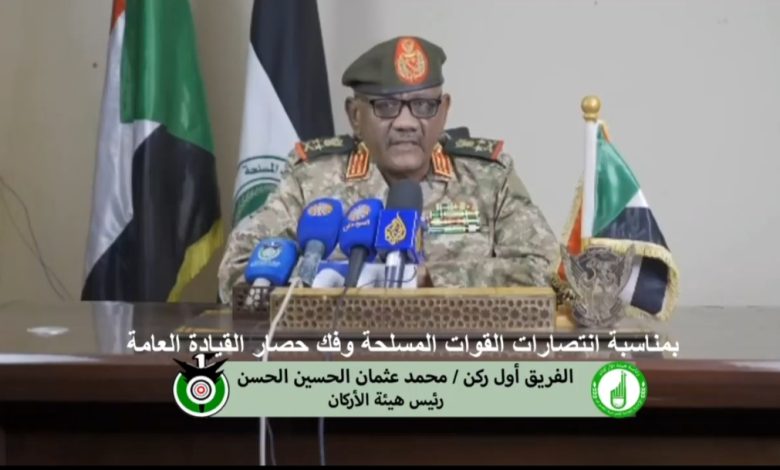
In a significant development in military operations, the Sudanese army on Friday made notable progress by breaking the siege imposed since mid-April 2023 on the Signal Corps in Khartoum North and the General Command of the army in central Khartoum.
Military experts believe this advancement by the army could pave the way for gaining control over strategic points and cause a significant shift, especially with the Rapid Support Forces (RSF) retreating across all operational axes in Khartoum and the Gezira state.
Eyewitnesses in Khartoum North, where battles intensified, reported that RSF elements began noticeable withdrawals from key positions days before the army’s deployment. RSF resorted to positioning professional snipers on high buildings and employing rocket strikes to hinder the army’s advance.
Breaking the Siege
A military expert told Al Jazeera Net that no fewer than 30 army units were operating and advancing across critical battlefronts. One unit from Wadi Seidna Base in Omdurman reached Khartoum North, while another advanced from Shendi in the Nile River State toward the Al-Jaili refinery. A third battalion moved from Al-Halfaya toward the same refinery.
Simultaneously, the army moved from Omdurman toward the Signal Corps, bypassing RSF strategic positions, and opened a direct path to the General Command in central Khartoum.
Army spokesperson Nabil Abdullah announced on Friday that the army had completed the second phase of its operations, merging forces from Khartoum North with those stationed at the General Command.
Breaking the siege has allowed for the delivery of military supplies and food to hundreds of soldiers and officers trapped inside the General Command for nearly two years. These forces had previously relied on air-dropped supplies from military aircraft, according to a soldier stationed inside the headquarters.
A Strategic Shift
The lifting of the siege on the General Command is considered a major strategic turning point in the conflict, according to military affairs expert Osama Eidrous.
Eidrous explained to Al Jazeera Net that this achievement will simplify efforts to “clear Khartoum of isolated rebel pockets,” secure supply lines for the army, and shift operations entirely westward.
Following this, other units could lift the siege on Al-Obeid in North Kordofan and transform it into a new military base to launch operations to liberate cities like Ed Daein in East Darfur, Zalingei, Geneina, and Nyala in Central, West, and South Darfur, respectively. It could also aid in breaking the siege on El Fasher in North Darfur.
Eidrous added that these developments signal the countdown to the end of the rebellion, as RSF movements have become exposed and are unable to sustain the fight.
He also pointed to “bold operations” conducted by joint forces in the deserts of North Darfur, including the destruction of the Zarqa base and the closure of supply routes in the border triangle between Sudan, Chad, and Libya. This demonstrates, he said, that the RSF has no surprises left for the army, which has regained its strength and is prepared to liberate the rest of Sudan.
A Crushing Blow
Fath Al-Aleem Al-Shobli, a leader in special operations in Sennar state, described the army’s unification in Omdurman and Khartoum North and the lifting of the siege on the General Command as highly significant due to the symbolic importance of the headquarters. According to him, breaking the siege crushed the RSF’s hopes of seizing or toppling the General Command.
This development, he explained, will allow forces from Khartoum North, the Signal Corps, and the General Command to advance southwest of Khartoum and join forces with the Armored Corps. They will also move southeast of Khartoum to clear remaining RSF pockets in neighborhoods like Burri, Riyadh, and Al-Manshiya.
According to Al-Shobli, the lifting of the siege on the General Command is also a “crippling blow to mercenaries,” as it will serve as a control center connecting all army forces in the Khartoum area. This will enable the armed forces to liberate areas west of the headquarters, join forces in Al-Muqran, and advance further southeast to secure Al-Manshiya Bridge and block any RSF reinforcements from East Nile.
A Calculated Approach
Military expert Mutasim Abdelqader emphasized that the lifting of the siege on the General Command and the Signal Corps is part of a broader strategy by the armed forces since late September 2024. This includes crossing bridges from Omdurman to Khartoum and Khartoum North and defeating RSF in Sennar, Gezira, and southern Nile River state.
Abdelqader explained that RSF had initially deployed across strategic locations in and around Khartoum and other states, enabling them to seize military sites and besiege others.
The army, in the early stages of the war, focused on defending key strategic sites such as the General Command, Armored Corps, Engineers Corps, and other units. These served as launching points for later phases of the war.
Abdelqader added that the army used targeted airstrikes to destroy RSF command centers in central Khartoum during the first months of the war, crippling RSF communications.
Since then, the army has developed strategic and tactical plans to dismantle the rebellion, training and preparing its forces for a flexible, phased operation that adapts to evolving battlefield conditions.
The Rapid Support Forces’ Position
RSF leadership has remained silent about the recent developments, particularly regarding the army’s entry into the General Command and the lifting of its siege. Earlier, RSF spokespeople had dismissed reports of army advances as fabricated.
However, RSF media figure Omar Jibril appeared to acknowledge the setbacks, writing on X (formerly Twitter): “War is about victories and defeats—one day for you, another against you. Those who rejoice in victory must also accept defeat, reflect on its causes, and strive for future success.”
He warned of internal threats within RSF ranks, accusing some members of spreading despair and undermining confidence in leadership. He urged addressing these “internal enemies” before focusing on external battles.
Source: Al Jazeera Net