Baraka Sakin: Setting the Clock to the Armed Forces’ Time
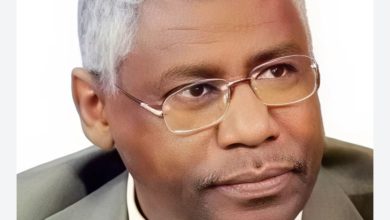
Dr. Fadlallah Ahmed Abdullah
We know that ancient Arab poets used to compose poetry for the benefit of their tribe, as their world ended at the tribe’s borders. Later, writers began crafting their works in service of political parties, and today, many write upon the request of publishing houses—writing that is not truly writing.
These words come from the refined literary insights of the renowned Arab theater critic, Dr. Abdelkarim Berchid, who has consistently advocated for writing that emerges from the writer’s very essence.
He believes that a true writer must first live life fully, second, attune himself to the pulse of existence, and third, set his inner clock to the rhythm of history. A writer must be a faithful translator of the soul of writing before its outward form, speaking with the language and expressions of the living moment.
Searching for this meaning, especially in the turbulent moment Sudan is experiencing, makes it impossible for any discerning critic to overlook our novelist Abdulaziz Baraka Sakin. His literary works pose deep questions about how our society has reached its current state of confusion and loss. He embodies the highest model of a creative writer who establishes a national cultural project—the conscience and voice of the nation—reminding us of our identity and the meaningfulness of life. His works attempt to offer a remedy for our dire situation.
From his Trilogy of the Great Country, The Bedouin Lover, The Imagination of Al-Khandarees, The Jungo: Nails of the Earth—which won the Tayeb Salih Award in 2012—to The Wrecked Man and his short story collection On the Margins of the Pavements, each of his works acts as a signal within a broader system of signs. They collectively shape his vision of Sudanese cultural identity, tracing the essence and historical spirit of its people across generations. His works compel us to confront our reflection in the mirror of thought, knowledge, and art.
Among his many published novels, The Messiah of Darfur remains the most significant—not just in Sudan, but across the Arab world. It is considered one of the top ten Arabic novels of the 21st century, according to Palestinian writer Rajab Atta Al-Tayyib.
As I mentioned in a previous article, The Messiah of Darfur rises above suffering, urging us to grasp its deeper meanings and witness the silent tears that fall as we read. In the novel, Baraka Sakin defines the Janjaweed as follows:
“They are men clad in dirty clothes, soaked with sweat and dust, surrounded by large amulets. Their thick hair carries the scent of the desert and exile. They sling rifles over their shoulders, firing at the slightest provocation, with no regard for human life. They make no distinction between humans and stray dogs. You recognize them by their strange language, a dialect known as ‘Dhar’, a blend of Arabic spoken in Niger and the Western Sahara. They have no women, no daughters, no civilians, no scholars, no teachers, no craftsmen. They have no village, no town, no country to call home. They have no houses to return to at the end of the day.”
At the start of The Messiah of Darfur, Sakin declares:
“It is easier for a camel to pass through the eye of a needle than for a Janjaweed to enter the kingdom of God.”
In his novel—published years ago—Sakin vividly portrayed the Janjaweed at a time when they were brutally attacking the people of Darfur. Back then, the group was officially designated by the government as “Border Guards,” a militia composed primarily of Arab tribes in Darfur. In 2013, this force was formally rebranded as the Rapid Support Forces (RSF).
However, in the minds of the Darfuri people, the Janjaweed had long been identified with a different, deeply rooted name. The term Janjaweed is derived from two Sudanese words:
- “Jan” (جن), meaning “demon” or “spirit,” referring to a man who wields a G3 rifle, a widely used weapon in Darfur.
- “Jawid” (جويد), meaning “horse,” signifying a spirit-like warrior on horseback.
The Janjaweed do not adhere to any ideological or political beliefs. They are a functional armed group that serves Arab tribes allied with the Sudanese government to fight against rebel movements, which are composed of non-Arab Sudanese tribes, often referred to in local terminology as “Zarqa” (meaning “dark-skinned”), including the Fur, Masalit, Zaghawa, and others.
The crimes committed by the Janjaweed were more brutal than those of ISIS—burning villages, committing mass rape, and killing people based on race and ethnicity.
Palestinian writer Rajab Atta Al-Tayyib analyzed The Messiah of Darfur with great depth, stating:
- The novel provides an insightful portrayal of a brutal civil war in Darfur, paralleling the final chapter of the North-South Sudan conflict.
- It objectively presents the situation through the voice of an astute narrator—perhaps the author himself.
- It depicts society in a moment of violent clash between a tyrannical regime and poor civilians suffering ethnic cleansing, with 300,000 killed and 3 million displaced, according to UN estimates.
- It highlights the historical roots of slavery in Sudan, which persisted under various regimes, including the Funj Sultanate, the Mahdist State, and was only officially abolished during British colonial rule.
- The novel is exceptional in structure and style, combining fluid, diverse storytelling with compelling narratives. Despite the inclusion of Sudanese dialect and local expressions, the prose remains engaging and thought-provoking.
This is Abdulaziz Baraka Sakin—an author who remains steadfast amid shifting political tides. He has not been swayed by tribalism, regionalism, or ideology; rather, he has always upheld a national vision in his literary contributions. Whether during the rule of the National Congress Party, the revolution against it, its downfall, or the RSF rebellion, Sakin’s stance has remained consistent: The Janjaweed are the Janjaweed, as he described them in The Messiah of Darfur.
Thus, Baraka Sakin sets his inner clock to the rhythm of the Sudanese Armed Forces—not merely as the nation’s constitutionally mandated defender, but as a reflection of Sudan’s heritage, culture, literature, morality, and historical identity.
Leaders may come and go, ideologies may rise and fall, but Abdulaziz Baraka Sakin remains unwavering—rooted in the heart of Sudan, standing tall like a spear, refusing to bend or disappear. Today, his words align with the Sudanese Armed Forces in their battle for dignity, reinforcing his long-standing cultural and national vision—one that mirrors reality, history, and the essence of beauty.
The army is the soul and image of Sudan—
They stand tall like the peaks of Mount Taka,
Blooming like the flowers of Jebel Marra,
Generous as the Nile’s endless flow,
Steadfast as the pyramids of Barkal.
They are Sudan’s only true pen, its paper, its horse, and its night.