Ta’sis Alliance Selects Hemedti as President and Al-Hilu as His Deputy
Sudan Events – Reports
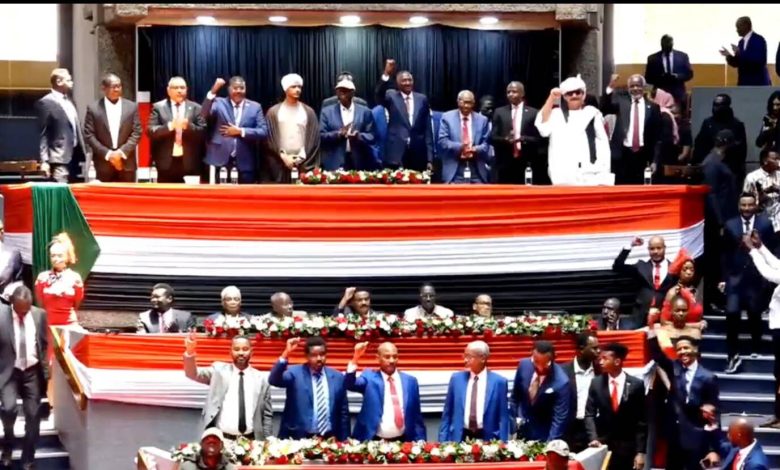
On Tuesday, the Founding Sudan Alliance (Ta’sis) announced the ratification of its basic charter and the formation of a leadership body consisting of 31 members, headed by the leader of the Rapid Support Forces militia, Mohamed Hamdan Dagalo “Hemedti,” with the Sudan People’s Liberation Movement leader Abdelaziz Al-Hilu appointed as his deputy.
The alliance’s spokesperson, Alaa Al-Din Naqd, stated during a press conference held by the group in the city of Nyala, the capital of South Darfur State, that “following extensive consultations, the leadership body of the Ta’sis Alliance held a series of transparent and serious meetings during which the alliance’s basic charter was approved, and the leadership body of 31 members was formed.”
He revealed that a consensus was reached on appointing Mohamed Hamdan Dagalo as president and Abdelaziz Adam Al-Hilu as his deputy, while Alaa Al-Din Awad Naqd was named official spokesperson and Makeen Hamid Tirab was chosen as rapporteur.
The spokesperson reaffirmed the alliance’s full commitment to engaging with all political, civil, and military organizations that oppose what he described as “the old Sudan,” reject war, and support a just, comprehensive, and sustainable peace.
He called on all the oppressed, persecuted, and advocates of radical change—whether individuals or groups—to rally around the principles and goals of the Ta’sis Alliance and join its efforts to “completely eliminate the old Sudan and establish and build a new Sudan.”
In a related context, the United Nations warned on Monday that a lack of funding is putting millions of displaced Sudanese in neighboring countries at greater risk of hunger and malnutrition due to the halt in vital aid. The war that has ravaged Sudan since April 2023 has displaced over 13 million people fleeing violence and hunger, including 4 million who have taken refuge in neighboring countries.
Sean Hughes, the World Food Programme’s Emergency Coordinator for the Sudan crisis, warned that “millions of people who fled Sudan are entirely dependent on WFP support, but without additional funding, we will be forced to further cut food assistance.”
He added, “This will leave the most vulnerable families—especially children—at greater risk of hunger and malnutrition.”
He described the situation as a “full-blown regional crisis” affecting countries already suffering from severe food insecurity and conflict, noting that many Sudanese refugees heavily rely on United Nations aid.
In April, the World Food Programme announced a 40% drop in donor funding for 2025 compared to the previous year, while the UN Office for the Coordination of Humanitarian Affairs has so far received only 14.4% of the funding required for its Sudan assistance program.
The United Nations is holding a conference in Spain on Monday aimed at discussing the funding crisis amid global challenges and a significant budget cut by the United States, which will be absent from the meeting.