Khartoum State: Agricultural Projects Reduced to Ruins
Mohamed Abdelbagi
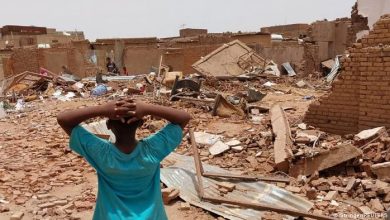
Over the two years of warfare in Khartoum State, the agricultural and livestock sectors have suffered devastating losses, amounting to tens of millions of Sudanese pounds per project, according to farm owners who spoke to Atar. Vast farms that once produced vegetables and fruits and raised thousands of heads of cattle and sheep have turned into ruins, reflecting the horror that unfolded in those once lush and thriving fields up until mid-April 2023.
Out of hundreds of agricultural projects in Khartoum State, only a few escaped destruction. The majority—once crucial to supplying the capital with vegetables, fruits, meat, and dairy—now lie in ruins, according to testimonies from farmers in Khartoum shared with Atar.
Mohamed Saleh, who owns a 58-acre agricultural project north of Al-Huda Prison on the Northern Artery Road, said that before the war, his farm produced significant quantities of oranges, lemons, and nabag (jujube), and he raised herds of sheep. He explained that the destruction over the two years of war included infrastructure, fruit-bearing trees, and rare livestock breeds. In addition, solar panels, batteries, water storage tanks, irrigation systems, and farming equipment were looted. Even buildings and administrative facilities were stripped down, with thieves dismantling zinc sheets, bricks, and timber.
Mohamed Saleh estimated his losses at over one trillion Sudanese pounds, saying that restoring projects like his, which had reached advanced production stages, would take decades. He noted that equipment from three groundwater wells was stolen, describing the theft as “professional,” as it involved extracting pipes from deep underground.
In Omdurman’s Umbadda locality alone, more than 60,000 acres of farmland—once sufficient to meet local demand for vegetables and fruits—have been lost.
Jaber, who preferred to go by his first name only, said he lost more than 700 million Sudanese pounds—the value of his agricultural project in northwest Omdurman, which included dairy cows and a poultry farm for meat and egg production. A large number of his cows were stolen at the beginning of the war, and he was forced to sell the remaining ones at extremely low prices to butchers and small-scale breeders. His poultry died due to a lack of water and feed.
Jaber added that the project’s infrastructure—including sheds, barns, water wells, and feed storage—was completely looted. The thieves, he said, didn’t appear to be in a hurry while dismantling the facilities, which now stand as ruins with no sign they ever produced anything.
According to an official from the Umbadda Agricultural and Animal Resources Department (who requested anonymity), dozens of other projects in rural Umbadda and Omdurman were similarly affected. The same source stated that Umbadda locality alone lost over 60,000 acres of agricultural land, which previously produced various field and horticultural crops, satisfying local demand for fruits and vegetables.
The official added that the destroyed projects had been capable of significantly contributing to the capital’s supply of meat, dairy, fruits, vegetables, and animal feed. Livestock at those farms produced in large quantities, and surplus fodder was often exported. However, looters and bandits destroyed the farms, and the Rapid Support Forces (RSF) turned many of them into military garrisons, exploiting dense vegetation and buildings to evade detection by military and security forces.
Umbadda is home to more than 40 large agricultural and livestock companies, including fish and poultry production operations, spread across an estimated 700,000 acres of arable land. These projects supply local and export markets and play a vital role in ensuring food security and employment in Khartoum State.
Satellite images show the transformation of farmland in southern Khartoum near the Soba agricultural project, comparing its state before the war (January 2023) and after (January 2025).
According to the official from the Agriculture Department in Umbadda, eight government agricultural projects in Khartoum State were destroyed, including the 30,000-acre Soba West Project, the 7,000-acre Gamouya Project, the 18,000-acre Sileit Project, the over-4,000-acre Koko Dairy and Livestock Project, and the over-30,000-acre Sundus Project. These government initiatives were completely destroyed and will need to be rebuilt from scratch.
Atar obtained information from the Ministry of Agriculture and Animal Resources indicating that Khartoum State’s agricultural projects previously housed nearly two million heads of livestock: 700,000 sheep, 800,000 goats, 400,000 cattle, and tens of thousands of camels raised for meat, racing, and milk.
A ministry official confirmed to Atar that nearly all this livestock was either stolen, died due to lack of water and feed, or was sold off as managing them became increasingly dangerous.
Damages to agricultural projects varied: power and water cuts, looting, and being turned into military bases. Mohanad Omar, a farm owner in western Umbadda, told Atar that electricity cuts led to water shortages, drying out trees. Theft extended even to water wells and irrigation pipes.
Mohanad described the destruction in western Umbadda as catastrophic. He said the looting started with the solar panels powering water wells. Once the water stopped, the trees and crops withered. Thieves later returned with cranes to extract the wells themselves, along with dismantling buildings and stealing zinc roofing.
He said fruit trees—including mango, orange, jujube, and date palms—were cut down and used for firewood and charcoal. “After the solar panels were stolen and the wells uprooted, the trees dried up and were then chopped down for fuel,” he explained. “Now, many farms are just barren open land with no trees or buildings.”
Mohanad concluded that the devastation in Khartoum’s farms exceeds the worst expectations and that restoring them to pre-war conditions depends entirely on government support for farm owners who lost everything—even their outer fences were stolen.
Quoted from Atar