Will Sudan’s New Government Succeed in Tackling Its Hot-Button Issues?

Sudan Events – Agencies
Nearly two months after his appointment as Sudan’s prime minister, Kamil Idris is close to completing the gradual formation of his government in five phases. The Sudanese people now await swift actions that could change their complex reality after more than 27 months of war—leaving Idris on what observers describe as “political hot coals.”
In early June, Idris announced the structure of the 22-ministry “Government of Hope,” dissolving the caretaker government in place since January 2022. He also established an Authority for Transparency and Integrity to combat corruption, promising austerity, justice, tolerance, and the fight against extremism.
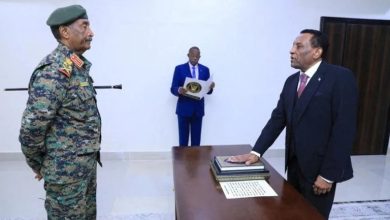
Within about two months, Idris appointed 20 ministers, the latest being five covering Cabinet Affairs, Energy, Digital Transformation and Telecommunications, National Education, and Youth and Sports. This batch also included, for the first time, junior ministers for Foreign Affairs, Finance, and Human Resources and Social Development.
While six ministers were absent from the swearing-in ceremony, questions remain about the absence of Agriculture and Livestock Minister Ahmed al-Tijani al-Mansouri—weeks after his appointment and his denial of any resignation. Health Minister Moaz Omar Bakhit was also absent, having broken his leg at his residence in Bahrain before relocating to the UK for a months-long treatment.
Cabinet Formation
The ministries of Foreign Affairs and Environment and Sustainability remain vacant. Rumors suggest that Idris will temporarily assume the foreign affairs portfolio himself, raising debate on social media about the wisdom of such a move at a time when Sudan faces increasingly complex international challenges.
Among the most notable aspects of the cabinet is the return of five ministers to their previous posts: Finance Minister Jibril Ibrahim; Information and Culture Minister Khalid al-Iyseir; Federal Governance Minister Mohammed Kortkila; Industry and Trade Minister Mahasin Yaqoub; and National Education Minister Tihami al-Zein Hajar, who had served less than a month before the previous government’s dissolution.
In a historic first, Lamia Abdel Ghaffar was appointed Minister of Cabinet Affairs, raising the number of women in the cabinet to three—the lowest female representation in decades. Another key appointment was the return of Ambassador Omar Sadiq as Minister of State for Foreign Affairs and International Cooperation, having briefly led the ministry from late April to the end of May.
Since the overthrow of former president Omar al-Bashir in 2019, the foreign ministry has seen seven ministers, four of them during the ongoing war.
Despite Idris’s inaugural speech highlighting that “youth represent 65% of the nation,” the new government includes only one young minister: engineer Ahmed al-Dardiri Gandour, Minister of Digital Transformation and Telecommunications, a 2004 university graduate. This drew criticism from youth activists online, who said the government does not reflect the country’s demographic reality.
Political Fragility
Political analyst Faisal Abdel Karim notes that the Idris government faces thorny challenges, including:
Fragile political backing – evident during cabinet consultations, reflecting divisions among pro-army factions that feel Idris did not sufficiently engage them.
Ongoing polarization and political fragmentation, which weakens government support and hinders any meaningful political process to end the crisis.
Speaking to Al Jazeera Net, Abdel Karim added that doubts remain about the military’s commitment to avoid interference in the prime minister’s mandate, as its influence was visible during cabinet formation. External support is also hard to secure amid ongoing war and overlapping regional agendas, leaving the government facing a severe test.
International relations and security expert Amer Hassan believes the government’s challenges are both domestic and external:
Restoring the civil service and public institutions to improve citizens’ lives and alleviate war-induced burdens.
Harnessing Sudan’s vast resources to transform living conditions.
He stressed to Al Jazeera Net that Sudan needs an effective economic vision to rebuild destroyed infrastructure and industry, while also re-engaging internationally. The war has rendered Sudan a “forgotten conflict” in the eyes of global and regional actors, reflected in the limited and ineffectual humanitarian aid flows.
Hopes Pinned on Performance
Economic expert Mohammed al-Nayer told Al Jazeera Net that restarting state operations and restoring key services—especially electricity—must be top priorities. Power drives production, he said, alongside rehabilitating the agricultural sector and rebuilding the industrial sector, 80% of which has been damaged and was previously concentrated in the capital.
Al-Nayer believes the prime minister must:
Activate the Cabinet and link ministers to the states.
Take bold decisions to pivot eastward, forge economic partnerships, and join the BRICS group.
Halt gold smuggling and shift from artisanal to organized mining to stabilize the economy and attract major investments.
Meanwhile, political analyst Ibrahim Shaqlawi argued that the long-delayed cabinet formation, the result of intricate political and societal balancing, reflects serious efforts to restructure the state and rebuild Sudanese confidence in public institutions.
He told Al Jazeera Net that the government now faces a true test: whether the chosen technocrats can translate political will into tangible outcomes, restore popular trust, and lay the foundations for a state built on justice, development, and peace.
Source: Al Jazeera