Bernard-Henri Lévy Writes: Sudan of the Forgotten Dead
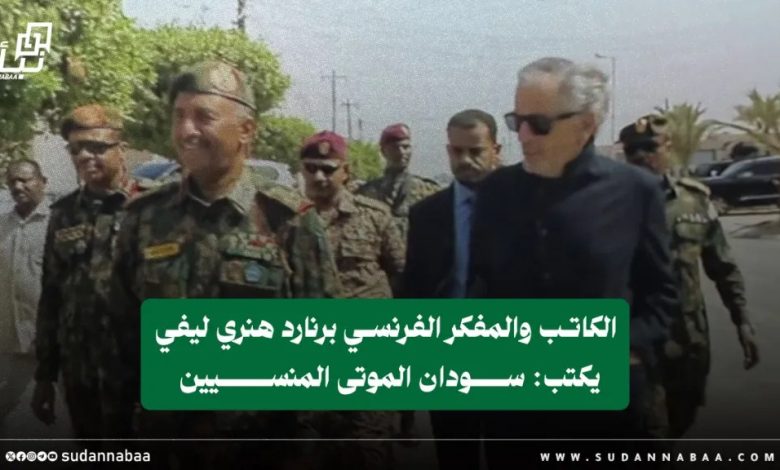
French writer and intellectual Bernard-Henri Lévy has published a compelling report in La Stampa, Italy’s most prominent newspaper, under the title: “Sudan of the Forgotten Dead… A Journey into the Deadliest War of the Decade, with 150,000 Casualties”. In Khartoum, people have one plea: “Stop Dagalo’s atrocities.”
“Among all the wars I’ve written about over the past fifty years,” writes Lévy, “this is one of the most savage—and unquestionably one of the most forgotten.”
“Did you know that this war has displaced twelve million people and claimed 150,000 civilian lives?” asks Suleiman, a former attaché at the Sudanese Embassy in France, who joined the army after the conflict broke out in April 2023, and who accompanied Lévy through much of this report.
Port Sudan: A Bombarded, Isolated City
Inside the arrival hall of Port Sudan’s international airport—connected, in theory, to only Istanbul, Doha, and Addis Ababa—there is a complete sense of isolation. Men in pristine white robes, skinny youths in torn shirts like fishing nets, and stray cats wandering beneath luggage belts in oppressive heat create a haunting tableau. One might wonder if these are ghosts, as legend says.
Scars of Drone Strikes
It’s almost miraculous that anything here functions at all. The airport has suffered repeated drone attacks by the army of Mohamed Hamdan Dagalo—known as Hemedti—a former camel trader turned general who rose up against President Burhan. Bombs exploded on the cracked walls of the departure hall; the control tower looked like a decapitated blast furnace. Massive craters, scorched black from a ten-day blaze, mark the fuel tanks. “150,000 dead,” repeats Suleiman coldly, in a sharp British accent. “That’s three times Gaza’s toll, I believe. And yet no one—no one in American universities, among Greta Thunberg’s friends, or the so-called progressives—seems to care.”
A Night with Burhan
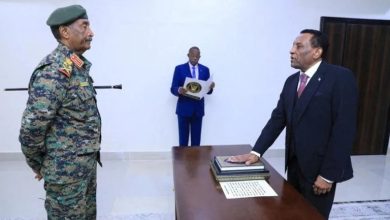
In the dead of night, Lévy meets President Abdel Fattah al-Burhan in a modest house engulfed in darkness, lit only by a few dim lights due to the threat of drone attacks. Tall, in full camouflage, with a chest covered in medals, Burhan has the aura of a Nile general. He speaks of President Macron—one of the few Western leaders he’s met in recent years—yet says he’s heard nothing new from him. He discusses the impossibility of fighting alone against an enemy that commits every imaginable war crime and targets civilians indiscriminately.
Burhan expresses frustration with the ambiguous stance of the UAE—once an ally, now allegedly supplying arms to the enemy via Chad.
Denials, Diplomacy, and Delayed Democracy
When challenged about supposed ties to Iran, Burhan is firm: “Iran opened an embassy, nothing more. No military experts, no weapons—contrary to the attackers’ disinformation.” On the Abraham Accords: “Civil war delayed ratification. But I am ready to cooperate with the Jewish state against terrorism—our mutual threat that extends beyond Sudan to Chad, Libya, and the region at large.”
When questioned about the long-promised democratic transition since 2019, Burhan falls silent, then leads Lévy into a dry, dark garden and out to the corniche. A crowd gathers. Cheers erupt: “Long live Sudan!” Selfies abound. Burhan raises his fist and declares, “Here is democracy.” Then, turning to Lévy, he adds: “Tell the propagandists that Kamal Idris, a renowned legal scholar, has been appointed Prime Minister—and he will form a 100% civilian government.”
A City of Ghosts
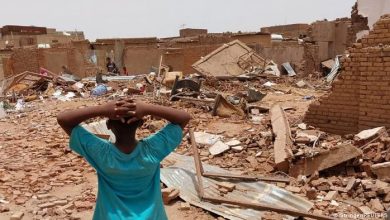
Sudan—once the largest African country before South Sudan’s secession—unfolds before Lévy’s eyes from a helicopter flying dangerously low to avoid Hemedti’s missiles. Khartoum lies in ruins, a ghost city reminiscent of Bakhmut, but once home to seven million people. Women—skin and bone from hunger—stand in endless lines for humanitarian aid that never comes.
In Nubawi, entire neighborhoods have been flattened by fire. In the silence of the uninhabited zones, lean dogs wander the streets with terrifying hunger in their eyes. At the national museum, ancient murals and Nubian artifacts—surviving for centuries—have been deliberately destroyed. At the national library, historic documents were burned as fuel.
The devastation of Khartoum resembles every historical example of urban genocide—a systematic annihilation of a city. Perhaps, Lévy writes, this is its most extreme manifestation yet.
The Mass Grave of Omdurman
In the Omdurman district of Amboada, Lévy encounters a burial mound—one of many mass graves. “There are 244 bodies down there,” says a man. During the war, people were arrested at home or while searching for food. They were told, “Don’t worry—Hemedti will help you relocate.” Then Rapid Support Forces opened fire, screaming “Allahu Akbar”. Bodies lay in the sun for months before neighbors dared bury them.
Mourners lift their robes to show wounds: lash marks, burns, dog bites. Then they gather in a circle, raise their hands, and offer a funeral prayer to the forgotten dead.
Rape as a Weapon of War
In Badr Street, Nana Taher, director of a family planning clinic, introduces Lévy to women who had been raped by Hemedti’s fighters. Mothers raped in front of daughters. Daughters in front of mothers. Rape cycles conducted in public or in torture centers. Some women went mad. Some were told to pay ransom; when they couldn’t, they were taken anyway. One woman screamed so loud her mouth was filled with sand, then dirt. Another only remembers the slimy hand of a man holding her down.
Then come the children of rape. Dr. Taher asks: “What will you do?” Some want abortions to hide from their husbands. Others fear they’ll never find one. Some accept their fate—but plan to give up the child to another family far away. A couple arrives with a 15-day-old baby. “We are all victims,” they say. “Together, we will build a peaceful Sudan.”
The Damned of the Earth
The most haunting testimony comes west of Khartoum, on the road to El Obeid. A group of 12 men—some victims, some former perpetrators—gather during a thunderstorm. One, a teenage boy of 17, recounts his horror. He was drugged and forced to rape 24 women over three days. Alone, in a room, supplied with food and performance-enhancing drugs. A monster created by other monsters.
This is Sartre’s “The Wretched of the Earth”—but inverted: 24 women destroyed. One boy, damned forever.
A General in the Dark
Back in Khartoum, in a pitch-black safe house, Lévy is visited by a general he’d seen earlier in Port Sudan. A close aide of Burhan, he offers Lévy a secret visit to a special forces base near El Fasher.
At Dawn with the Commandos
At dawn, in the sands beneath a bare hill, Lévy witnesses a squad of elite anti-terrorist commandos. Twelve men—snipers, medics, technicians—fully camouflaged. Their leader: Commander Hafez al-Taj, suave and steely, vows: “We will defeat Hemedti’s legions.”
But there’s more: when insurgents stormed Khartoum, they freed jihadists from prison. Now, with ISIS and al-Qaeda regrouping in the Sahel, Sudan risks becoming a powder keg. “It is us who fight them,” al-Taj declares.
The Joint Force
Near a village whose name remains undisclosed, Lévy witnesses the “Joint Force”—former rebel fighters from the Zaghawa, Masalit, and Fur tribes, now allied with the army. One of them is General Ali Mokhtar, a former guerrilla commander from the Darfur war. Once enemies, these groups now fight side by side against Hemedti’s Janjaweed heirs.
At dusk, they sit around lamb skewers, recalling past battles. Two Sudans—once divided—now reconciled in the face of a common enemy who knows only scorched earth.
Lévy concludes:
“This land—soaked in blood and history older than Egypt’s—deserves better than silence. To refuse to understand is a disgrace. To open our eyes is a duty.”