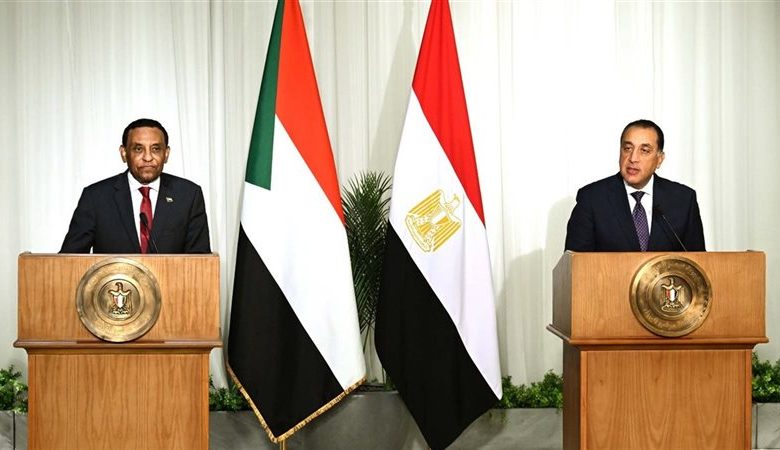
Egyptian Prime Minister Mostafa Madbouly held a joint press conference in Cairo on Thursday with his Sudanese counterpart Dr. Kamil Idris following an extended round of talks between the two delegations.
At the outset of his remarks, Madbouly welcomed Dr. Idris and his accompanying delegation to their “second home, Egypt,” describing the visit as deeply significant and expressing hope for more frequent exchanges in the near future.
He reiterated Egypt’s full support for Sudan’s government and for all efforts aimed at preserving Sudan’s national institutions, rejecting any threats to its unity and territorial integrity, and backing the Sudanese people’s aspirations for reconstruction, development, and prosperity.
Madbouly also expressed deep appreciation for Sudan choosing Egypt as the first country to visit following the formation of its new government—an act he said reflects the historic and deeply rooted ties between the two nations, as well as Sudan’s appreciation for Egypt’s efforts to help restore stability to its neighbor.
“We are pained and deeply saddened by the war in our brotherly Sudan,” Madbouly stated. “Egypt and Sudan are like one body; when one part suffers, the whole body feels the pain. Our bond is rooted in a shared history and the unity of the Nile Valley peoples.”
He reaffirmed Egypt’s longstanding commitment—under the directives of President El-Sisi—since the outbreak of the conflict in Sudan, to provide all forms of assistance to the Sudanese people, including those who have fled the violence and sought refuge in Egypt. “We opened our doors not out of charity or favor, but because it is our duty as brothers,” he said.
Madbouly voiced hope that Sudan would soon recover from its ordeal and restore peace and stability, emphasizing the urgent need to protect innocent lives, alleviate the suffering of the Sudanese people, and preserve the country’s unity, sovereignty, and independence. He categorically rejected any infringement on Sudan’s territorial integrity under any pretext.
He also highlighted Egypt’s active role in various regional and international initiatives aimed at ending the war in Sudan, asserting that peace and security in Sudan are essential not only for the country itself but for the broader stability of the African continent.
Madbouly said he had co-chaired with Dr. Idris a wide-ranging session of talks that explored all aspects of Egyptian-Sudanese relations and strategies to deepen cooperation in a way that serves the shared interests of both peoples.
The two sides agreed to enhance bilateral cooperation through activating mechanisms of consultation and coordination at all levels. They also emphasized the need to hold joint committee meetings, with relevant authorities in both countries to determine suitable dates.
Madbouly noted that economic cooperation and increased trade were among the main topics discussed, along with strengthening partnerships and exchanging expertise across multiple sectors to support mutual development goals.
He affirmed Egypt’s strong interest in contributing to Sudan’s reconstruction and increasing investments in the country—a move that was warmly welcomed by Prime Minister Idris.
On the regional and international fronts, Madbouly said the talks stressed the need for continuous coordination between the two countries on security-related issues, particularly concerning the Red Sea. He also expressed Egypt’s hope for greater cooperation on the vital issue of Nile waters, stressing the importance of working through the Joint Technical Commission to safeguard both nations’ rights.
Both Egyptian and Sudanese sides, he added, affirmed their commitment to fraternal relations with other Nile Basin countries based on mutual benefit and non-harm. They also called for enhanced cooperation rooted in international law to ensure the sustainable use of the Nile—an essential resource for all.
In this context, Madbouly firmly rejected Ethiopia’s unilateral actions regarding the Nile, stressing the necessity of abiding by international law and rejecting any exceptions for the Nile from the principles that apply to all transboundary rivers—especially the principles of consultation, coordination, and mutual benefit to prevent harm and serve all stakeholders.