It’s Not Sudan’s War — It’s Yours, Dear Westerner
Sudan Events – Agencies
Just six months before Hamas’s massacre on October 7, violence erupted on April 15, 2023, within Sudan’s military establishment. It was not a coup in the traditional sense, but a descent into fratricidal conflict: Sudan’s Armed Forces, led by General Abdel Fattah al-Burhan, against the Rapid Support Forces (RSF), led by Mohamed Hamdan Dagalo, known as Hemedti.
The fighting began in Khartoum, the heart of Sudan, and quickly spread westward to Darfur, reviving the darkest chapters of the country’s history. Massacres targeting the Masalit people received scant coverage, yet outside observers described them as acts of ethnic cleansing. By early 2025, the United States had formally declared that the RSF and allied militias had committed genocide, with non-Arab groups such as the Masalit being the primary victims and intended targets.
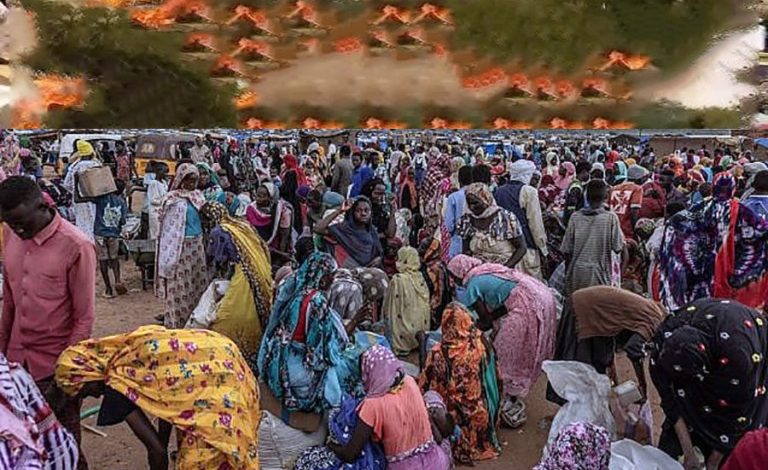
The numbers are staggering — and still only hint at the abyss. Nearly 25 million people now face extreme hunger, the largest hunger crisis in the world today. Famine conditions have been confirmed in parts of North Darfur. More than 522,000 children are estimated to have died from hunger alone, while the true death toll — including those killed by violence, disease, and forced displacement — remains incalculable.
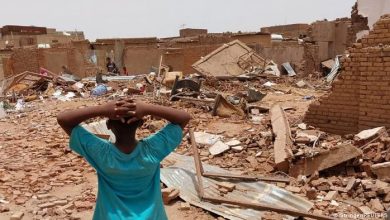
In Khartoum alone, at least 61,000 people have been killed, 26,000 of them directly in combat. Over 8.8 million Sudanese have been displaced internally, and more than 3.5 million have fled as refugees across borders. The Sudanese Journalists Syndicate documented over 40 war crimes in May 2023 alone. Dozens of journalists have been injured or killed. Humanitarian workers have been targeted, with 18 killed and many more arrested. No ceasefire has been reached, and the war continues, with dire humanitarian consequences and growing regional spillover.
Some wars haunt the conscience of the world; others vanish from it entirely. To understand why, we must first grasp the nature of Sudan’s catastrophe — and the ideological fault lines it threatens to expose.
Sudan’s war cannot be twisted into a neat narrative that rouses the fury of today’s so-called justice activists. There are no colonial villains, no Zionist specters, no corporations to boycott. It cannot be framed as a fight between “oppressor” and “oppressed,” no clear dichotomy of “resistance” versus “occupation.” This is a postcolonial war, an African war, an Arab war, an Islamic war — a war between two brutal factions, each claiming legitimacy while acting with impunity.
The RSF is historically responsible for unspeakable atrocities: ethnically motivated killings, mass rape, child soldier recruitment. The Sudanese Armed Forces bombard entire neighborhoods into obliteration. Most perpetrators and victims alike are Black, Arab, and Muslim. There is no progressive cause to champion, no liberal guilt to be absolved, no poster to be printed in time for Pride Month. And so, the war disappears.
But Sudan’s disappearance is no accident. It is the final chapter in a longer, more damning story — a story of the selective conscience of the postmodern West, and the ideological wreckage we now call “progress.”
Let us remember: in Darfur two decades ago, the world first glimpsed the consequences of such selective outrage. Between 2003 and 2005, Janjaweed militias — backed by Sudan’s Islamist government — waged a campaign of genocide against non-Arab tribes. The world noticed only briefly. There were limited campus protests. A few celebrities wore “Save Darfur” bracelets. But once the war failed to fit neatly into an imperial-guilt template, attention waned. The perpetrators were not the “right” kind for the script. They were not Americans. They were not Zionists. They were Sudanese Arabs, many devout Muslims, and the genocide they carried out was not against infidels, but against fellow Muslims deemed “not Arab enough.” That silence set today’s precedent.
In the years that followed, as Sudan moved toward democracy, its struggle was met not with solidarity but suspicion — and, ironically, by a certain liberal condescension. Many Western diplomats and intellectuals regarded Sudanese liberalism with a patronizing eye. One could almost imagine them, behind closed doors if not openly, asking: Who are these Black Arab Muslims to speak the language of constitutional democracy and secular law? It was easier, and trendier, to treat Sudan’s Islamist strongman Omar al-Bashir as a bulwark against imperialism than to listen to the dissidents he jailed and tortured.
Even after the 2019 revolution — when Sudanese youth ousted Bashir through peaceful protests, waving flags and chanting for freedom — the world yawned. The same Western progressives who had glorified Cairo’s Tahrir Square and momentarily embraced Syria’s revolution greeted Sudan’s democratic movement with apathy, or worse, disdain. And when that fragile civilian government was overthrown in the 2021 coup, the West barely muttered regret before moving on.
Now comes the final collapse. And still, the world looks away. Why?
I believe the answer lies in the identity architecture of our age. The Western left’s moral radar seems tuned not to human suffering, but to ideological utility.
And why is Sudan ideologically useless? Because its bloody descent exposes the total breakdown of the postcolonial dream — a dream born in Paris lecture halls and in the revolutionary fantasies of the Global South. A dream midwifed by some of France’s most bankrupt intellectuals of the 20th century — from Foucault to Derrida. A generation of Western academics adopted their theories as moral scripture, convinced that oppression could only flow in one direction. Now, as Sudan once again collapses into genocide, those same voices are silent. They cannot process this kind of suffering. It does not fit. Oppression here flows the “wrong” way, offering no symbolic redemption.
Moreover, Sudan lays bare not only the violence of warlords, but the failure of entire political legacies: the collapse of Arab nationalism under kleptocracy; the betrayal of Islamic justice, which in practice can only lead to tyranny; the impotence of African nationalism and its institutions; the cowardice of global diplomacy; and the moral provincialism of the Western left.
Yet, amid the nightmare, in besieged cities, doctors continue to operate without anesthesia. Civilians organize food convoys under the threat of airstrikes. Women, who bear the brunt of this war, continue to raise their voices against both factions, risking rape and death for their right to speak.
What Sudan asks for, then, is not merely aid or intervention — but memory. It demands the burial of lazy, ideologically convenient piety. The forgotten, or rather erased, war is not Sudan’s war. It is yours, dear Westerner.
Samuel Hyde is a writer and political researcher based in Tel Aviv, Israel. He works at the Jewish People Policy Institute and has previously served at the Foundation for Defense of Democracies, the Institute for Monitoring Peace and Cultural Tolerance, and the Cape Town Holocaust and Genocide Centre. He is the editor of Dr. Einat Wilf’s book “We Should All Be Zionists.”