High Demand for Voluntary Return of Sudanese Amid Egyptian Facilitation
Sudan Events – Agencies
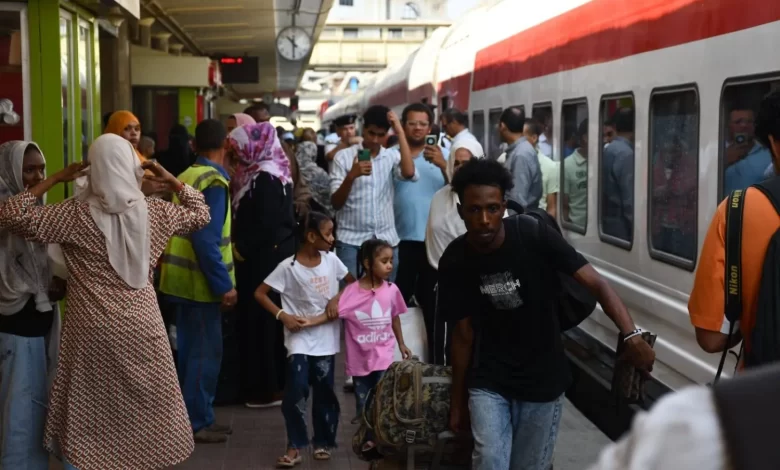
The Egyptian government has expanded its support for Sudanese citizens seeking voluntary return to their homeland, announcing the operation of two weekly trains instead of one to transport returnees from Cairo to Aswan in southern Egypt. From there, buses carry them on to various Sudanese cities, according to Sudan’s Consul in Aswan, Abdel Qader Abdullah.
Abdullah told Asharq Al-Awsat that “the fifth train of the initiative arrived in Aswan on Monday, after departing Cairo on Sunday, while a second train this week will depart Cairo on Wednesday and reach Aswan on Thursday. This schedule will continue in the coming weeks.”
The ongoing conflict in Sudan—pitting the Sudanese army against the Rapid Support Forces (RSF) since mid-April 2023—has forced millions to flee their homes, both inside and outside the country. Around 1.5 million Sudanese have entered Egypt, according to official statistics.
In coordination with Sudan’s Defense Industries System, the Egyptian government launched a new mechanism for voluntary repatriation on July 21. The plan includes a free weekly train from Ramses Station in central Cairo to Aswan. Each train carries up to 1,000 passengers, marking a significant development compared to the earlier reliance on buses, each of which accommodates about 50 passengers. The initiative also aims to protect Sudanese returnees from scams related to travel arrangements.
Following the departure of the fifth train on Sunday, the Egyptian National Railways Authority announced that, “due to the growing demand for participation in the voluntary return initiative, the Authority, in coordination with Sudanese counterparts, is preparing to operate additional trips in the coming period, meeting the needs of our Sudanese brothers and sisters. The initiative stands as a model of humanitarian solidarity and cooperation at both official and popular levels.”
Consul Abdullah expressed gratitude to the Egyptian government for “providing trains despite the crowded rail schedule, and for treating Sudanese as Egyptians in ticket pricing.” He clarified that travelers pay nothing, as the Defense Industries System covers the full cost of return.
Upon arrival in Aswan, the Sudanese consulate, with the help of volunteers, organizes returnees onto buses that take them across the border into Sudan. “Around 40 buses depart daily to Sudan, each carrying about 50 passengers, except on Fridays when the border is closed,” Abdullah said.
According to official data, 323,386 Sudanese have returned by land between January 2024 and August 13 of this year. Abdullah estimated that “those returning via Aswan by land represent about one-third of the Sudanese who entered Egypt after the war. The overall number is higher, as some return by air while others move on to different countries.”
Alongside the official repatriation effort, numerous grassroots initiatives are also at work, including the campaign “Returning to the Land of the Kindhearted,” which has helped thousands return over the past months, according to campaign coordinator Abdel Nasser Hassan Jaafar. “We still have long waiting lists,” he added.
Speaking to Asharq Al-Awsat, Jaafar explained that the campaign “runs three buses weekly, some of them free of charge for families unable to cover costs. Demand is high, especially from residents of Khartoum, Omdurman, Bahri, and central Sudan around Wad Madani.” He noted that “several campaigns are operating alongside ours, while the train initiative has marked a turning point in the numbers of returnees.”
The Egyptian Railways Authority said it has “ensured all necessary facilities and comfort for passengers, including reception procedures at stations, support teams to assist the elderly, safe and comfortable travel conditions on board, and the addition of a carriage for luggage and personal belongings.”
A number of Sudanese citizens expressed their appreciation for “the efforts made, the smooth organization, and the facilitations provided throughout their journey—from reception at the station to the train ride itself.” They emphasized that “the spirit of brotherhood and solidarity they felt from Egyptians, from their arrival until their departure, will remain deeply etched in their hearts,” according to the Authority’s statement.