How the Weapon of Starvation Shapes the Resilience of Cities in Darfur and Kordofan
Sudan Events – Agencies
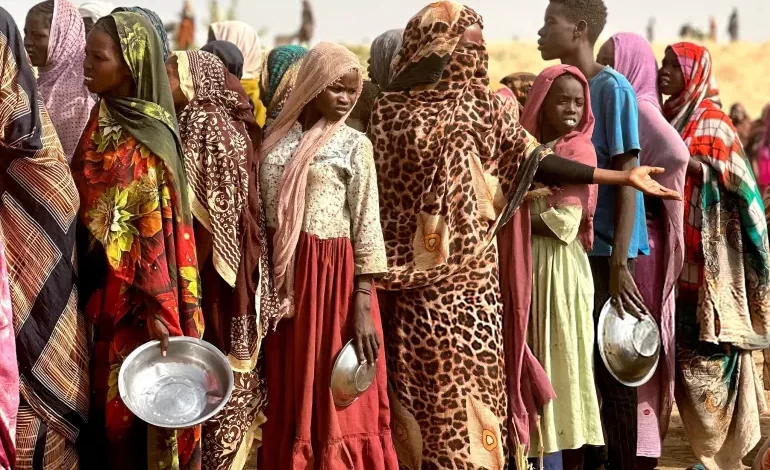
Outstretched hands, hollow eyes, and bodies that may have escaped bullets and shells but not hunger. From eating animal fodder to chewing tree leaves, survival in towns across Darfur and South Kordofan has been reduced to desperate means of submission and forced displacement.
For more than a year, the cities of El Fasher, Dilling, and Kadugli have withstood military assaults, only to face another battle: an economic blockade imposed by the Rapid Support Forces (RSF), wielding what has come to be known as the “weapon of starvation.”
Once vibrant economic and trade hubs, El Fasher and Kadugli are now encircled, cut off from the movement of goods and supplies.
Hunger and Soaring Prices
In the besieged city of Dilling, South Kordofan—trapped since January 2024 by both the RSF and the SPLM-North under Abdelaziz al-Hilu—residents have been reduced to eating tree leaves, with children suffering acute malnutrition.
Hawa Adam (a pseudonym), who has remained in the city for over a year, told Al Jazeera Net that the situation is catastrophic: “There are no vegetables, no basic goods. For more than two weeks, no one in Dilling has had morning tea or even seen sugar. Half the shops in the market are shuttered, and many traders are imprisoned because of a year-long cash shortage, while prices of essentials keep rising.”
According to Hawa, a local measure of sorghum now costs around $8.5, sugar sells for $5 per kilo ($6.3 via banking apps), rice at $6.3, lentils at $8.5, and cooking oil at $2.5 per pound in cash—double through digital payment.
In El Fasher, the situation is equally dire. Residents are surviving on animal fodder as the price of a sack of wheat has skyrocketed to nearly $3,500. The RSF has enforced a siege on the city since April 2024, which intensified after its forces stormed Zamzam IDP camp in February 2025.
Abdel-Baqi Mohamed, humanitarian coordinator for the Darfur Regional Government, told Al Jazeera Net that 928,000 people are trapped inside El Fasher—410,000 displaced persons and 518,000 residents.
A Strangling Siege
The World Food Programme (WFP) has described the situation in Darfur, especially El Fasher, as “extremely grave.” The city has been cut off from aid for more than a year.
“Our reports and testimonies from residents confirm that families are eating animal feed to survive,” said WFP Sudan spokesperson Mohamed Gamal al-Din. “People are on the brink of catastrophic hunger.”
He added that more than 24 million Sudanese—half the population—are facing acute food insecurity, with thousands in El Fasher enduring conditions classified at the UN’s highest level of famine (Phase 5). “We have food stocks ready to be dispatched, but delivery requires RSF approval for safe passage. One convoy will not be enough; assistance must be consistent.”
In Dilling and Kadugli, where people heavily depend on aid, the rainy season and ongoing sieges are making access even harder. Reports point to deaths linked to hunger and malnutrition.
Health System Collapse
According to the preliminary committee of the Sudanese Doctors’ Union, the humanitarian crisis in South Kordofan has crippled the health sector.
Committee member Adeeba al-Sayed told Al Jazeera Net that medical staff and medicines are in critically short supply, with obstetrics and gynecology hit hardest. Drugs for pregnant women, nursing mothers, and newborns have run out, leading to rising mortality.
The union detailed the toll:
12,000 pregnant women and 6,000 nursing mothers suffering malnutrition and related diseases.
3,000 newborns dead due to poor health conditions.
21,000 children unvaccinated against infectious diseases in South and North Kordofan.
A study by the Norwegian Refugee Council and the Danish Refugee Council in May 2025 found that among displaced families in Kadugli:
74% struggle to access food.
96% have poor food consumption scores.
64% lack sufficient water.
The city is classified in Phase 4 (emergency), one step before famine. Malaria and malnutrition remain the most prevalent diseases.
Starvation as a Weapon
Political analyst and development media researcher Ibrahim Shaqlawi told Al Jazeera Net that the RSF’s resort to starvation tactics reflects both military and political bankruptcy: “When advances failed in cities like El Fasher, Dilling, and Kadugli, they turned to exhausting civilians into submission. But history shows Sudanese cities rarely fall through hunger; such policies may instead fuel stronger resistance.”
Journalist Yousif Abdel Manan warned that conditions in South Kordofan’s Nuba Mountains could worsen beyond famine by October: “If residents of Dilling and Kadugli remain alive until then, the catastrophe could engulf more than a million people. Already, 12 children died in a single week in Dilling due to hunger.”
He argued that hunger is a deadlier weapon than bombs: “Starving cities or displacing populations weakens the army’s ability to defend against militia attacks.”
A Military Tactic
Researcher Hassan al-Nasir explained that the RSF employs starvation on two levels:
Tactical: dismantling urban life to trigger emergencies, hoping to infiltrate cities while straining defending forces.
Strategic: controlling supply routes, weaponizing humanitarian aid as leverage in negotiations, and creating political and social pressures—visible in recent criticism of the government by armed groups and community leaders.
“Starvation has not yet toppled any Sudanese city or forced a military unit to surrender,” he said. “But it imposes crushing economic and social realities that could eventually reshape the army’s broader strategy toward the sieges.”
Source: Al Jazeera