Darfur: Cholera Outbreak Deepens the Suffering of Displaced Communities
Sudan Events – Agencies
As Sudan’s war drags on, with displacement and forced migration on the rise and no peaceful resolution in sight, the humanitarian crisis has intensified, particularly in displacement camps where shortages of food and medicine, alongside the destruction of hospitals and health facilities, have left millions in dire conditions.
Darfur is now facing a worrying cholera outbreak, especially in the camps of Tawila, Jebel Marra, Nyala, Zalingei, and Shaeria’s Khazan Jadeed area, where daily case numbers reported in displacement centers continue to climb.
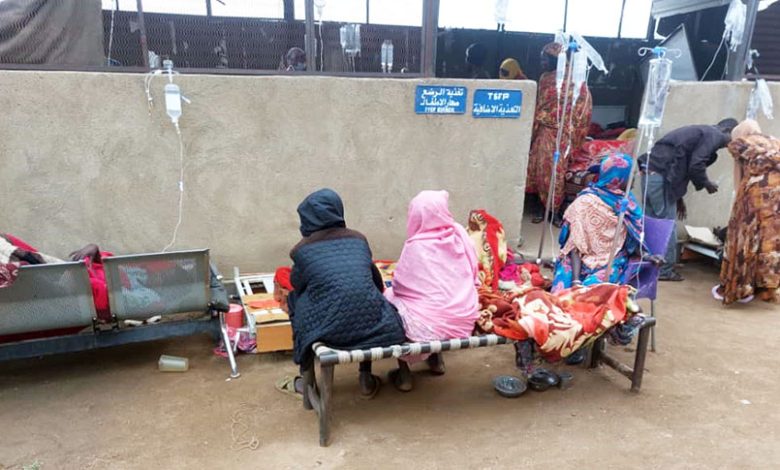
In Nyala, isolation centers are overwhelmed. “There’s a severe shortage of medicine and IV fluids,” said displaced woman Haya Abdullah to Muwatinun. “Patients are lying on the floor because there aren’t enough beds or blankets. The suffering is immense as cholera spreads.”
A statement from the Darfur Displaced and Refugees Coordination, seen by Muwatinun, confirmed that most cases in Tawila are concentrated in the camps, with others reported in Martal, south of Tawila, and in the Tabra area.
Since the outbreak began, cumulative daily case counts have reached 4,592, including 75 deaths. At present, 76 patients are in isolation centers, with 55 new cases recorded.
Is-haq Haroun, a displaced man in Tawila, said the area—already overwhelmed after receiving thousands who fled El-Fasher—was struggling with overcrowding and a surge of cholera and dengue fever cases. He appealed for urgent humanitarian intervention, stressing that Tawila, under the control of Abdel Wahid Mohamed Nour, lacked the means to meet the needs of the displaced suffering from hunger and disease.
According to the Coordination, cholera has also spread to Tabra, with 178 cumulative cases; to Rubia and Tibsa, which recorded 209 cases including 13 deaths and 15 new infections; to Golo in Jebel Marra with 1,172 cases including 51 deaths; and to Geldo, with 80 cases and nine deaths.
Other affected areas include Nierteti (41 cases, 4 deaths), Rokero (111 cases, 7 deaths), Fanga (60 cases, 3 deaths), and Deribat in eastern Jebel Marra (149 cases, 9 deaths, 47 currently in isolation). Two cases were also confirmed in Fina.
In Sortoni camp, 57 cases were reported with six deaths. In Kalma camp, 435 cases including 64 deaths were documented. Otash camp reported 207 cases and 51 deaths, Dreij camp 117 cases and 4 deaths, with additional infections in Salam camp.
In East Darfur’s Shaeria locality (Khazan Jadeed), 85 cases including 18 deaths were recorded.
The outbreak has continued to spread into Zalingei. In Hamidiya and Hassahissa camps, 75 cases and two deaths were confirmed; Khamsa Dagaig camp reported three cases including one death. In Azum (west of Zalingei), 109 cases including two deaths were reported; in Zalingei town, 89 cases. Two cases were confirmed in the Sid Kambo agricultural area, and four in Orkom, south of Zalingei.
Overall, the cumulative number of cases across Darfur has surpassed 7,538, including 322 deaths.
Despite severe shortages of medical supplies and functioning isolation centers, humanitarian organizations, local volunteers, emergency rooms, and local authorities are struggling to contain the outbreak. But with infections rising rapidly, the epidemic poses a deadly threat, described as a forgotten humanitarian catastrophe in a country already ravaged by war, famine, and disease.
The Coordination urged the World Health Organization and relevant international bodies to take immediate and effective measures to prevent further deterioration of the crisis in displacement areas where cholera is spreading at unprecedented rates.
The ongoing war in Sudan since mid-April 2023 has created the world’s largest humanitarian crisis. In Darfur, displaced families—spread across 51 camps in the region’s five states—have resorted to eating animal fodder and tree leaves due to the collapse of food supplies.
Darfur’s displacement camps date back to 2003, when villagers fled to larger towns seeking safety after conflict erupted between government forces and rebel factions.
The region has been scarred by violence since 2003, with an estimated 300,000 people killed and 2.5 million displaced, according to UN figures.
The United Nations now warns that Sudan—already one of the world’s poorest countries before the current war—is facing “one of the worst displacement crises globally” and could soon descend into the world’s worst hunger crisis.