Simultaneous Visits to Mogadishu Expose Rivalry for Influence in the Horn of Africa
Sudan Events – Agencies
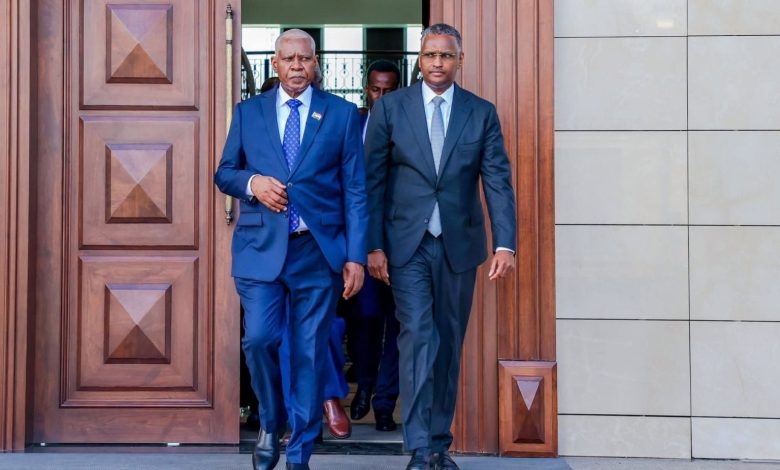
Mogadishu – Within the span of just 24 hours, Somalia’s capital Mogadishu hosted two high-profile arrivals from rival spheres of influence in the Horn of Africa: UAE Minister of State for Foreign Affairs Sheikh Shakhbout bin Nahyan Al Nahyan, and Sudan’s Director of General Intelligence, Lt. Gen. Ahmed Ibrahim Mufaddal.
The back-to-back visits have raised questions about the motives behind such diplomatic and security moves in a region that today sits at the heart of strategic power balances between the Gulf and East Africa.
Somalia’s Place in the Regional Power Equation
Strategic location: Overlooking one of the world’s most vital maritime routes in the Gulf of Aden and Bab al-Mandeb, Somalia is a key player in Red Sea security.
Internal fractures: The country continues to grapple with the insurgency of Al-Shabaab, as well as political disputes between the federal government and regional states—making it fertile ground for foreign intervention.
Gulf involvement: The UAE, Qatar, and Turkey have all pursued competing agendas in Mogadishu in recent years, ranging from military and security assistance to economic and infrastructure investments.
Sheikh Shakhbout’s Visit – The Emirati Dimension
For the UAE, Somalia is central to a wider Red Sea and Horn of Africa strategy.
Economic interests: Managing and operating ports, expanding investments, and leveraging infrastructure projects to project influence.
Security calculus: Building alliances to counter Turkish and Qatari influence while strengthening cooperation on counterterrorism.
Timing: The visit comes as war rages in Sudan, suggesting Abu Dhabi may be seeking to recalibrate the balance of power in the region through the Somali gateway.
Sudan’s Intelligence Chief in Mogadishu – Khartoum’s Calculations
Lt. Gen. Ahmed Ibrahim Mufaddal’s visit carried its own security and diplomatic weight.
Security coordination: Sudan and Somalia intersect on counterterrorism and arms-smuggling routes across the Red Sea.
Regional alliances: Khartoum is attempting to break out of the diplomatic isolation imposed by its internal conflict by forging stronger ties in the Horn.
Indirect message: The trip could signal Sudan’s willingness to work with Somalia as part of a counterweight to external—particularly Emirati—interventions.
Implications for Sudan, Somalia, and the Horn of Africa
1. For Sudan:
The UAE’s high-level engagement with Mogadishu, immediately after Sudan’s intelligence chief, could be read as an effort to offset Khartoum’s outreach.
A risk of indirect tensions emerging between Khartoum and Abu Dhabi over influence in Somalia.
2. For Somalia:
Potential political and economic gains from competing regional suitors.
But also the danger of becoming yet another battleground for external rivalries.
3. For the Horn of Africa:
Intensifying Gulf competition—particularly from the UAE—against Turkey, Qatar, and Sudan.
The prospect of new alliance realignments that could reshape the power map of the Red Sea.
Conclusion
The near-simultaneous visits highlight that Somalia is no longer merely a domestic concern, but an integral part of a broader contest for influence stretching from the Gulf to the Horn of Africa.
For the UAE: Mogadishu is a gateway to bolstering maritime influence and countering rival blocs.
For Sudan: The visit is an attempt to reengage with its regional environment and secure a foothold in the Red Sea equation.
Ultimately, the overlapping moves point to an intensifying race for strategic dominance, underscoring that the Horn of Africa remains an open arena for intersecting Gulf and African agendas.