Jebel Marra: A Homeland of Cultural and Natural Diversity in Darfur
Sudan Events – Agencies
Jebel Marra, one of Sudan’s most iconic natural and heritage landmarks, rises more than 3,000 meters above sea level, making it the highest mountain range in Darfur and among the tallest in the country.
With its volcanic terrain, cascading waterfalls, and crater lakes, Jebel Marra is a hub of environmental and cultural diversity. It sustains agriculture and pastoralism for local communities and remains one of Sudan’s most important tourist attractions.
Location and Size
Situated in western Sudan’s Darfur region, Jebel Marra stretches some 135 kilometers north to south, with a maximum width of 80 kilometers in its southern third. Covering an area of around 12,800 square kilometers, the mountain range marks the highest point between the Nile Basin and Lake Chad, reaching an elevation of 3,043 meters.
The range extends from Kass in South Darfur northward to the outskirts of El-Fasher, capital of North Darfur.
Geological Formation
Geologically, Jebel Marra is a volcanic chain of plateaus and peaks interspersed with waterfalls and crater lakes. Its highest point, the Deriba Crater, lies at 3,042 meters above sea level. Formed by a massive volcanic eruption in 1479 BCE, the crater spans five kilometers in diameter.
According to UNESCO, the Deriba volcano is dormant but not extinct. Hot springs and fumaroles — vents emitting steam and gases — remain active in the area.
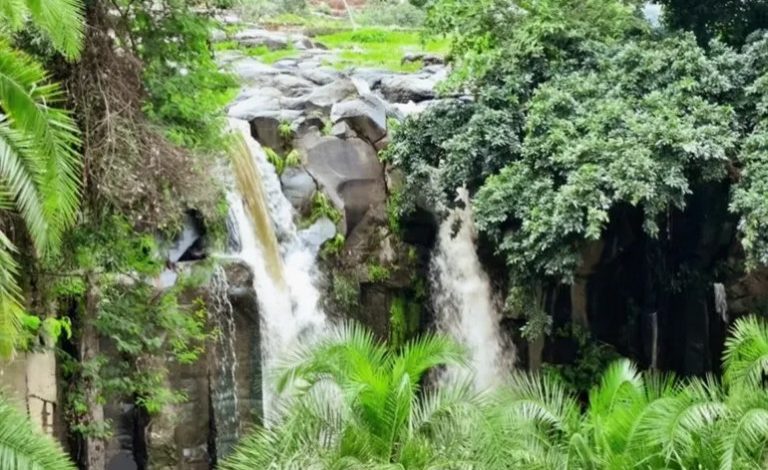
Despite being surrounded by semi-desert plains and desert to the north, Jebel Marra enjoys a temperate Mediterranean-like climate, with rainfall across most of the year supporting dense vegetation. Rain-fed crater lakes atop the mountain feed spectacular waterfalls such as Golol, Nierteti, Mortagalo, and Suni.
People and Culture
The region is home to several ethnic groups, notably the Fur and Zaghawa. Traditional housing consists of qutati — small round huts with thatched conical roofs and stone walls. The area is renowned for its rich cultural heritage of traditional music, dances, and folklore, reflecting the diverse identities of Darfur’s peoples.
Livelihoods rely on farming and herding, with key crops including lemons, oranges, apples, millet, sorghum, garlic, and onions.
Large parts of Jebel Marra remain under the control of the Sudan Liberation Movement (SLM) led by Abdul Wahid al-Nur, which launched an armed rebellion against former President Omar al-Bashir in 2003.
Religious Significance
Some researchers suggest that Jebel Marra may be linked to the Qur’anic “Mount Ṭūr,” where Prophet Moses is believed to have spoken with God. A nearby village named Ṭūr has been cited as possible evidence.
Sudanese historian Abbas Ahmed al-Haj notes that 19th-century Torah translations referenced the death of Aaron, Moses’ brother, on a mountain called Hor near Wadi Howar. This, he argues, has led some historians to speculate that Jebel Marra might be the sacred mountain where God spoke to Moses.
Tourism Potential
Jebel Marra remains one of Sudan’s premier tourist destinations, thanks to its striking mountain landscapes, rich biodiversity, and cultural legacy. Its ecological zones include riparian forests, savannah woodlands, and aromatic Boswellia (frankincense) trees on its slopes.
The mountain shelters rare and unique plant species alongside populations of both domestic and wild animals. It has also been immortalized in Sudanese music and poetry, with artists such as Abdel Karim al-Kabli and Abdel Azim Haraka celebrating its beauty. One famous song about Jebel Marra says: “If you visit once, Jebel Marra will stay in your heart for a lifetime, and you will yearn to see it again.”
Recent Landslide Disaster
On August 31, 2025, the Sudan Liberation Movement reported a massive landslide east of Jebel Marra near Suni, which completely destroyed the village of Tarsin. The movement said more than 1,000 people were killed, with only one survivor, after heavy rains triggered the catastrophe.
The SLM appealed to the United Nations and international humanitarian agencies for urgent assistance to recover the bodies of victims buried beneath the debris.