Satellite Images Document Rapid Support Forces’ Strikes on Infrastructure Since the Beginning of the Year
Sudan Events – Agencies
Since the start of the year, Sudan has witnessed an intensified campaign by the Rapid Support Forces (RSF) targeting vital and service-related facilities. The attacks have disrupted essential services, placed further strain on the country’s remaining infrastructure, and deepened the humanitarian crisis.
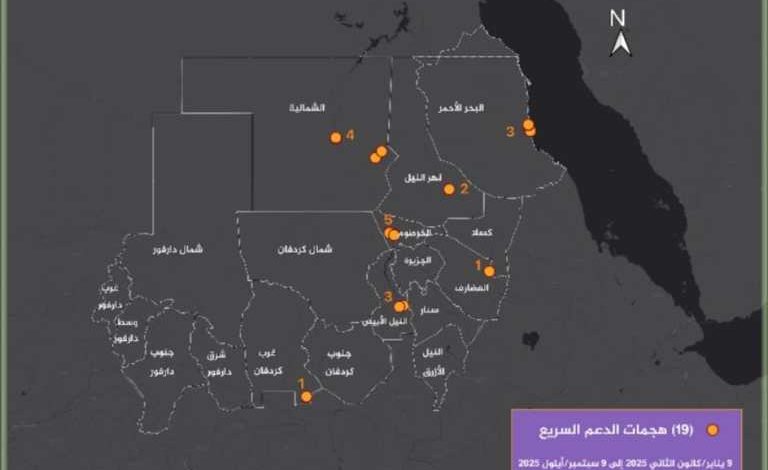
The strikes—carried out using drones—were recorded across several states, most notably Khartoum, the Northern State, and the Red Sea State, totaling 19 documented incidents.
According to an analysis conducted by Sanad fact-checking unit at Al Jazeera, an interactive map was developed to illustrate the geographic distribution of these attacks between January 9 and September 9, 2025. The map was based on open-source intelligence, official statements from both parties, and corroborated with satellite imagery to verify the extent of the damage.
The documented sites include attacks in seven states under Sudanese army control, targeting power stations, dams, fuel depots, and a water facility.
One of the most significant incidents involved repeated strikes on the Marawi Dam’s transformer station between January and April. This critical facility suffered substantial disruption, cutting power supplies to large areas and impacting the daily lives and essential services of thousands of civilians. The attack drew widespread condemnation from Emergency Lawyers, the Secretary-General of the Arab League, and the Sudanese government spokesperson, who described the RSF’s actions as violations of international law that endanger civilian lives and exacerbate their suffering.
In March, the RSF deliberately sabotaged the Qumayr water station in Omdurman, resulting in severe water shortages across large parts of the city, according to the Khartoum Water Authority.
On September 9, the RSF launched a fresh strike on the al-Murakhiyat power station in Omdurman—its second assault following a May attack. The Ministry of Energy and Petroleum condemned the targeting of critical electricity and fuel facilities, noting that the sites were undergoing maintenance to ensure essential services for Khartoum residents. The ministry also reported that the RSF attacked the Heglig oilfield and airport in South Kordofan the previous week, killing five people.
Fuel depots in the Nile River, White Nile, and Red Sea states were also targeted in separate incidents.
UN human rights expert Radhouane Nouicer expressed deep concern over the escalation of drone strikes on vital infrastructure. A report by the Office of the High Commissioner for Human Rights stated that these attacks have severely hindered civilians’ access to essential services.
Electricity cuts were among the most damaging consequences, directly affecting the supply of drinking water. With power stations down, water treatment and pumping facilities halted operations, forcing residents to rely on unsafe sources such as the Nile River. This has fueled the spread of waterborne diseases, including cholera, posing serious health risks to civilians, particularly children and the elderly.
On September 9, the RSF-aligned “Government of Tasis” claimed responsibility for the latest strike in Khartoum, insisting it had targeted military and logistical sites supporting the Sudanese army’s war effort.
Satellite imagery analyzed by Sanad confirmed extensive damage at several locations, including the al-Shawak power station in Gedaref State, the Marawi Dam power station in the Northern State, and fuel depots in Port Sudan, Red Sea State.