Taasis Government… A State Built on the Shoulders of Victims
Sudan Events – Agencies
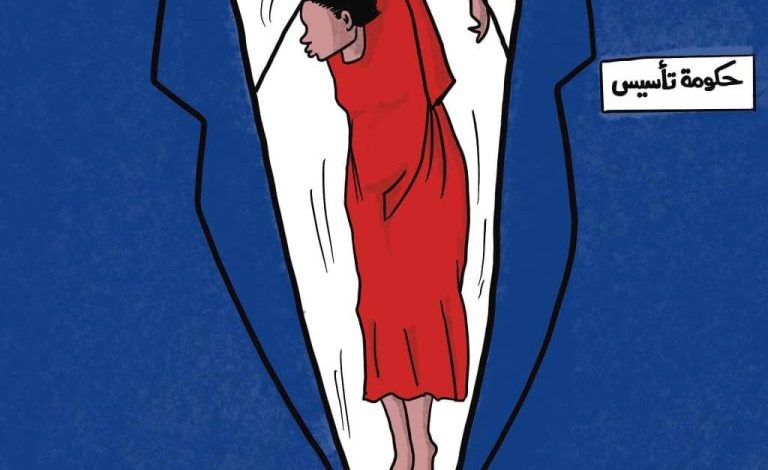
The caricature that has recently dominated public discourse cannot be dismissed as mere satire; it is a fully formed political statement. In the image, a towering man in an elegant suit bears an identification card reading “Taasis Government.” Yet the shocking detail lies within the suit: a Sudanese woman in a red dress, abducted, hanging by her neck, confined within the folds of the fabric as if she were a lifeless body.
This image is not a fleeting fantasy; it is a precise reflection of a bitter reality. The woman in the caricature is not just an individual—she symbolizes the entire Sudanese people, particularly the women at the heart of Darfur’s suffering, where the Janjaweed/RSF militias have committed the most heinous crimes: abduction, rape, hanging from trees, and systematic humiliation.
A Polished Facade… and a Crime Behind the Curtain
The elegant suit represents the outward appearance of the so-called “Founding Government,” presented to the world as a step toward state-building. In reality, it is merely a political façade controlled by the same militias stained with blood. What appears as “founding” is nothing more than a veneer for crime, an attempt to legitimize a power born of violence.
The woman’s red dress is not a trivial artistic choice—it is a stark symbolic message: the blood of victims, the wounds of women turned by the Janjaweed into instruments of collective humiliation. Every attempt by this authority to wear the mask of politics is pierced by the blood beneath, revealing its true nature.
Sudanese Women: From Victims to Symbols
The woman trapped within the suit is no accident. Sudanese women in Darfur bore the initial brunt: abducted from their villages, displaced, hung from trees in scenes reminiscent of slavery. In the caricature, she becomes a symbol of a people kidnapped, trapped within a regime that denies their humanity.
It is not merely an individual tragedy but a national one, where the female body becomes the theater of political struggle, a tool to spread terror, and a message to local and international powers: “We hold absolute control.”
Founding on Blood… Is This Building?
The political project called the “Founding Government” seeks to market itself as a new beginning. But what kind of foundation is built on systematic violence? What state can arise from the blood of innocents?
The caricature delivers a clear visual message: no founding without justice, and no legitimacy for those who derive power from the barrel of a gun. Governments built on the bodies of women and children do not establish a nation—they entrench ongoing crimes.
A Message to the World
This caricature speaks not only to Sudanese citizens but also to the international community. It exposes attempts by regional and global capitals to whitewash the “Founding Government” as part of the solution. The message is clear: do not be deceived by the elegant suit; inside lies crime, an abducted woman, and a people crushed daily.
Art as a Weapon of Resistance
In this piece, art becomes a form of resistance. The artist requires neither lengthy discourse nor a human rights report; a single brushstroke encapsulates the entire scene: a founding government in a formal suit, yet carrying its hanging victims in its chest.
This type of caricature is not intended to amuse but to reveal the mask and provoke questions. It is a visual trial of a system attempting to conceal its crimes behind the façade of statehood.
Conclusion
The “Founding Government” presented today is nothing but a militia-led administration with a civilian façade. The caricature declares it plainly: there can be no founding on blood. The woman suspended within the suit is not merely a victim but a symbol of a kidnapped nation, of a Sudan that refuses to become a project cemented by the Janjaweed under an official guise.
It is a visual outcry summarizing the Sudanese struggle: a fight for dignity, justice, and freedom against a regime intent on building its future on the remnants of the present.
[9/15, 8:07 PM] Just Me: Sudan Welcomes Peace Efforts to End War with RSF, Rejects Foreign Intervention
Sudan Events – Agencies
Sudan on Saturday welcomed efforts to end the ongoing war in the country and attacks carried out by the Rapid Support Forces (RSF) paramilitary group, while reaffirming its rejection of any foreign interference in its internal affairs, according to Anadolu Agency.
“The Sudanese government welcomes any regional or international efforts to help end the war, halt the terrorist attacks by the RSF on cities and infrastructure, and lift sieges on urban areas to prevent the repetition of tragedies and crimes against the Sudanese people,” the U.S. State Department said in a statement.
The statement followed a joint declaration by Egypt, Saudi Arabia, the United Arab Emirates, and the United States calling for a “humanitarian truce” in Sudan to enable swift access for aid across the country.
The ministry reiterated its rejection of any “international or regional intervention that does not respect Sudan’s sovereignty, its legitimate institutions, and its right to defend its people and territory.”
It also expressed regret over the international community’s failure to compel the RSF to implement UN Security Council Resolutions 2736 and 1591, lift the siege on Al-Fashir, alleviate the suffering of its citizens—including the elderly, women, and children—and allow humanitarian convoys to pass.
Al-Fashir has witnessed intense fighting between the Sudanese army and the RSF since May 2024, despite international warnings about the risks of violence in a city that serves as a major humanitarian hub for the five states of Darfur.
The RSF and the army have been engaged in a brutal struggle for power since April 2023, resulting in thousands of deaths and pushing Sudan into one of the world’s worst humanitarian crises.
According to the United Nations and local sources, more than 20,000 people have been killed and 15 million displaced. However, U.S.-based researchers estimate that the actual death toll may reach 130,000.
Target Civilians
A military source told Al Jazeera that the Rapid Support Forces (RSF) carried out drone strikes early this morning on several cities in the White Nile state in southern Sudan, including the state capital, Kosti.
The source confirmed that the Sudanese army’s air defenses, stationed with the 18th Infantry Division in Kosti, successfully shot down several drones targeting the cities of Rabak, Kosti, and Kenana.
Some of the drones were reported to have targeted the Kenana army airbase, the headquarters of the 18th Infantry Division in Kosti, the Um Dabakir electrical substation in Rabak—which is the largest of its kind in the country—and fuel depots, before being intercepted by air defenses.
Vital and strategic installations in Kosti have been repeatedly targeted by RSF drones.
The Sudanese Sovereign Council described the attack as a “continuing violation amid suspicious regional and international silence,” adding that “this war is directed against the Sudanese people.”
In Al-Fashir, the capital of North Darfur in western Sudan, military sources told Al Jazeera that the RSF shelled residential neighborhoods with heavy artillery. The city has been under siege and facing clashes for over 500 days.
Abbas Youssef, the Humanitarian Commissioner of North Darfur, accused the RSF of causing the forced displacement of Sudanese residents in Al-Fashir. He told Al Jazeera that “the RSF prevents food and humanitarian aid from entering the city, while daily shelling of IDP camps, shelters, and residential neighborhoods continues.”