American Newspaper: In Sudan’s El-Fasher, Those Not Killed by Bombing Die of Hunger
Sudan Events – Agencies
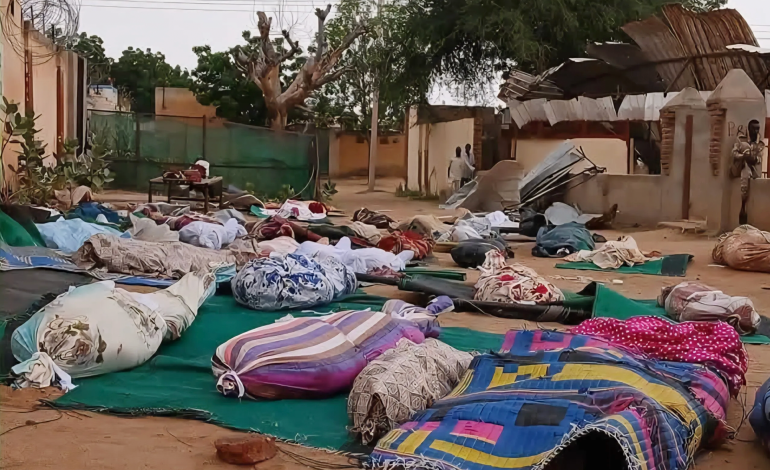
In El-Fasher, the capital of North Darfur in western Sudan, death is no longer a possibility but a certainty. Those trapped inside the siege face famine, disease, and relentless bombardment. Those who try to flee risk abduction, rape, or execution—marking one of the most harrowing humanitarian tragedies of modern times.
This is the grim picture painted by The Washington Post in an in-depth report by field correspondents Katharine Houreld and Hafiz Haroun.
According to the report, El-Fasher—the last stronghold of Sudan’s army in Darfur—has become an epicenter of suffering under a deadly blockade that encapsulates the broader Sudanese catastrophe.
Since April 2023, the city’s more than 250,000 residents have faced impossible choices: remain and endure starvation, disease, and airstrikes, or attempt to escape—only to fall into the hands of the Rapid Support Forces (RSF), who abduct civilians, extort them, and subject women and children to rape.
A catastrophic situation
The paper describes the city’s healthcare system as “catastrophic,” noting that out of 36 hospitals and clinics, only one is partially functioning, while doctors are in hiding for fear of being targeted.
The main water station has been repeatedly hit, leaving the city parched. Cholera is spreading among a population already weakened by hunger. Families survive on scraps of groundnut shells meant for livestock feed or on wild grasses.
According to The Post, even venturing out to look for food has become a deadly gamble: men risk summary execution, while women and girls are kidnapped. One father recounted how his 14-year-old daughter and 16-year-old niece were raped by armed men, while the latter’s mother was killed by shelling as she sought treatment.
Economic collapse has deepened the misery: markets have crumbled, flour now sells for as much as $30 a kilogram, and millet for $53, residents told the newspaper.
The journalists said they spoke with or exchanged voice messages with a doctor, a volunteer medic, three aid workers, and six civilians. Several provided photos and videos to corroborate their testimonies, though they asked not to publish them for fear of RSF reprisals. Their accounts, the reporters noted, align with aid agency data and other reports from inside the city.
“Death is everywhere”
“Death is everywhere,” one resident told The Post, echoing others who described RSF actions as amounting to crimes against humanity—“even genocide,” a designation echoed by the United Nations this month.
From space, the siege is visible. Satellite images from Yale University’s Humanitarian Research Lab show a 31-kilometer earthen wall erected by the RSF encircling El-Fasher.
The paper warns of echoes of the massacre in El-Geneina, West Darfur’s capital, in May 2024, where nearly 15,000 people were killed.
The humanitarian situation continues to deteriorate, The Post adds, with international aid suspended since April after UN convoys were bombed. Despite U.S. and Arab calls for a three-month humanitarian truce, the RSF has shown no willingness to comply.
Relentless displacement
Meanwhile, displacement continues. More than 600,000 people have fled in the past 16 months. Many head toward the small town of Tawila, now overwhelmed with 800,000 displaced people and grappling with a cholera outbreak.
Along escape routes, corpses lie by the roadside. Survivors speak of arbitrary arrests and exorbitant ransoms demanded at checkpoints. Those unable to pay remain detained in makeshift camps, sleeping under trees in degrading conditions.
Among the countless tragedies is that of Fatima, a 31-year-old woman who lost three of her four children when the RSF attacked Zamzam camp, once home to half a million displaced people. Her husband was wounded and disappeared while searching for them. Fatima now shelters with her eldest daughter in a dilapidated school housing dozens of families, under constant threat of bombardment.
Endless horrors
The onslaught on El-Fasher shows no sign of abating. In August, artillery fire killed several children, including a three-year-old girl who was torn apart before her mother’s eyes. In September, a drone struck a mosque during dawn prayers, killing more than 50 worshippers.
Yet even in these dire conditions, doctors continue working secretly inside homes. They dress wounds with mosquito nets instead of gauze, and use hot water instead of disinfectant. Still, they refuse to leave, insisting their patients need them.
Source: Al Jazeera Net, reporting on The Washington Post