Sudanese Civilians Survive on Tree Leaves as Food Runs Out in Besieged Cities
Sudan Events – Agencies
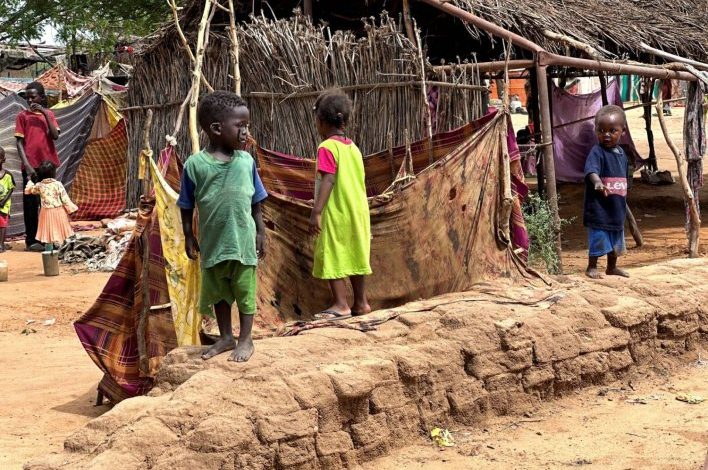
Desperate Sudanese civilians trapped amid fierce fighting between the army and the Rapid Support Forces (RSF) are struggling to survive in besieged cities across western Sudan, where no aid has reached for months and food has virtually disappeared.
Now entering its third year, the war in Sudan has killed tens of thousands and created a famine threatening millions. Entire populations are cut off in cities under RSF siege, deprived of food, medicine, and basic services, as diseases spread unchecked.
The Agence France-Presse (AFP) spoke with residents in three major cities currently encircled by the RSF — El Fasher in North Darfur, Kadugli, and Dilling in South Kordofan — where civilians recount scenes of devastation and hunger.
“Everything Has Disappeared”
“In El Fasher, shelling goes on all day, so most of the time we stay in the shelters we dug near our homes,” said Omar Adam, who fled Abu Shouk Camp on the city’s outskirts to the Al-Daraja neighborhood. Residents have resorted to digging shallow shelters in open spaces and in front of their houses for protection from bombardments.
In recent months, the RSF has intensified attacks on army-held positions in western and southern Sudan, after the army regained control of key cities in central and eastern regions.
The RSF has laid siege to El Fasher for over 500 days, trapping an estimated 260,000 civilians — half of them children — in a city where humanitarian aid has almost completely ceased, according to the UN.
“Everything has disappeared, even ambaz,” Adam said, referring to a type of animal fodder made from sesame and peanut husks. “It’s too expensive and unsafe to leave the city now.”
Last week, UN humanitarian coordinator Denise Brown reported accounts of “unlawful killings, kidnappings, and arbitrary arrests” of civilians attempting to flee El Fasher.
Satellite images analyzed by Yale University’s Humanitarian Research Lab revealed that the RSF has built a 68-kilometer-long wall encircling the city, leaving only one exit — where civilians are reportedly extorted to pass through.
Halima Issa, a mother of three who lost her husband to artillery fire, said her family now relies entirely on a communal kitchen, known locally as Al-Takiya, which provides free meals to residents.
“When the Takiya stops, we don’t eat,” she said. “If one of the children falls sick, there’s no treatment.”
According to the El Fasher Resistance Committees, the price of a single sack of ambaz has exceeded 2 million Sudanese pounds (about $600 USD), an impossible sum for most families.
At El Fasher Hospital, one of the few medical facilities still functioning after widespread destruction of the city’s health infrastructure, a doctor who requested anonymity described a desperate situation.
“There are no medicines left — even gauze is gone,” he said. “We now use mosquito nets to wrap wounds, and it’s nearly impossible to sterilize tools for surgeries or remove shrapnel without disinfectants.”
The Resistance Committees described the city as “an open morgue, bleeding from every direction.”
In a statement this week, they said: “Shells rain down like water, leaving bodies pulled from under the rubble — no names, no faces. Just numbers in a long record of massacres.”
Hunger in South Kordofan
In South Kordofan, the RSF’s siege of Kadugli has left residents surviving on a single meager meal per day — or none at all.
“Sometimes we have no food for days, so we eat tree leaves and wild plants,” said Hajer Juma, 28.
Hassan Ahmed, a volunteer doctor at a children’s hospital, said: “People die in front of us every day — deaths that could have been easily prevented under normal circumstances. There are no medicines, and pharmacies are almost empty.”
The UNICEF warned that 63,000 children in South Kordofan are suffering from severe acute malnutrition.
The RSF and its allied militias have also encircled Dilling, another key city in the region.
“Prices double every day — no family can keep up,” said Mujahid Musa, a 22-year-old resident. “Many are fleeing the city, only to end up displaced in nearby villages.”
Relief volunteer Sadiq Issa reported that “security forces” — referring to the army — had seized a shipment of UNICEF-provided nutritional biscuits and sold them on the black market.
He and other witnesses also accused the army of withholding aid sent by the World Food Programme, preventing it from reaching the most vulnerable.