Washington Talks… What’s the Point?
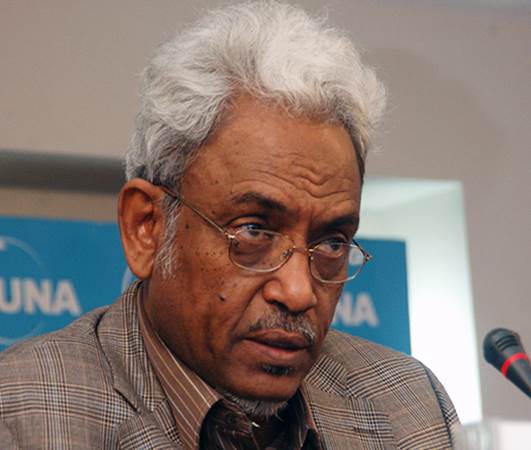
By Dr. Amin Hassan Omar
The Sovereignty Council has denied any direct or indirect negotiations between the government and the militia in Washington—and we believe them. Perhaps, for now, the United States is content to speak with each party separately, later attempting to formulate solutions that might, by coincidence, gain acceptance from both sides. This possibility cannot be ruled out and does not contradict the official denial of indirect talks.
However, the problem does not lie in negotiating with the militia. I doubt that any government official would dare provoke the anger of the army and the public through such a reckless move. Personally, I am convinced by the assurances of the head of the Sovereignty Council that there will be no acceptance of any future role for the militia in Sudan’s political or military life.
Yet, if we trace the crisis back to its roots, we find that it did not begin with the militia’s rebellion against the state. It began as a deliberate and well-planned effort by known international and regional actors to reshape Sudan’s political, economic—even cultural—landscape in a way that serves their own interests, regardless of what benefits or harms the Sudanese people.
At the forefront of these actors stands the United States of America. Its narrative regarding Sudan—before and after the war—has never changed: Washington refuses to recognize any legitimate authority, military or civilian, unless that authority has already aligned itself with what America and its allies consider the “politically correct” course for Sudan. The U.S. does not care whether Sudan is ruled by soldiers, civilians, kings, or princes. What matters to Washington are its own strategic interests in the country. Chief among these is ensuring that Sudan does not again become a state defying American will. In practical terms, this means full normalization with Israel, complete subordination to U.S. policy, and granting Washington everything it demands from what former President Trump once described as “that small hole called Sudan, located in the big pit of filth called Africa.”
Mr. Trump does not want a loyal Sudan—he wants a submissive one. This means that Washington will not tolerate diversified alliances: Sudan must not turn to China, Russia, or any other country to meet its military or economic needs, even when the United States is unwilling to do so itself. Keeping China and Russia out of Sudan—and out of Africa—is an openly declared objective. Moreover, Washington wants Sudan to become an integral part of its Red Sea security arrangements, deemed vital for Israel’s safety. It also seeks to expel Chinese, Russian, and Turkish partners from Sudan’s mineral and rare-earth sectors, monopolizing these resources for America and its regional allies.
But the central question remains: Is the United States qualified to make peace in Sudan?
It is well known that solving a problem depends on defining it correctly. If the definition is accurate, then the solution—though difficult—is at least possible. But does the U.S. definition of Sudan’s war reflect reality? Every ordinary, uneducated Sudanese knows how flawed the American understanding is. Washington views the conflict as a civil war—a mere power struggle between two ambitious generals. It sees both sides as equal in legitimacy, making no distinction between a militia it has itself described as a war criminal organization and the national army, a century-old institution with an honorable record of service at home and abroad.
America refuses to recognize the army’s authority and instead seeks to replace it with a handpicked civilian group, unelected, failed, and corrupt—by all fair accounts, both domestic and foreign. Yet this does not bother Washington as long as that group gives the “politically correct” answers according to the American standard of correctness, which has nothing to do with good governance or Sudan’s vast potential.
The U.S. appoints itself as a mediator, choosing its own partners for mediation without regard for Sudan’s objections—even though it is now well known that some of those “partners” are not mediators at all but allies of the militia. Then, Washington expects the Sudanese government—which it does not even recognize—to impose upon its army and people whatever “solutions” this mediation dictates. Afterward, Sudan is expected to step aside and allow America and its partners to install their chosen rulers.
In all of this, the United States shows no concern for the suffering of the Sudanese people, their demands, or their aspirations. It offers no compensation for the immense destruction caused by the militia and its backers. Indeed, Washington has done nothing to build confidence in its mediation role; it has returned Sudan to the list of sanctioned states and punished the head of state and several honorable patriots—not for any crime, but simply for defending their homeland, dignity, and sovereignty.
For all these reasons, I ask: Why is the Foreign Minister traveling to Washington? Does he believe that talks there will change America’s narrative? Or is this another uncalculated, ill-advised maneuver? Anyone who thinks that dialogue with Washington will alter its strategy toward Sudan—a strategy that forms part of a broader regional policy—is merely indulging in wishful thinking. And as experience has shown, wishful thinking is often nothing more than a waste of time and money.