Displaced People from El Fasher Reveal Harrowing Details to Al Jazeera Net
Sudan Events – Agencies
Amid scattered remains, the stench of corpses, and the fear that hangs over the death-filled streets of El Fasher, Adam and the few surviving members of his small family managed to escape that hell toward the unknown—after a year and a half under bombardment and extreme hunger that forced them to eat animal fodder.
Adam, who witnessed nearly 300 clashes between the Sudanese army and the Rapid Support Forces (RSF), told Al Jazeera Net: “I had only two choices: either stay in El Fasher and wait for certain death by gunfire, as happened to dozens of my relatives, or attempt an escape through dangerous, rugged routes.”
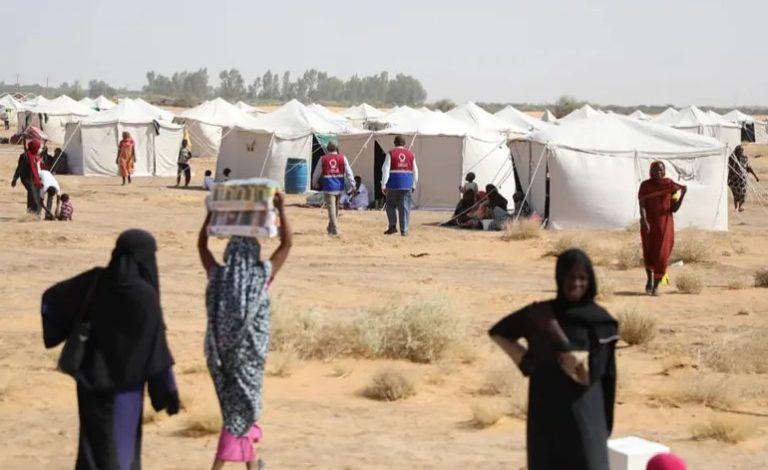
After a grueling displacement journey, he eventually made it to safety and began a new life upon reaching the “Qatar Al-Khayr” camp for the displaced from El Fasher in the Debbah area. The camp had been established early on by Qatar Charity—with support from the Qatar Fund for Development—to absorb the influx of thousands escaping El Fasher, even before their arrival, and to help them live with dignity.
Shared Suffering
Reem, another displaced woman from El Fasher, endured no less hardship during her longer and more grueling escape before reaching the Qatar Al-Khayr camp in northern Sudan.
She told Al Jazeera Net that the situation in the city—which they fled as the “deliberate starvation crisis intensified”—had become unbearable due to the RSF siege before the group fully seized control. “There was no food or safety. Anyone who tried to bring food into the city was executed in cold blood. We saw the bodies of many of our relatives who had tried to deliver even a small amount.”
Reem showed her right forearm, bearing scars from shrapnel caused by an exploding projectile that narrowly missed her and killed others around her. Her left leg now suffers from near paralysis after she was shot by a sniper in El Fasher. She explained that their escape took nearly a month, most of it on foot, after militia forces looted the vehicles transporting them and abducted some women and children to demand ransom under threats and gunfire.
She added that she saw children crying from hunger until they died, and the same happened to many elderly people who couldn’t endure the starvation. Even animal fodder—which families shared with livestock during the siege—became extremely expensive.
Qatar Charity’s Intervention
Emergency Qatari assistance helped end the suffering of Reem and thousands of other women who managed to flee to Debbah during the recent escalation of fighting. “When we arrived, we knew nothing and had no one,” she said. “But everyone welcomed us warmly, and Qatar Charity provided essential food and shelter supplies.”
When Adam arrived with the elderly and children from his family, they were immediately housed in pre-prepared tents, and the Qatar Charity field team provided food baskets and medical aid. He noted that support from donors in Qatar—both for the camp and for the communal kitchen providing meals—relieved much of their distress.
Adam revealed that “Adam” is a pseudonym he chose to protect the remaining members of his family still in El Fasher. “The militia monitors the media closely. If my identity is revealed, they might kill my family or demand ransom.”
Qatar Charity, as part of its emergency humanitarian response, established and now operates the Qatar Al-Khayr camp in Debbah to provide shelter, water, and food to those displaced from El Fasher, in addition to offering health and education services for three months—with support from the Qatar Fund for Development.
Its field teams have begun implementing interventions in shelter, food security, non-food items, clean drinking water, and the distribution of urgent necessities—including tents, mats, blankets, and family hygiene kits.
Tariq Mohiuddin, acting director of the Qatar Charity office in Sudan, told Al Jazeera Net that the intervention plan includes a series of humanitarian initiatives: distributing thousands of food baskets, providing a daily meal through a communal kitchen, supplying shelter kits, hygiene packs, cooking utensils, mobile clinics, clean drinking water, a temporary school, and additional services.
Speed and Effectiveness
Othman Ahmed Othman, acting governor of Northern State, praised the speed and effectiveness of Qatar Charity’s response, saying that the food, shelter, and health assistance would help absorb the initial shock experienced by the displaced—especially as the state receives large numbers of people “from all directions.”
Al-Hassan Ibrahim Hamid, head of the Emergency and Crisis Committee in Debbah, told Al Jazeera Net that tens of thousands more displaced people are expected to arrive. So far, around 7,000 families have fled El Fasher and other parts of Darfur under extremely dire circumstances—with some injured, others amputated, and nearly 50% suffering from malnutrition, especially women and children.
He explained that before Qatar Charity’s intervention, only about 100 tents had been secured for the displaced. The organization’s decision to support 3,300 families with shelter, food, and health services brought reassurance. He called for urgent expansion of water and sanitation services, construction of latrines, provision of mosquito nets and blankets, cooking supplies, health interventions, and lighting—due to the prevalence of scorpions in the area.
It is worth noting that Sudanese Sovereignty Council chairman Abdel Fattah Al-Burhan and several ministers recently visited the displaced from El Fasher in Debbah to inspect their conditions—praising the efforts of benefactors in Qatar and the various grassroots initiatives working to ease the humanitarian crisis.
Source: Al Jazeera Net