Tawila: Child of War and Refuge for Survivors
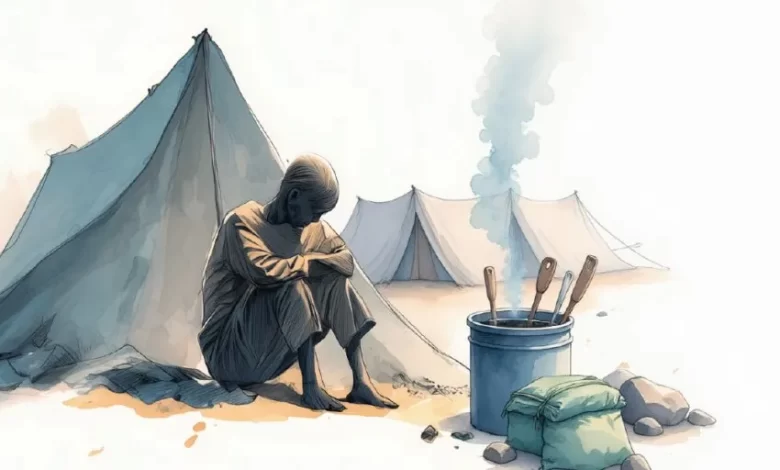
On November 14, Tom Fletcher, the UN Under-Secretary-General for Humanitarian Affairs, visited the Tawila area. During his visit, he said that the suffering experienced by the displaced “cannot be expressed in words.”
There is no precise count of the displaced in Tawila, but it is estimated that approximately 30,000 people arrived with the latest wave of displacement following the fall of El Fasher, while around 600,000 to 700,000 displaced persons arrived since the Rapid Support Forces (RSF) took over the Zamzam camp on April 11, according to Imran, a member of the Tawila Emergency Room (“ATR”).
According to the International Organization for Migration (IOM), more than 400,000 new displaced people have arrived in Tawila since April 2025, in addition to around 80,000 who were already present.
Imran explained that Diba Naira camp is the largest camp around Tawila, with other camps including Tawila East, Tawila West, Tina, Mertal, Masal, and Tanduba. The Norwegian Refugee Council reports that displaced people are accommodated in 20 shelter sites, including 11 within Tawila, of which four new camps—A, B, C, and D—alone host around 213,099 people, and nine other sites are in surrounding areas.
Other camps include Rwanda, Dali, Diba Naira, Argo, Bargo, Tawila Al-Umda, City of Tawila, Hilla Na’ma, Dubu Al-Umda, and Tenger Reservoir. According to Imran, the Tawila Emergency Room provides urgent response services rather than fixed programs. It fills gaps in emergency needs, evacuates those stranded en route to Tawila, and operates about 30 kitchens in the weeks following the fall of El Fasher, providing shelter materials such as blankets and mats, as well as supplies for women.
Tawila and surrounding camps now accommodate more displaced persons from El Fasher in recent weeks. ATR receives support from various organizations, including international ones, after submitting needs assessments, and also from local donors and community contributions. Despite the presence of many emergency rooms, such as Jebel Marra and Safe Women Units, needs still exceed response capacity, especially in water, food, shelter, and healthcare, as diseases such as malaria and cholera challenge health centers and aid organizations.
Hanaa, a member of the Tawila Emergency Room, described the displaced’s situation as dire, noting the pervasive grief: “Most families have lost their sons and daughters, and some families are left with only one member. The sorrow they live in is indescribable; they have nothing for themselves and need immense aid, far beyond what we can provide.”
She added that the team strives to be ready to save newcomers from hunger and thirst, preparing 2–4 meals daily, with 22 emergency rooms cooking collectively. Despite 31 kitchens operated by ATR and others by associations and charities, the needs remain unmet. Hanaa stressed the urgent need for water and shelter materials, especially with winter approaching.
She emotionally described the challenges: “Some have only a single mat or a piece of cloth used for shade by day and as a blanket at night. We prepare rice and pasta with meat for newly arrived families, delivering food via ‘tuk-tuks’ while people line up to receive a meal. Women have specific needs; menstruation does not stop for war, and it deeply affects me that women cannot access sanitary pads. Some women have only one set of clothing. Safe spaces are needed for women, especially those traumatized or who suffered sexual assault. Small projects for women could help distract them from traumatic memories, though forgetting such experiences is nearly impossible.”
Since the Beginning of the War
When the war broke out on April 15, citizens of Tawila found themselves under immediate siege, unable to access farms or leave the city due to armed looting along the route from El Fasher. Some army and police units had already withdrawn, while others evacuated forces from East Jebel Marra to Tawila and then to El Fasher.
A witness recounted that on June 13, 2023, an attempted withdrawal failed after clashes with RSF, which sparked further conflict. On June 16, RSF attacked Tawila city and the displaced camps, clashing with forces entrenched in the garrison. Civilians were severely affected, and markets were looted.
Despite a three-day truce brokered by Saudi Arabia and the USA on June 18, clashes continued, and RSF renewed attacks on June 19, eventually taking control of Tawila. Muhammad Ya’qub recalled: “It was a dark and sad day; the garrison fell, some troops withdrew to El Fasher, RSF ravaged the city, committing violations against civilians. Our family lost all property, part of our home burned, and we fled to Nivasha camp in El Fasher, only returning a year and a half later.”
RSF occupied the city for over 30 days, burning homes to signal allied militias and warn nearby villages. At night, some residents risked returning to salvage what they could.
Since September 2023, the Sudan Liberation Movement (SLM) led by Abdel Wahid Mohamed Nour took control of Tawila after clashes with RSF. In early October 2024, SLM and the Sudan Liberation Forces led by Taher Hajar announced forming a Neutral Force to protect civilians. However, the force no longer exists due to Hajar joining a new coalition.
Current Situation in Tawila
Muhammad Ya’qub explains that current residents are either returning residents or newly displaced seeking safety. Camps have expanded and merged with the city, such as Rwanda camp to the north, now separated only by a dirt road, and Bargo camp to the west. Three camps—Tawila Al-Umda, Diba Naira, and Shakshko—are south of the Wadi, about 3 km from the city.
Displacement has changed daily life: “People now use ‘karo’ carts for transportation between neighborhoods and markets,” previously used only in farms. Water sources vary between wells powered by motors or solar energy, while some require buckets (“Saniya”). Water is transported in barrels on karo carts, sometimes purchased at 3,000 SDG per barrel.
Trade and agriculture remain main income sources, with a significant rise in street vendors, especially children and displaced persons working in local farms. The city’s market has expanded, new shops were built, and parks, cafes, and tourist areas have emerged. Employment with organizations operating in Tawila is now a key source of income.