Foreign Minister: We Will Not Accept Any External Impositions
Agencies – Events
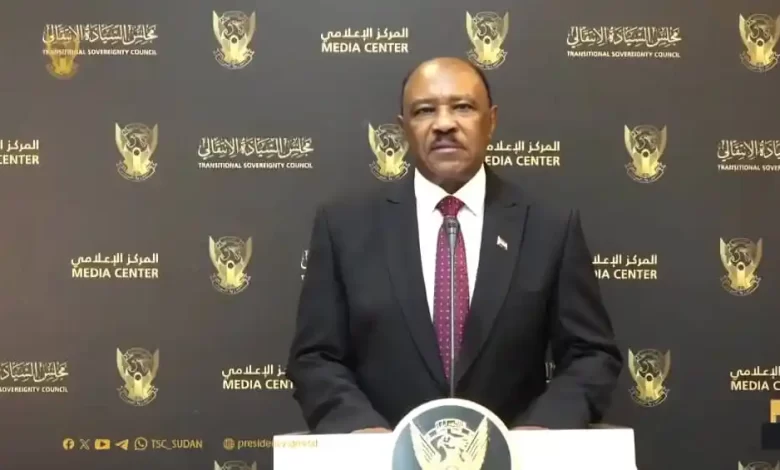
Sudanese Foreign Minister Mohieddin Salem emphasized that Sudan will not accept any externally imposed solutions, asserting that the country possesses a long-standing legacy in managing wars and building peace, which enables it to determine its political path independently.
In a press conference on Wednesday, the minister stated that Sudan “is not a country that waits for someone to dictate how it negotiates or builds peace,” adding that the Sudanese people and armed forces have been “masters of war and peace throughout history.” He highlighted key moments in which the army directly participated in peace-making, from the 1972 Addis Ababa Agreement to the 2005 Nairobi (Naivasha) Agreement and the 2006 Darfur Agreement.
Salem added that negotiation is a purely sovereign matter, and no external party has the right to impose conditions or dictate the political process. He said, “We negotiate when we decide, and we make peace when we decide, not when it is imposed upon us.”
The minister noted that the international and regional communities have failed to compel the Rapid Support Forces (RSF) to implement the Jeddah Agreement, asserting that this proves Sudan’s crisis is not one of governmental will but of armed rebellion supported by external forces.
He called on the international community to classify the RSF as a “terrorist organization,” stating: “The massacres and crimes committed by this militia in Al-Fashir, Al-Jeneina, and other areas leave no room for ambiguity.”
Salem affirmed the Sudanese government’s commitment to the roadmap it submitted to the United Nations, noting that any ceasefire arrangements must be based on the full implementation of the Jeddah Agreement, not bypassing or ignoring it.
He also referred to the recent speech by the Commander-in-Chief of the Armed Forces, Lieutenant General Abdel Fattah al-Burhan, which emphasized national decision-making independence and rejection of external impositions, adding that statements by the Council of Ministers and the Security and Defense Council align with this unified official position.
Salem stressed that Sudan will continue to defend its sovereignty, warning against “any attempts to reshape the crisis at the expense of the Sudanese people,” and urged citizens to uphold their country’s stance against the “externally supported terrorist militia.”