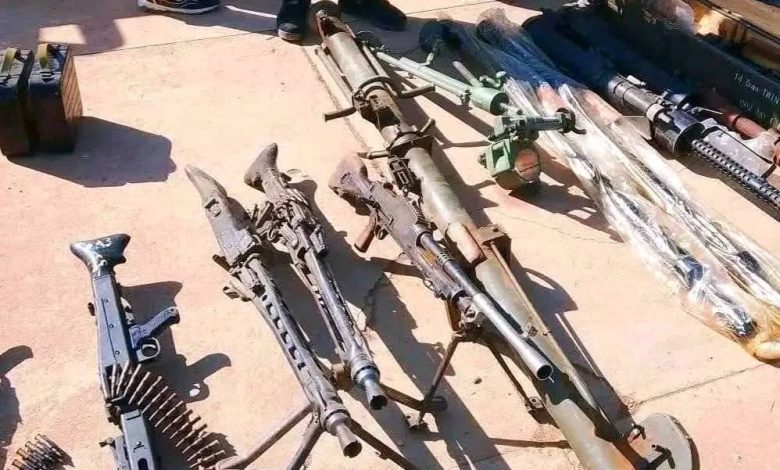
Khartoum: Advanced Weapons and Combat Vehicles Among Seized Items in Security Campaign
Sudan Events – Agencies
Joint forces from the army, security services, intelligence, and police are currently conducting operations targeting areas with concentrated informal settlements, peripheral districts, and neighborhoods from which residents have filed complaints. Specific locations identified as hubs for storing looted property—gathered from citizens’ homes and held for later resale—are also being targeted. Much of this stolen property has long served as the main commodity traded in several makeshift markets that sprang up across the city.
In these markets—such as the well-known “Daglo Market,” found in many areas—sellers openly advertise stolen goods. Improvised stalls and shacks, uprooted from various locations, have been re-erected in these new markets. Vendors do not conceal the nature of their merchandise; one had even written on a stolen kiosk: “Furniture—its owners have fled.” Among their notorious sayings are: “If you want the market, follow the stolen goods,” “The shirt’s owner is dead,” and “East Nile chairs are excellent.”
Khartoum lived through a terrifying ordeal, caught between the gunfire and shells of the Rapid Support Forces (RSF) and the bullets of looters who raided homes, leaving nothing behind—not even electrical wiring, floor tiles, or zinc roofing sheets. These looters spread throughout the city under RSF protection, stealing what even the RSF themselves had not taken. They assaulted homes and established full-fledged markets for their stolen goods. Witnesses to that period in Khartoum know exactly where these looted items went: they were transported in trucks, donkey carts, tuk-tuks, and rickshaws to informal settlements or to buildings seized for use as storage sites. Many perpetrators impersonated law enforcement or military personnel, and women were also involved, specializing in removing valuables from abandoned homes. Numerous residents were killed or threatened for attempting to stop the theft of their own property or that of their neighbors.
Abdelmonem al-Sir, a primary-school teacher, recounts: “I only left for a short trip to visit my children in Shendi. When I returned, I found that after the RSF withdrew, others had completely overrun the area.”
He added: “I’m from Wad Nubawi. I didn’t leave even during the fierce battles near army positions in Karari. I left only when RSF militants stormed our homes, beat us, and ordered us to leave, accusing us of being army collaborators. When I left, my home was intact except for damage to the front gate caused by a shell that exploded in the street.”
He continued: “When we returned, we found thieves openly looting homes and clashing with residents. One of them even asked us why we had come back.”
According to him, “They were no less criminal than the RSF. They stole everything they could reach, ransacked homes, and stayed inside for hours until tuk-tuks and rickshaws arrived to load the stolen items.”
Authorities are now moving directly to address both past and ongoing crimes, as theft has not completely stopped despite sustained efforts to contain it.
Retired Police Major General Yasser Saad al-Din says the situation requires “daily operations, checkpoints, inspections, and intelligence work because the chaos that engulfed Khartoum was vast and affected everything—from vehicles to kitchen utensils. Everything was looted, stolen, and transported to storage sites.”
He added: “Some stolen items—especially vehicles—have already left Khartoum and may have left the country. But household furniture and other goods remain. Police have recovered some of them, while others are still missing. Recent police campaigns have certainly recovered many items, but the issue is that most were never reported stolen, which is alarming.”
He continued: “I know that many people believe their belongings will never return. But they must file a report and come to identify recovered items—many families have already found their possessions this way. The joint force conducts daily operations based on intelligence and has achieved real results on the ground, recovering property and arresting perpetrators to bring them to justice.”
He added: “I urge citizens to file reports, follow up, and identify recovered belongings. This is your property and your right—don’t give it up.”
Saad al-Din also noted that large quantities of weapons have been seized in many areas, and recently, military vehicles were recovered in Omdurman—highlighting the scale of the threat.