Sudanese Source to Al Jazeera Net: Ethiopia Training and Arming the Rapid Support Forces

Sudan Events – Agencies
A Sudanese official source has stated that Ethiopia, with support from other actors, has established a military camp on its territory to train the Rapid Support Forces (RSF) and has provided them with logistical services. The source warned that Addis Ababa’s miscalculation of this move could ignite a war with Khartoum.
Khartoum – Official Sudanese sources told Al Jazeera Net that Sudan is bracing for the possible opening of a new military front in the east, after neighboring Ethiopia allowed the establishment of a training camp for the RSF and foreign mercenaries affiliated with it, with the goal of attacking the Blue Nile region, which borders Ethiopia.
Government sources—speaking on condition of anonymity—explained that Ethiopian authorities have coordinated militarily with the RSF through supportive regional powers. Agreements were reportedly made on supply routes, the construction of training camps, and the preparation of airstrips.
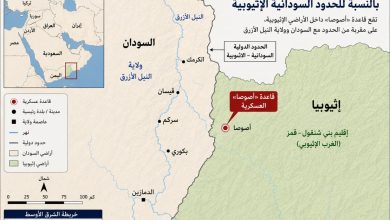
According to the same sources, movements of supplies, combat vehicles, artillery systems, and jamming equipment have begun arriving through Asosa, the capital of Ethiopia’s Benishangul-Gumuz region, adjacent to Sudan’s Blue Nile region and home to the Grand Ethiopian Renaissance Dam (GERD).
Training and Supply
The government sources further revealed intelligence coordination between the Ethiopian army, the RSF, and the Sudan People’s Liberation Army-North (SPLA-N), the military wing of the Sudan People’s Liberation Movement-North (SPLM-N) led by Abdelaziz al-Hilu and commanded in the Blue Nile region by Joseph Tukka. Tukka’s forces operate in pockets across the region and along the border strip with South Sudan’s Upper Nile state.
Platforms close to the Sudanese authorities released additional details on the new developments in the war, reporting that the Ethiopian training camp for the RSF can host more than 10,000 fighters. The camp is located in the Mangi and Al-Ahmar areas in Ondlu locality and is reportedly overseen by Ethiopian General Getachew Gudina, in coordination with foreign officers whose countries back the RSF.
The foreign elements being trained include mercenaries from South Sudan and fighters from Latin American countries—most notably Colombians—along with RSF members who fled battlefronts in Sudan and were later regrouped and transported from Darfur.
These reports also stated that logistical supplies for the camp arrive through the Somali port of Berbera and Kenya’s port of Mombasa before being moved into Ethiopia.
Joseph Tukka—who operates his main base in the Sudanese border region of Yabus—has reportedly received recently delivered drones used in attacks in recent days targeting Damazin, the capital of the Blue Nile region, and the town of al-Kurmuk near the Ethiopian border. The drones were launched from Yabus, Maklaf, and Balila.
The weapons, combat equipment, and logistics reportedly pass through the Benishangul capital toward the villages of Aboramo, Ashoguli, and Ahufundo, then onward to Qashen, about 30 km from Yabus. From there, they are supplied to the RSF and SPLM-N forces, which maintain several camps in the area. Drone supplies are transported by air.
Warnings
Ismail al-Amin, a university professor specializing in African affairs, believes the establishment of an RSF training camp inside Ethiopian territory marks a dangerous escalation in regional intervention in the Sudanese conflict.
Unless met with a decisive Sudanese, regional, and international response, al-Amin told Al Jazeera Net, the war will enter a new and more brutal phase that threatens security and stability in the Horn of Africa, where Sudan and Ethiopia are the region’s two largest states and hold significant geopolitical importance.
He added that, given Ethiopia’s economic pressures and internal tensions in some of its regions, Addis Ababa is unlikely to have the financial capacity to wage a new major war. Any military involvement in the Sudanese conflict could further destabilize Ethiopia internally, especially since Khartoum possesses leverage that could harm its neighbor’s security—due to the shared borders and the presence of armed opposition groups close to the frontier.
“Edge-Pulling Strategy”
Political writer and analyst Youssef Abdel-Mannan described the developments on Sudan’s eastern border as part of an “edge-pulling” strategy. According to him, the RSF’s military and logistical supplies now flow through eastern Libya, the Central African Republic, Chad, South Sudan, and most recently Ethiopia.
He compared the current situation to events of the mid-1990s, when Washington attempted to topple former President Omar al-Bashir’s government through “Operation Thunderbolt,” during which Uganda, Ethiopia, and Eritrea supported the Sudan People’s Liberation Army (SPLA), led by John Garang. The operation included simultaneous attacks on Sudan’s southern and eastern borders from all three countries, aimed at toppling the government or forcing it to sign a peace agreement with the rebels.
Since the early weeks of the Sudan war, Ethiopia has demonstrated growing closeness with the RSF and its allied political forces. Addis Ababa hosted their officials during the July 2023 IGAD summit, prompting the Sudanese delegation to walk out in protest.
Statements by Ethiopian Prime Minister Abiy Ahmed at the time angered Khartoum, after he claimed that Sudan was experiencing a leadership vacuum and called for deploying African forces and imposing a no-fly zone.
Abiy Ahmed later visited Port Sudan in July 2024 for talks with Sudan’s Transitional Sovereignty Council Chairman Abdel Fattah al-Burhan to ease tensions and mediate between Khartoum and Abu Dhabi. Ethiopian intelligence chief Redwan Hussein also visited Port Sudan in July 2024 on a mission whose outcomes were not disclosed.
Source: Al Jazeera Net