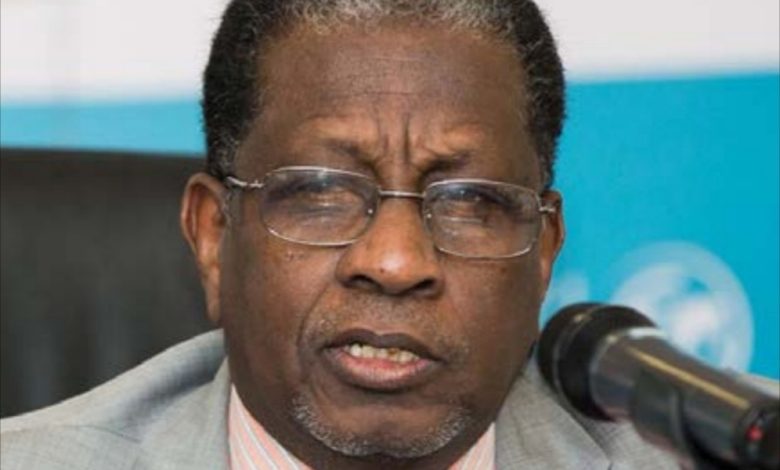
Al-Tijani Abdel Qader Hamed
One of the greatest military surprises of World War II—one that led to the collapse of the theory of static territorial defense—was the German army’s ability, during its attack on the French front, to carry out a swift and unexpected flanking maneuver. By advancing through Belgium and bypassing the Maginot Line, German forces forced France to its knees. (The Maginot Line consisted of underground concrete fortifications stretching some 300 miles along the Franco-German border, the construction of which took ten years of deep excavation work.)
While German ground forces were only a few miles away from Paris, and German aircraft controlled French airspace, a British delegation led by Winston Churchill—accompanied by the minister of war and the chief of the general staff—arrived on an urgent mission to assess what could be done to support the French leadership, which was teetering on the brink of moral and military collapse.
The British delegation found their French allies in a state of confusion and panic. They also discovered that the headquarters of the French high command—responsible for directing the war effort and housing the prime minister and senior military leaders—contained nothing more than a single telephone installed in a restroom. That phone was constantly occupied due to delays in securing communications and the incessant shouting.
At the meeting, French leaders asked their British allies to send whatever reinforcements they could, foremost among them a squadron of British fighter planes to be thrown urgently into battle. They argued that this was the “decisive moment” upon which the fate of the French front—and the national security of both allies—depended.
The British delegation, however, had other calculations. They believed it possible to separate French national security from British national security. Based on this illusion, they bluntly told their French allies that this was not the decisive moment, that British fighters would remain in Britain, and that they would not risk them. Giving up those aircraft, they said, would mean destroying Britain’s own chances of survival.
France was thus forced to swallow the bitterness of military defeat at the hands of Nazi Germany, as well as the bitterness of betrayal by its British allies. It later became clear that Britain had committed a grave strategic error and would pay a heavy price for it.
With the end of that extraordinary historic meeting, the shared destiny between Britain and France came to an end, and the balance of power shifted decisively in favor of Nazi Germany. German forces swiftly overran French territory in May–June 1940, and France surrendered after just six weeks of resistance on 22 June 1940.
French Prime Minister Paul Reynaud (1878–1966) resigned under political and military pressure and was replaced by General Philippe Pétain, who signed the armistice with Nazi Germany—delivering a fatal blow from behind to Britain. He accepted humiliating German terms that divided France into two parts: a northern zone under direct Nazi occupation and a southern zone ruled by Pétain from the town of Vichy. (It should be noted that General Charles de Gaulle rejected defeat and fled to lead the resistance from abroad.)
Britain, left to face its fate alone, soon realized that the collapse of the French state would not serve its interests. On the contrary, it posed a new military and security threat in addition to the German one. Although French forces had ceased fighting Germany—a tragic and shameful end—it was not the end of Britain’s troubles. French weapons and ammunition were likely to fall into German hands, voluntarily or otherwise, forcing Britain to confront a victorious German army equipped not only with its own arsenal but also with what remained of the surrendered French military—especially the vast French navy scattered across the globe, which had not yet entered the war.
Britain understood that if the French fleet joined the German and Italian navies, it would pose an existential threat. The French navy included large numbers of warships and submarines positioned in strategic locations, particularly in North Africa (Algeria, Morocco, Egypt) and Southeast Asia. Reluctantly, Britain decided to seize, disable, or, if necessary, destroy the French fleet. Field commanders were instructed that “His Majesty’s Government is determined that, should the French refuse the options presented, their naval vessels must be sunk and destroyed.”
Fighting erupted between the former allies. French and British sailors sabotaged their own warships to prevent them from falling into enemy hands—while the enemy rubbed its hands in glee.
One month after the fall of Paris, German aircraft launched a massive assault on London, as expected. In swift strikes, they penetrated nearly all British defensive lines, destroyed airfields, aircraft factories, railways, and docks, and carried out daylight bombing raids over London for ten consecutive days. Within two weeks, Britain lost a quarter of its air force personnel, and nearly 500 aircraft were destroyed.
This was a catastrophic outcome by all measures. Instead of meeting German forces over Paris, as the French had requested, British aircraft were forced to confront them over London. Instead of losing a few planes defending France, Britain lost a third of its air power defending its own capital. Instead of fighting alongside France against Germany, Britain was compelled to fight its former ally’s navy to prevent it from being used by Germany and Italy.
Had it not been for U.S. President Franklin D. Roosevelt’s intervention on Britain’s behalf at the “decisive moment,” London might have fallen as Paris did.
Which brings us to Sudan: Has the decisive moment arrived in Sudan’s war? Will Sudan’s allies and neighbors adopt Britain’s stance of abandonment, or America’s stance of rescue? Will General Abdel Fattah al-Burhan assume the role of Pétain the surrenderer, or that of de Gaulle the resister? And if the Sudanese state collapses and the war expands, will the region enjoy security and stability—or will regional maps be redrawn, as Netanyahu and others desire?
The Decisive Moment in Sudan’s Battle
When the Sudanese army lost the battle of El Fasher (October 2025), the battle of Babanusa (November 2025), and then withdrew from the Heglig oil region (December 2025), pessimists argue that only one battle remains—in the city of El Obeid. If that battle is lost, militia forces and their backers would gain full control over Darfur and Kordofan in western Sudan, opening the road toward Khartoum and then the new capital, Port Sudan, on the western shore of the Red Sea—before the eyes of Egypt and Saudi Arabia. This is a terrifying scenario.
An even more horrifying scenario is one in which the Sudanese army is forced to surrender and the state disintegrates after successive military defeats and regional and international abandonment. In that case, General al-Burhan might play a role similar to that of General Pétain—God forbid—handing over parts of his forces, equipment, and airfields to the militias, voluntarily or otherwise. Other forces might fragment into rival militias driven by grievance and revenge. Militias would proliferate from the Libyan desert to the Red Sea, each seeking backing, funding, training, and arms from neighboring states.
At that point, Egypt, Saudi Arabia, and the international community—if it still exists—would realize too late that the nature of the conflict in Sudan had changed, that external powers were fueling and expanding it, and that it now threatened regional security. They would discover, too late, that the best way to defend their own security was to enable Sudan to defend itself at the decisive moment—when it was fighting for survival in El Fasher, Babanusa, Heglig, and El Obeid. They would realize that Egypt’s and Saudi Arabia’s backs were exposed when Sudan’s back was broken.
A Final Lesson
During World War II, President Roosevelt explained to Americans how U.S. national security was inseparable from Britain’s. He said:
“Suppose my neighbor’s house catches fire, and I have a long garden hose. If he can take my hose, connect it to his faucet, and put out the fire, what do you think I should do? I don’t say to him: ‘My hose cost me fifteen dollars—you must pay me first.’ I don’t say that. I say: ‘I don’t want the fifteen dollars. I want my hose back after the fire is out.’”
Roosevelt concluded:
“There is no doubt in the mind of any American that the most immediate way to defend the United States is by Britain’s success in defending itself.”