Nairobi Declaration… Rituals at the Threshold of Noise
Report – Sudan Events
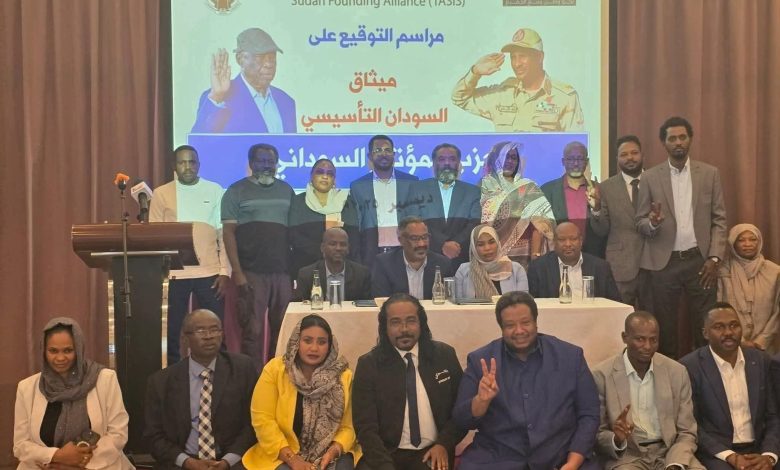
Political forces announced last week that they had reached an agreement signed in Nairobi aimed at creating a unified civilian and political voice, in addition to signing legal memoranda calling for the designation of the Islamic Movement, the National Congress Party, and their fronts as terrorist organizations.
Wajdi Saleh, a member of the Arab Socialist Ba’ath Party—one of the signatory groups—said that out of 12 to 15 issues discussed, the parties arrived at three main papers: agreement on principles under the title The Sudanese Declaration of Principles for Building a New Homeland; affirmation of confronting terrorism and resisting attempts to derail the September Revolution; discussion of core issues related to ending the war; and legal memoranda demanding the classification of the Islamic Movement, the National Congress Party, and their fronts as terrorist organizations.
The question here—before and after the signing—is whether this truly represents Sudan’s problem today. Will a paper issued by these political forces resolve the crisis and stop the war? Or is it merely another political-media declaration, like hundreds of previous declarations and conferences held by these forces that failed to move the reality of Sudanese people in any way—often without attracting any attention at all?
This is precisely what Al-Tayar newspaper’s Editor-in-Chief, Osman Mirghani, pointed to when he asked: “What comes next, and what is the final outcome of such signings?” He added: “With complete certainty, no one asks the question, and no one expects an answer—for the simple reason that in Sudan’s political arena, productive action is not required as much as fame and media exposure, even without tangible results. Media outlets publish news and photos of meetings with foreign and American delegations, or appearances on European Union platforms or other parliaments, and in the end nothing changes.”
He continued: “If I were to list the political memoranda we celebrated signing, space would not suffice.” He added that there are, in his view, two reasons for this: first, the doctrine of political work in Sudan does not value effectiveness, nor does it include any criteria for measuring impact on reality or tangible returns—making competition revolve solely around photo opportunities and signatures. Second, the Sudanese political sector believes that signing a piece of paper is sufficient to solve a crisis.
The declaration was met with widespread criticism and sarcastic commentary from the Sudanese street, which viewed it as a repetition of previous declarations that ended in silence, oblivion, and even a lack of acknowledgment by their own signatories—some of whom later spent years asserting that those declarations granted them legitimacy to govern the state and dominate its resources.
El-Yasa’ Mohamed Nour, a political affairs researcher and director of the Nour Center for Strategic Studies, said the problem with these forces—addicted to speaking in the name of civil society—is that they do not learn from their experiences. “Every failed experiment leads them to another failure. If they reviewed their own records, they would find that what was said in these workshops has been said before, and that these decisions and signatures were made previously. There is nothing new—neither at the level of ideas nor in their approach to Sudan’s crisis. They are still repeating the same phrases they used before the revolution that toppled Bashir, and they have not even changed their vocabulary.”
He added: “Look, for example, at their meeting to declare the Islamic current a terrorist group at a time when the Rapid Support Forces are killing people across the country, squandering millions, looting, killing, and committing acts unprecedented in Sudan’s wars. Yet they do not mention the RSF’s atrocities—not even in a single line—and instead proceed to condemn the Islamic current. What will the citizen gain now from condemning the Islamic current?”
He continued: “Even if we assume that the ‘Keizan’ ruled for many years and committed grave crimes, were they the ones who stormed people’s homes, raped women, executed people in cold blood, and scattered them into pieces with shelling? Were they the ones who devastated the country and spread destruction throughout it?”
He said: “These groups have fallen outside the course of history—not because an Islamist demonized them, but because they demonized themselves and chose a strange position by supporting the killers of the people. It is bizarre that those who claim to represent the people and speak on their behalf are the very ones defending and backing the killer. Do these parties truly represent the Sudanese people? And how can the Sudanese people accept representation by those who dance with joy over the corpses of their dead?”
He concluded: “Setting aside all their previous positions, why did they ignore, in their declaration, even a simple condemnation of the Rapid Support Forces for what they have done—and are still doing—in El-Fasher?”