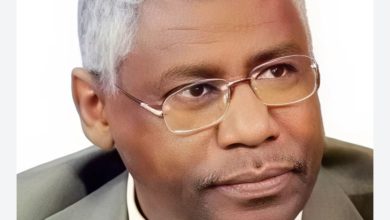
Soft Janjaweedism

Osman Jalal
(1)
The widely acknowledged mercenary Hemedti was a product of the power vacuum created by the withdrawal of the Islamists’ hard power from the institutions governing the state between 1999 and 2013, as a result of internal schisms that tore through the national Islamic movement and its experiment. Until the fall of President al-Bashir in April 2019, Hemedti was little more than a guard dog, grasping politics and its logic no better than a sieve holds water.
We offered sincere advice to the more rational leaders of the Forces of Freedom and Change (FFC) on the necessity of dissolving the Rapid Support Forces (RSF) before the revolutionaries left the sit-in square. However, an unrestrained lust for power overwhelmed the revolution’s slogans and values. Hemedti was transformed into one of the icons of the December 2018 revolution and even became its central point of attraction. The FFC alliance sought to lean on him to counter the Islamist current (“Hemedti will scare the Islamists”), while General al-Burhan also clung to him to safeguard his own authority against any internal military challenge.
The ultimate outcome of this political orbiting around Hemedti was the weakening of the parent military institution and the fragmentation of civilian political forces. In contrast, the RSF’s political, economic, and military empire expanded massively. Hemedti became the second most powerful man in the state and built an extensive network of regional and international relations. His ambitions then soared, prompting the “flying boy” to attempt a full seizure of power and crown himself king of Sudan.
(2)
Hemedti would not have dared to carry out his bloody coup against the Sudanese army on April 15, 2023, without support and political cover from civilian political forces, necessary to market the coup domestically and internationally. He found this backing among FFC leaders, who participated with him in political and media planning, deception, and the deliberate misleading of army commanders. They were even prepared to mobilize their supporters to take to the streets in support of the coup and to form a new government from the Republican Palace by midday on the day the coup was launched.
(3)
However, when the plot backfired and the coup conspiracy collapsed in the face of the legendary resilience of the army and supporting forces, and as the Sudanese people rallied behind their armed forces, instructions were issued by the Emirati sponsor to the leaders of FFC/Sumoud to shift to “Plan B.” This plan involved playing the role of soft Janjaweedism—by repeatedly promoting the narrative of a “third party” allegedly igniting the war between the army and the RSF.
The purpose of this narrative is to sap the morale of the Sudanese people and discourage them from rallying and fighting alongside the army in the battle for national honor, by portraying the war as merely a struggle over power and governance rather than an existential war aimed at stripping Sudan of its statehood, looting its resources, humiliating its communities, and dismantling their inherited cultural, moral, and ethical norms.
Through this fabricated narrative, the FFC/Sumoud leadership also seeks to sow discord and fractures within the Sudanese army, and to practice intellectual and political intimidation against the army leadership to push it into excluding the base of the national Islamist current that is fighting alongside the army and the people in the trench of the Battle of Dignity—ultimately dragging al-Burhan into a long-term confrontation with them. But such designs are doomed to fail.
(4)
The ultimate objective behind these soft Janjaweed roles is the strategic weakening and exhaustion of the Sudanese army and the creation of a balance of power on the battlefield that would force the military and state leadership into negotiations and a political settlement. Such a settlement would reproduce the terrorist Dagalo militia and its civilian political wing—represented by Sumoud and Ta’sis—returning them to the forefront of power and the political scene.
Yet this is wishful thinking. The Battle of Dignity is, above all, a battle of awareness and enlightenment. The deeply rooted consciousness across Sudanese society today transcends ideological, political, and regional loyalties, uniting with the Sudanese army to confront the Janjaweed until their crushing defeat—or negotiations conducted on the basis of surrender.