Hemedti: The Man of Deadly Illusions
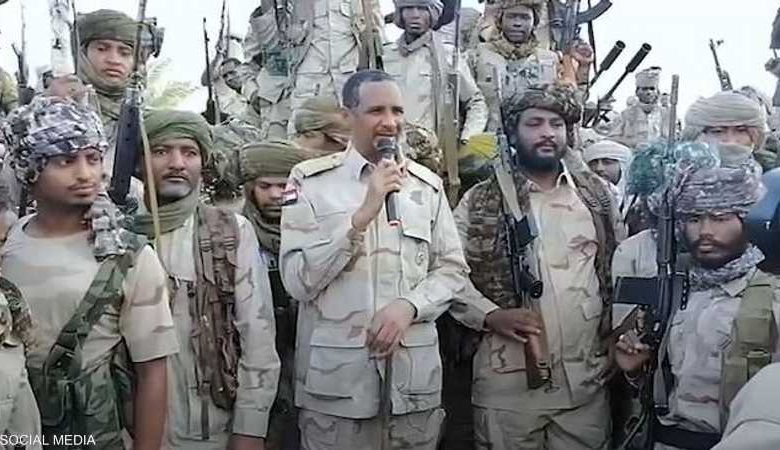
Report – Sudan Events
His absence from the scene has undeniably had an impact on the course of events. This is a fact. But to what extent did that impact matter? Would his presence have altered the trajectory of the war or the proposed peace initiatives? Could his involvement have imposed a degree of control that might have prevented the conflict from spiraling into its current state — marked by the expansion of the war, the widening of combat operations, and the growing scale of violence and genocide committed by the militia?
Would his political ambitions for power have served as a deterrent, restraining the militia from spilling Sudanese blood, as some believe? And was the militia itself ever an organized army over which Hemedti could truly exercise control? What ultimately happened to him, and where did he end up? Did he achieve through war what he failed to accomplish while serving as Vice President of the Sovereignty Council?
There are numerous accounts regarding the fate of the commander of the Rapid Support Forces (RSF). What is consistent across all versions, however, is that he sustained a serious injury in the early days of the war as a result of an airstrike in Khartoum. He was reportedly transferred to Fadil Clinic in central Khartoum, then to East Nile Hospital. It is widely claimed that he lost his left eye and had a leg amputated — information confirmed by most militia commanders who were later captured. Some stated that they personally witnessed Hemedti’s transfer from Fadil Clinic to East Nile Hospital, where doctors attempted emergency surgeries that ultimately resulted in the amputation of his leg and the loss of his left eye.
Commanders who recently defected from the militia said Hemedti was later transferred to the United Arab Emirates for further treatment. However, he reportedly remained absent from managing militia affairs, and it remains unclear whether he is still alive or has died, as access to him is said to be restricted even for those close to him. Other accounts suggest that he was killed in Khartoum and buried somewhere in East Nile.
The central question remains: would his presence have changed the reality of the fighting and brought the war to an end? Or would it have enabled the militia to occupy the entire country and impose military and political control?
Ramah Abdelbaqi, who closely followed Hemedti’s military and political trajectory within Sudan’s landscape, says his absence initially had a noticeable effect on the militia. “At the very least, he was the media and political voice of the forces,” Abdelbaqi said. “He also controlled the money, coordination, and leadership. With his disappearance, matters became chaotic and fragmented.”
He explained that all agreements concluded before the war — both domestically and internationally — were brokered by Hemedti himself, while those around him, including his brothers, merely executed his decisions. Following his absence, dealings began to take place directly between Emirati officials and Abdelrahim Dagalo, who, according to Abdelbaqi, is fundamentally different from his brother in managing relationships.
“Hemedti, whether we like it or not, was more intelligent than all his brothers combined,” Abdelbaqi said. “He was the one who orchestrated conspiracies, negotiated deals, bought loyalties, and planned the seizure of the Sudanese state in partnership with the Emiratis. They found in Abdelrahim an ideal model — a man who follows orders without question and draws no red lines in engagement, unlike Hemedti, who sought Emirati support to achieve his own ambitions while guaranteeing their interests.”
Abdelbaqi added that, years later, he does not believe Hemedti’s return would change anything. “The dynamics have shifted,” he said. “The Emiratis now manage the militia’s political and media apparatus, while the militia itself has devolved into gangs scattered across cities and villages. It has turned into a project of looting, killing, rape, and pillage, with no connection to governance or state control.”
He noted that with the killing of most senior leaders, looters within the militia have effectively become its new leadership. “The militia has become their means of acquiring spoils,” he said. “At the same time, the UAE can no longer dispense with these criminal leaders, because it knows that stopping them from fighting would mean losing the war.”
“In any case,” Abdelbaqi continued, “I do not believe Hemedti’s reappearance would change anything — neither on the battlefield nor in political decision-making. The militia today consists of criminal enclaves fighting to preserve their existence and what they have gained through looting and theft. They also fear accountability for their crimes and understand, given society’s determination to hold them accountable, that they will not be safe within their own local communities.”
He stressed that the current reality is fundamentally different from what Hemedti had envisioned. “Hemedti sought to swallow the state and reengineer it demographically, based on illusions he and his inner circle long promoted,” he said.
Describing Hemedti as “the head of the snake,” Abdelbaqi said he was the one who led “these killers, looters, and mercenaries” into Khartoum. “Had time turned back, he would have led them once again to kill and spill blood,” he said, adding: “What has happened to him is only a fraction of what he inflicted on millions of Sudanese.”
According to Abdelbaqi, Hemedti is now, based on available information, disconnected from events, sidelined, and stripped of any role by the very state that once employed him — and employed others like him.