Exclusive: Tracking Emirati Cargo Flights Linked to the Sudan War from Israel to Ethiopia
Sudan Events – Agencies
The news website Middle East Eye has revealed that a cargo aircraft previously linked to supplying UAE-backed fighters in Sudan and Libya with weapons has carried out a series of flights in recent days between military bases in Abu Dhabi, Israel, Bahrain, and Ethiopia.
While the purpose of these flights, or any direct connection between them, remains unclear, they have taken place against the backdrop of an escalating struggle for influence between the United Arab Emirates and Saudi Arabia across Yemen and the Horn of Africa—a rivalry that has reshaped the region’s geopolitics and raised fears of a new escalation in the Sudan war.
The UAE has retreated into a defensive posture after Saudi Arabia launched a military move to oust the Emirati-backed Southern Transitional Council from the Yemeni port city of Aden. The UAE was also forced to withdraw from its main military base in Bosaso, on Somalia’s opposite coastline.
At the same time, Israel’s recognition of Somaliland—where the UAE maintains another military base and controls the port of Berbera—has further destabilized the regional order and fueled speculation that Ethiopia, a close ally of Abu Dhabi, may be prepared to take a similar step in exchange for access to Berbera port.
The war in Sudan between the Sudanese Armed Forces (SAF) and the Rapid Support Forces (RSF), which began in April 2023 and has triggered the world’s largest humanitarian crisis, has now become firmly embedded in this broader conflict. Saudi Arabia—alongside Egypt and Turkey—has intensified its military support for the Sudanese army in an effort to counter the UAE’s long-standing backing of the RSF.
Uncertainty surrounding the UAE’s bases in Berbera and Bosaso, following the Somali government’s cancellation of all agreements with Abu Dhabi, has led to the redeployment of Emirati personnel to Ethiopia. According to multiple sources, including a former adviser to the Ethiopian government, Ethiopia has now become central to the UAE’s regional strategy.
The adviser, who worked with the Addis Ababa government for more than a decade, said Prime Minister Abiy Ahmed “clearly appears to see Ethiopia’s future in firmly aligning with the Emirati axis rather than other options.” The source added: “Some within Ethiopia’s foreign ministry and elsewhere believe the UAE has been steering Ethiopia’s position on the Sudanese government, the RSF, and Eritrea’s Assab port over the past two years,” referring to the Eritrean port that Abiy Ahmed was “on the verge of invading last year at Abu Dhabi’s behest.”
Jalel Harchaoui, a political analyst specializing in North Africa and political economy, told Middle East Eye that since the outbreak of the Sudan war, “the UAE has acted faster, more boldly, and with greater financial commitment than any other foreign intervenor.” However, he added that “Saudi Arabia’s victory over the UAE in Yemen late last year boosted Riyadh’s regional credibility,” and that the Saudis are now “spending heavily to change the trajectory of the war in Sudan.”
Pakistani officials recently told Reuters that negotiations are at an advanced stage over a defense package worth approximately $1.5 billion, including JF-17 Block III fighter jets, K-8 attack aircraft, and more than 200 drones for the Sudanese Armed Forces.
Harchaoui said: “While many regional actors will adjust to Riyadh’s moves, Ethiopia will not. Addis Ababa will stick with the UAE. That is why Emirati military operations are being concentrated on Ethiopian territory, in preparation for a major offensive after Saudi moves disrupted other launch points.”
Emirati Cargo Flights
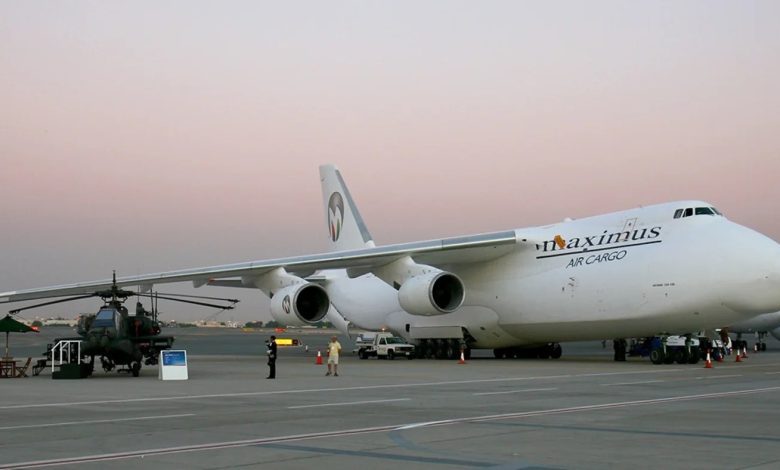
Flight-tracking data analyzed by Middle East Eye in recent days revealed a pattern of repeated flights between Abu Dhabi and Harar Meda Airport—the main base of the Ethiopian Air Force—by an Antonov An-124 cargo aircraft operated by Maximus Air and registered as UR-ZYD.
The An-124 is known as the world’s largest military transport aircraft. Maximus Air describes it as capable of carrying “21 Toyota Land Cruisers or four Mi-17 helicopters with ease.”
On January 3, the aircraft flew from Abu Dhabi International Airport to Harar Meda, landing at 9:12 a.m. local time before departing again at 10:45 a.m. back to Abu Dhabi. On January 12, it flew again to Harar Meda, this time departing from Al Dhafra Air Base in Abu Dhabi, landing at 10:50 a.m., and returning at 1:34 p.m. The same trip was repeated for a third time on January 15.
On January 17, the aircraft flew once more from Al Dhafra to Harar Meda, before heading to Addis Ababa’s Bole International Airport. From there, on January 18, it flew to Marseille, France, then to Taraz Airport in Kazakhstan the same day. On Monday, it flew from Taraz to Guangzhou Airport in China, and on Tuesday it was recorded flying from China to U-Tapao International Airport in Thailand.
Suspiciously, just days before its first flight to Ethiopia on January 3, the aircraft conducted three round trips between military airbases in Bahrain and Israel. On December 28 and 29, it departed from Sheikh Isa Air Base in Bahrain and appears to have landed at Ovda Air Base of the Israeli Air Force in the southern Negev desert. On December 31, it again flew from Sheikh Isa to Ovda, returning this time to Abu Dhabi.
Nathaniel Raymond, executive director of Yale University’s Humanitarian Research Lab (HRL), which monitors the Sudan war, said: “Evidence that an An-124—given the sheer cargo capacity of this airframe—was conducting repeated sorties between Abu Dhabi and an airfield near an area of growing RSF presence and operations should be a matter of global concern. If it is proven that these flights are the result of the UAE supplying the RSF, Ethiopia should follow its neighbors and immediately deny the UAE and its proxies access to Ethiopian airspace.”
A Sudanese intelligence source said the RSF recently purchased “at least six fighter jets”—including Sukhoi Su-24s and MiG-25s—which typically originate from Serbia, a country with growing ties to the Emirati defense contractor International Golden Group. The source said the aircraft—including wings and engines—are dismantled and transported by cargo planes from the UAE to Ethiopia or to Kufra, an airbase in eastern Libya controlled by the Libyan Arab Armed Forces loyal to General Khalifa Haftar.
Middle East Eye contacted the UAE and Ethiopian foreign ministries, the RSF, and Maximus Air for comment. The UAE has denied supporting the RSF, which has been widely accused of committing genocide in Darfur.
Haftar Connection
Maximus Air, headquartered in Abu Dhabi, describes itself as “the UAE’s largest cargo-only airline.” It is part of Abu Dhabi Aviation (ADA), which is majority-owned by the investment firm ADQ, chaired by UAE National Security Adviser Sheikh Tahnoun bin Zayed Al Nahyan. According to the group’s latest reports, its clients include “the General Command of the Armed Forces, the Crown Prince’s Court, the Ministry of Foreign Affairs, and many other government entities.”
However, the company’s operations have previously drawn scrutiny from a UN Panel of Experts investigating Emirati sanctions violations and arms transfers to Haftar. In a 2021 report, the panel accused the company of breaching a UN arms embargo on Libya, identifying 12 suspicious flights by UR-ZYD between Assab in Eritrea and Marsa Matrouh in Egypt. The panel said the flights were part of a covert Emirati air bridge supplying Haftar with weapons—forces that later continued to support the RSF in Sudan.
At the time, Lana Nusseibeh, then UAE ambassador to the United Nations, said the allegations were “false” and that the Emirati government denied them “in their entirety.”
In June last year, militias allied with Haftar helped the RSF seize control of the Sudanese portion of the tri-border area between Sudan, Egypt, and Libya. Middle East Eye tracked numerous UAE-linked cargo flights to Haftar’s Kufra airbase, which served as a major supply hub for the RSF.
Now, Saddam Haftar, Khalifa Haftar’s son, is reportedly under Saudi pressure to halt assistance to the UAE in backing the RSF. Egypt, which has intensified its support for the Sudanese army, has begun bombing RSF supply convoys near its territory. On Monday, a “temporary closure” of Kufra airbase was announced for runway “maintenance” for one month, despite the runway having been refurbished as recently as February 2024. The closure is believed to be designed to give the Haftar family time to choose between the UAE and Saudi Arabia.
Kholood Khair, a Sudanese policy analyst, said: “The Horn of Africa is now at the mercy of what happens in Riyadh and Abu Dhabi. We are witnessing the entrenchment of this Gulf imperialism that we have seen over the past five years… Many countries in the region are now making decisions based on which Gulf state they will align with.”
Mohammed bin Zayed Flights
The 2021 UN report estimated that each flight by UR-ZYD delivered cargo equivalent to up to 18 military vehicles and identified Mohammed bin Zayed—now UAE president and then crown prince of Abu Dhabi—as the aircraft’s beneficial owner. The panel said it was “not convinced of the accuracy of the documentation provided by Maximus Air.”
Open-source investigators have also linked the same aircraft to UAE arms supplies to the RSF via Chad. In September 2023, the flight-tracking account Gerjon highlighted 16 flights between Abu Dhabi and N’Djamena over five months. The same account had previously identified the aircraft as being used to supply Ethiopia with weapons during the 2021 Tigray war.
Maximus Air did not respond to requests for comment. Abu Dhabi Aviation Group’s 2022 and 2023 annual reports emphasized the company’s “humanitarian mission” in support of UAE efforts to assist refugees and displaced persons, noting that it transported two Mi-17 helicopters from China to Uganda in 2023 as part of a UN peacekeeping mission in the Abyei region.
The links between aircraft UR-ZYD and Mohammed bin Zayed appear to extend beyond alleged arms transfers. Last month, the aircraft was part of a cargo convoy accompanying the Emirati president on an official visit to Pakistan. Regional media reported that Mohammed bin Zayed was also there to take part in the annual houbara bustard hunting season—a bird highly prized in the region and whose meat is believed to possess aphrodisiac properties.