By the Numbers and Analysis: What Do Displaced People Need to Return to Their Homes?
Sudan Events – Agencies
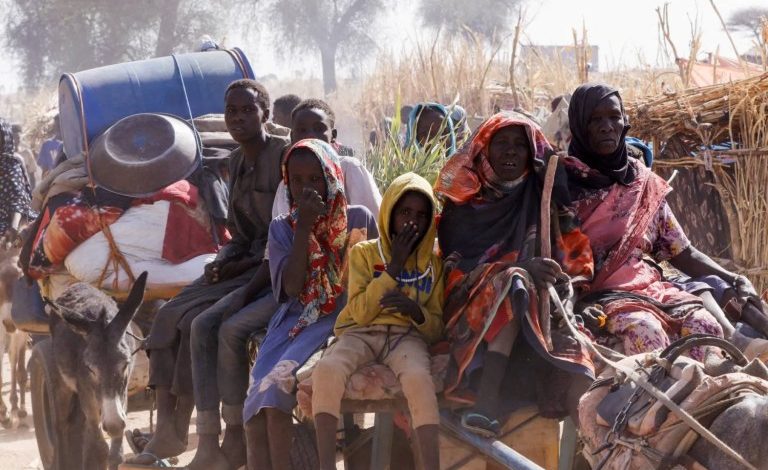
Sudan currently tops the global humanitarian agenda as the site of the world’s largest internal displacement crisis, with nearly 14 million internally displaced persons (IDPs), according to reports by the United Nations High Commissioner for Refugees (UNHCR).
These staggering figures compel a broader look at forced displacement worldwide, which has reached unprecedented levels. UNHCR estimates indicate that the global number of forcibly displaced people surpassed 122 million by the end of the first half of 2025.
Amid rapidly accelerating geopolitical shifts sweeping the Middle East, these figures take on heightened significance, shedding light on the phenomenon of forced displacement. Such shifts have exacerbated displacement crises in countries including Syria, Yemen, and Palestine—most acutely in the Gaza Strip.
Gaza has witnessed massive and repeated displacement affecting most of its population, often multiple times, as a result of the ongoing Israeli assault since October 2023. By mid-2025, the number of internally displaced people in Gaza was estimated at around two million, according to UNHCR data.
The same report notes that the number of forcibly displaced people worldwide fell by 5.9 million by mid-2025—marking the first tangible decline in a decade. This development raises pressing questions: What drives displaced people to return to the homes they fled? How do they confront a new reality and overcome its challenges?
To better understand the dimensions and implications of this phenomenon, Al Jazeera Net conducted in-depth interviews with experts, officials, and analysts who examined the causes, challenges, and possible solutions. The discussions aimed to provide a deeper analysis of the data and figures, with a particular focus on the “Khartoum case” as a clear example of return, especially given that Sudan accounts for the largest number of IDPs globally. This coincides with the Sudanese government’s recent resumption of work from the capital, sending positive signals about the potential restoration of life and the return of displaced residents to their homes.
The Displacement Crisis in Numbers
Data from UNHCR and other international organizations confirm that the global displacement crisis peaked in 2025. Beyond the global figure exceeding 122 million forcibly displaced people, specific numbers from the Middle East reveal the depth of the tragedy.
In Sudan, the war between the Sudanese Armed Forces and the Rapid Support Forces, which erupted in April 2023, displaced around 14 million people internally, making it the world’s largest internal displacement crisis. These figures reflect immense pressure on infrastructure and basic services across all Sudanese states.
In Gaza, the situation is different but equally dire. The number of IDPs is estimated at around two million—representing the vast majority of the population—many of whom have been displaced multiple times due to ongoing Israeli attacks.
Adnan Abu Hasna, media advisor to the United Nations Relief and Works Agency for Palestine Refugees (UNRWA), notes that Gaza presents a unique case: 90% of homes, schools, and infrastructure have been destroyed, leaving around 2.5 million Palestinians homeless. Under such extensive devastation, the return of displaced people to their homes is nearly impossible.
Displacement crises in other countries, such as Syria, have also driven global figures higher. Syria continues to suffer from large-scale internal and external displacement due to ongoing conflict, with the number of displaced people reaching around 12 million by 2025.
Yemen has not been spared either. Ongoing conflict there has displaced more than five million people.
What Displaced People Need to Return Home
“Relative peace,” as described by genocide studies researcher Tom Ndahiro from the Congo in statements to Al Jazeera Net, represents the core prerequisite for return. However, experts and analysts agree that “safe and sustainable return” requires a comprehensive package of conditions that go far beyond a mere cessation of fighting.
These essential requirements can be summarized as follows:
- Relative peace: Displaced people must feel that conditions have improved enough to allow them to stay, with confidence in what tomorrow holds.
- Shelter: The availability of shelter—even if it is a tent or a mobile home—does not necessarily mean a permanent house in the literal sense.
- Food security: A fundamental requirement; without guaranteed access to food, nothing else can be assured.
- Trusted leadership: Credible leadership is needed to organize resettlement efforts; otherwise, chaos prevails.
- Electricity: A decisive factor in return and stability, as it drives all aspects of daily life.
- Water: Any human settlement depends on access to clean water; without it, life comes to a halt.
- Healthcare: The collapse of health systems or the lack of medical supplies hinders community stability.
- Adaptation: Displaced people must accept that conditions are far worse than before and learn to live with what is currently available.
Khartoum: A Case of Return and Official Challenge
Khartoum represents a distinctive case of return, particularly following the Sudanese government’s decision to resume operations from the capital. Journalist and Director General of the African Center for Consultations, Adel Al-Baz, says the government’s return to Khartoum is “the first indicator of stability,” adding that official presence itself constitutes a direct call for displaced residents to return to their homes.
Former Director of the Strategic Studies and Research Center of the Sudanese Armed Forces, Major General Osama Abdel Salam, points out that the return of citizens automatically contributes to “enhancing security.” He explains that repopulating abandoned neighborhoods reduces negative phenomena, curbs theft, and spreads a sense of reassurance among residents.
For his part, the official spokesperson for Khartoum State says the government has been working for more than a year to rebuild what the war destroyed—starting with clearing cities of bodies and burned vehicles, restoring water stations, and rehabilitating electricity distribution plants and high-, medium-, and low-voltage lines.
In statements to Al Jazeera Net, the official—Al-Tayeb—confirmed that Khartoum suffered one of the largest looting operations targeting electricity infrastructure. Copper, the main component of underground cables and transformer engines, was stolen, with an estimated 15,000 power transformers looted.
Despite these challenges, he says the government is prioritizing available electricity for vital facilities such as water stations and hospitals, while encouraging citizens and the private sector to adopt solar energy.
Voices from the Ground
First-hand testimonies from displaced people themselves reflect both the depth of the challenge and the sincerity of the desire to return.
Reemaa Hamed, a dentist and journalist, recounts her displacement from Khartoum to Al-Jazira State, followed by her family’s move to Egypt. “The main reason for displacement was our fear of hospital closures and the deterioration of security conditions,” she says.
Explaining why she returned to her family home in Khartoum, Reemaa told Al Jazeera Net that despite the destruction and lack of services, “longing for home” was the primary motivation. She noted that “the Sudanese character is deeply emotional,” and that people returned “because they missed their homes.”
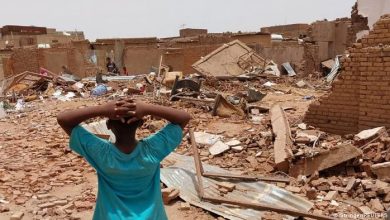
She describes the situation upon her return: “I came back to find the house almost empty—essential belongings had been stolen, and there was no electricity or water.” She added that there was only one water source in the neighborhood, where everyone gathered to fill containers and carry them home. Gradually, neighbors began to return, the area regained its social character, life slowly resumed, and some services started to come back, with relative improvement in water access.
Reemaa emphasizes that community initiatives played a major role in overcoming these challenges, and that people adapted to service shortages. “The harsh displacement experience created resilience and a strong ability to adapt to the new reality,” she says.
In another testimony, journalist Rami Mahkar summarizes displaced people’s needs succinctly: “They need the basic necessities of life—electricity and water—and above all, a stable security situation.” He adds that the absence of these essentials forces displaced people to move again to areas where basic living conditions are available.
Mahkar also stressed, in remarks to Al Jazeera Net, the importance of having “shops where displaced people can obtain essential and food supplies.”
Looking Ahead
By mid-2025, the number of forcibly displaced people had declined by 5.9 million—the first notable decrease in a decade. Indicators suggest this trend could continue if the requirements for permanent return are met, including peacebuilding, strengthening social cohesion, and achieving integration. These steps are essential to ensure genuine stability in areas of return and to prevent renewed displacement due to harsh conditions, according to UNHCR reports.
In Syria, for example, the intensity of conflict has eased, although insecurity persists in some areas and basic services remain insufficient.
In Sudan, returns have often taken place under harsh conditions to relatively stable pockets, while fighting and displacement continued elsewhere in the country. The future approach to addressing displacement increasingly points toward sustainable solutions centered on reconstruction and the provision of basic services.
Major General Abdel Salam said “the picture will become clearer within two months” if conditions continue to improve, potentially leading to “a large-scale return” encompassing most neighborhoods of Khartoum.
Al-Baz reiterated that the government’s return to Khartoum is “the first indicator of stability,” and that the return of citizens itself serves as a direct call for others to come back.
UNHCR underscores the importance of “durable solutions,” including voluntary and safe return or local integration. Ultimately, the goal of return remains tied to achieving the “relative peace” described by Tom Ndahiro—allowing displaced people, as Reemaa Hamed put it, to return home driven by “longing,” and to take part themselves in rebuilding what war has destroyed.