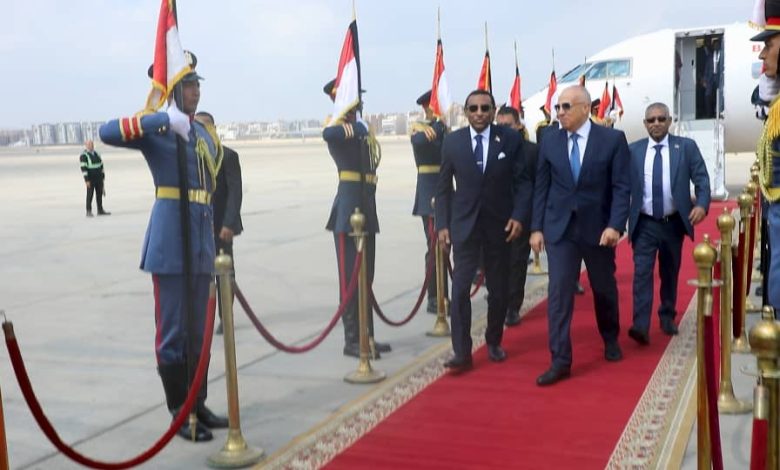
An expanded official round of talks was held on Thursday at the headquarters of the Egyptian Cabinet between a high-level Sudanese delegation headed by Prime Minister Dr. Kamil Idris and an Egyptian government delegation led by Prime Minister Dr. Mostafa Madbouly, in the presence of several ministers and officials from both sides.
In a joint statement, the two sides affirmed the depth of the fraternal ties binding the two peoples and the commitment of their leaderships to strengthening cooperation and sustained coordination in a manner that serves mutual interests and advances security, stability, and development.
Discussions addressed the latest developments in Sudan. Egypt reiterated the red lines set by its political leadership and affirmed its full support for Sudan’s unity, territorial integrity, and national institutions. The Egyptian side underscored its firm and unwavering backing of Sudan’s legitimate state institutions, including the Transitional Sovereignty Council headed by Abdel Fattah al-Burhan, the government of Prime Minister Kamil Idris, and the Sudanese Armed Forces, describing them as a fundamental pillar for preserving state cohesion, safeguarding national resources, and restoring security and stability.
Both sides emphasized the importance of enabling Sudanese state institutions to fully perform their roles, supporting the Sudanese government’s efforts to extend state authority, restore normal life, and alleviate the humanitarian suffering resulting from the war imposed on the Sudanese people. Idris expressed appreciation for Egypt’s supportive positions toward Sudan at various levels, within the framework of the historic Nile Valley brotherhood binding the two nations.
The talks also explored prospects for advancing bilateral relations. Both sides reaffirmed their commitment to strengthening economic, trade, and investment cooperation and supporting reconstruction efforts in Sudan as a national priority and urgent requirement for achieving sustainable stability. In this context, Egypt expressed interest in contributing to reconstruction projects across Sudan, particularly in infrastructure, electricity, and water sectors, and voiced readiness to transfer its expertise in construction, rehabilitation, and infrastructure development. The two sides stressed the importance of activating the joint task force on Sudan’s reconstruction and expediting the development of its implementation programs.
They further agreed on the importance of convening upcoming bilateral engagements, including the Egyptian–Sudanese Business Forum, joint committees, the exchange of official and technical delegations, and the transfer of development expertise to serve the interests of both countries and their peoples.
The two sides also reviewed developments related to the Nile River file. They agreed on the necessity of protecting the water security of Egypt and Sudan as downstream Nile states and of working jointly to preserve their full water rights and uses in accordance with the 1959 Agreement and international law. They underscored the need for full coordination and alignment of positions in relevant regional and international forums addressing Nile issues.
Both sides stressed that Sudanese and Egyptian water security is indivisible and reaffirmed their categorical rejection of any unilateral measures in the Eastern Nile Basin that could harm the water interests of the two downstream states or threaten their water security. They warned that such actions, in violation of international law, constitute a persistent source of regional instability. The two countries called on Ethiopia to abandon its unilateral approach and adhere to international legal principles governing shared watercourses, particularly prior notification, consultation, non-harm, and consensus, to ensure that the Nile remains a source of cooperation and shared prosperity.
They also affirmed their continued joint efforts with fellow Nile Basin countries to restore consensus within the Nile Basin Initiative (NBI) framework, within the ongoing consultative process with non-parties to the Cooperative Framework Agreement (CFA). In this regard, both countries welcomed progress achieved thus far, particularly the report submitted by the concerned subcommittee within the NBI recommending the continuation of consultations to reach solutions, including the possibility of amending or adding protocols to the CFA to address the concerns of all Nile Basin states. They rejected any unilateral attempts to obstruct the consultative process against the shared desire of Nile Basin countries to cooperate and achieve mutual benefit in a spirit of solidarity and fraternity.
The two sides agreed to maintain coordination and consultation through the Permanent Joint Technical Commission for Nile Waters under the 1959 Agreement, as the body mandated to formulate unified positions on Nile water affairs. They emphasized the importance of ensuring the regular functioning of the commission and providing it with the necessary technical and logistical support to effectively safeguard the shared interests of the two downstream states.
The Sudanese side expressed appreciation for Egypt’s continued support and care extended to members of the Sudanese community residing in Egypt.
Building on the historic and fraternal ties between the Arab Republic of Egypt and the Republic of Sudan, the two prime ministers agreed to further enhance cooperation and advance the utilization of Egyptian expertise in reconstruction and development. The Egyptian side welcomed Sudan’s request to benefit from Egypt’s experience in establishing a new administrative capital, modeled on Egypt’s distinguished experience in this field, in support of Sudan’s reconstruction efforts.
Both sides agreed to continue close coordination and consultation at all levels, intensify reciprocal visits, and expand cooperation on issues of mutual concern in a manner that reflects the strategic relationship and deep-rooted ties between the two countries and serves the aspirations of their peoples for security, stability, and sustainable development.