As the Region Ignites: The Impact of the Iranian War on Sudan
Report – Sudan Events
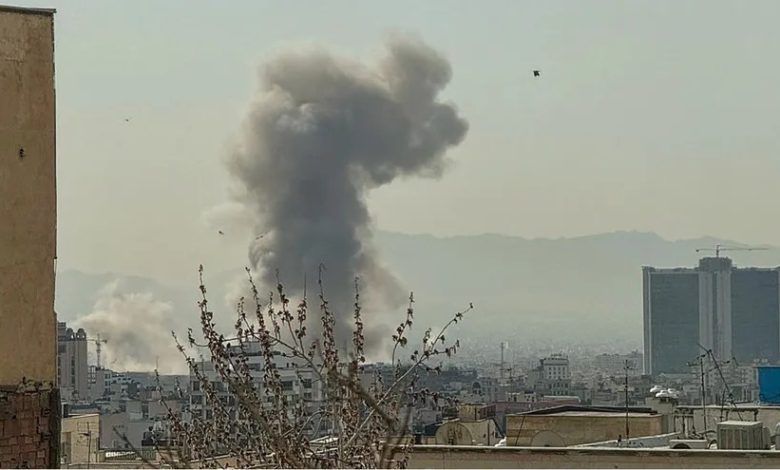
It is difficult to describe the war now erupting between the United States, Israel and Iran as a surprise. Throughout the past week, scenarios had echoed what was said in the final days before the outbreak of Sudan’s own war—waiting for the first shot to be fired. That moment came yesterday when U.S. President Donald Trump announced the launch of what he termed the “Epic Wrath” battle, describing the operation as pre-emptive strikes aimed at eliminating security threats and neutralizing Iran’s missile capabilities.
As is customary in U.S.–Israeli military campaigns, the first wave of strikes reportedly targeted senior Iranian leadership figures, including the president, the Supreme Leader, and the ministers of foreign affairs and defense. The attacks also struck the presidential compound and the Assembly of Experts. Tehran quickly absorbed the initial shock and began retaliating, targeting several Israeli cities before expanding its target bank to include what it described as American bases in the United Arab Emirates, Kuwait, Bahrain and Qatar.
Iranian missiles reportedly landed in several Gulf states, while missiles also struck cities in northern Israel. Observers note that one of the most significant developments in the war’s opening hours was Iran’s decision to widen the battlefield by directly targeting bases in Gulf countries—states that officially entered the war’s airspace yesterday. Civil aviation was suspended, scheduled flights were disrupted or redirected to Egypt, and commercial activity slowed across many Gulf cities amid fears of further missile attacks.
Iran’s decision to extend its strikes to Gulf states with which it maintains relatively stable relations is a notable escalation that could significantly complicate the trajectory of the conflict—one that now appears to have engulfed the entire Gulf region. Tehran’s ability to absorb the initial blow suggests prior preparation, including relocating leadership figures, evacuating facilities and readying retaliatory capabilities.
The pressing question now is what impact this war—unlikely to remain confined to what President Trump described as “pre-emptive strikes,” and potentially lasting days or even weeks—will have on Sudan’s own conflict.
Dr. Osama Hanafi, Professor of Political Science at Sudan University, argues that events are still unfolding and that all scenarios remain possible. “It is too early to measure potential shifts in the Sudanese landscape,” he said, adding that developments are unlikely to remain confined within the pre-designed framework of the United States and Israel. “The conflict could expand to ignite the entire Gulf region, and that remains a real possibility.”
He added that while the initial strike on Iran will be consequential, Washington may have forfeited key leverage. “By launching the attack, the United States may have lost pressure cards over Iran, which could now seek to inflame the entire region. That, in turn, could reduce the militia’s ability to secure external support—but the broader consequences are dangerous.”
According to Hanafi, escalation in the Gulf—particularly in the United Arab Emirates—would place Sudan’s Rapid Support Forces militia under severe strain, not only because of potential supply disruptions but due to the uncertainty that would follow. “If the Gulf enters a phase of direct warfare, Emirati support for the militia will undoubtedly be affected, and regional alliances will shift. The longer the war drags on, the more actors and interests will intervene. It will exhaust everyone.”
He suggested that Iran appears to have prepared carefully over recent months, and that its regional allies and proxy networks may soon become involved, further complicating matters. “Escalation in the Gulf will undoubtedly ease pressure here in Sudan,” he said, “but no one can predict what will actually unfold. The situation could shift at any moment and descend into unforeseen scenarios.”
Hanafi also pointed to divergent agendas among the parties attacking Iran. While Washington frames its objective as neutralizing Iran’s nuclear capabilities, Israel appears intent on regime change in Tehran—an ambition that could open unpredictable phases if Iran deploys strategic missile systems, whose locations—whether solely within Iran or distributed among its regional allies—remain unclear.
He questioned whether Iran will limit its strikes to military bases, and what role Gulf states will play as they now absorb missile fire. “Will they remain silent? These are developments with direct implications for Sudan’s war. The world’s focus is now turning to the Middle East, meaning Sudan’s conflict may once again fade into temporary obscurity. Diplomatic efforts will stall as the United States and Gulf states become consumed by a war that has struck at the political nerve center of the region.”
He concluded: “This is not a war that ends with a swift settlement. It is a conflict that could well endure.”