Sudan has reaffirmed its commitment to continuing efforts to promote and protect human rights and to cooperate with the African Commission on Human and Peoples’ Rights, as well as relevant regional and international mechanisms. Reiterating its commitment to African solutions to African problems, Sudan called on the Commission to visit the country to examine violations committed against civilians by the rebel militia and assess the humanitarian conditions of internally displaced persons and refugees.
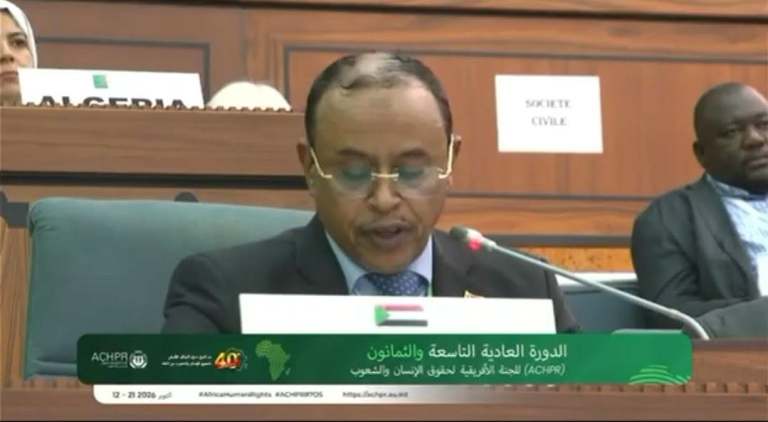
Ambassador Abdel Ghani Al-Naeem, head of the Sudanese delegation, welcomed the Senegalese government’s hosting of the 89th Ordinary Session of the African Commission on Human and Peoples’ Rights during his address to the session on Sunday in Senegal. He praised Senegal for its stability, peaceful coexistence, dialogue, and peaceful transfer of power. He also congratulated the Commission on the 45th anniversary of the adoption of the African Charter on Human and Peoples’ Rights and the 40th anniversary of its entry into force.
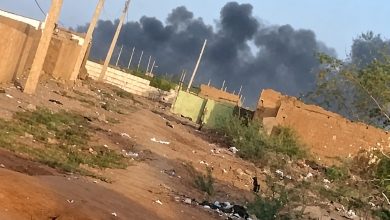
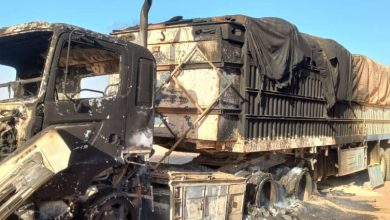
Ambassador Al-Naeem explained that Sudan has been experiencing exceptional circumstances since the outbreak of the rebellion by the Rapid Support Forces militia on April 15, 2023. He highlighted the human rights violations committed by what he described as the terrorist militia, including genocide, war crimes, and crimes against humanity, as well as attacks on civilians, state institutions, and civilian objects, as documented by international governmental and non-governmental organizations.
In response to these heinous crimes and grave violations, he added, the President of the Transitional Sovereignty Council issued a decree designating the Rapid Support Forces as a rebel terrorist group.
Ambassador Abdel Ghani further stated that the militia’s continued commission of crimes and violations was attributable to ongoing support from a country outside the African continent. This support, he said, includes the provision of advanced strategic weapons, drones, and military equipment, as well as financing and the recruitment and deployment of mercenaries from outside Africa.
He noted that this support was facilitated through cooperation with neighboring and sister countries, stressing that all parties involved bear full responsibility for their role in the bloodshed in Sudan, the rape and torture of women, and the violations of the most basic human rights of elderly people, children, and other Sudanese civilians.
He explained that these horrific crimes should not be portrayed, as some have done, as a conflict between two parties. Rather, he said, they constitute an attempt by external actors to pursue colonial objectives and take control of Sudan, Africa’s third-largest country by area.
Al-Naeem stressed that the Sudanese government and armed forces are working to protect the country’s sovereignty and territorial integrity and achieve lasting peace, in accordance with the United Nations Charter and the Constitutive Act of the African Union.
In this context, he referred to the peace initiative presented by General Abdel Fattah Al-Burhan, Chairman of the Transitional Sovereignty Council, before the United Nations General Assembly, as well as the initiative submitted by Prime Minister Dr. Kamil Idris to the UN Security Council.
He explained that the initiative includes arrangements for disarmament, demobilization, and reintegration, accountability before the courts, and a transitional period to be followed by free, fair, and transparent elections.
He also referred to the approval of a national initiative led by a civilian committee comprising prominent Sudanese figures, aimed at launching an intra-Sudanese dialogue that would allow Sudanese people themselves to determine the future of their country.
On strengthening accountability and preventing impunity, Ambassador Al-Naeem noted that the National Committee for Investigating Crimes and Violations of National Law and International Humanitarian Law had issued its fifth interim report, covering the period from August 11, 2025, to August 2026.
He also highlighted the government’s humanitarian efforts, including the opening of the Adré border crossing with Chad, the launch of reconstruction efforts, the restoration of services, and measures to create conditions for citizens to return to their areas of origin. He further noted that the National Executive Plan for Human Rights for 2026–2030 had been finalized and that cooperation with United Nations and regional mechanisms was being strengthened.
The Sudanese delegation called on the African Commission on Human and Peoples’ Rights to visit Sudan at the earliest possible opportunity to investigate on the ground the violations suffered by civilians and assess the humanitarian conditions of victims, internally displaced persons, and refugees whose suffering, it said, had been caused by the rebel Rapid Support Forces militia.
The delegation emphasized that developments in Sudan concern the entire African continent, given the country’s geographical location and its historical and cultural ties with neighboring states. It warned that any continuation of the war in Sudan by the militia and its supporters, particularly those from outside Africa, would pose a threat to the African continent and to regional peace and security.
At the conclusion of his address, Ambassador Al-Naeem expressed Sudan’s gratitude to the brotherly and friendly countries that had supported its sovereignty, unity, and territorial integrity, received Sudanese refugees, and provided them with assistance. He also praised the efforts of international and regional organizations, government agencies, and voluntary organizations in delivering humanitarian aid to those affected both inside and outside Sudan.