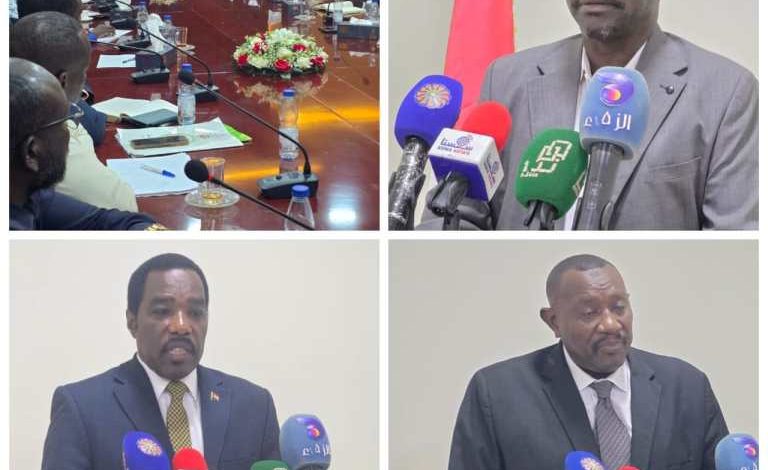
A joint meeting held in Khartoum, attended by Acting Governor of the Darfur Region Mohamed Adam Abdelrahman, governors of Darfur states, Federal Minister of Human Resources and Social Welfare Dr. Mutasim Ahmed Saleh, the Federal Humanitarian Aid Commission, and Khartoum State Minister of Social Development Siddig Hassan Farini, discussed the challenges facing displaced people from Darfur and ways to improve their living and social conditions.
Federal Minister of Human Resources and Social Welfare Dr. Mutasim Ahmed Saleh affirmed that issues affecting displaced people are a government priority. He stressed the importance of moving beyond immediate humanitarian interventions towards sustainable solutions that address the actual needs of displaced populations, strengthen social protection, and ensure their access to essential services. He also underscored the need for close coordination between federal and state authorities and for integrating efforts with the Darfur Regional Government and other relevant bodies.
For his part, Acting Governor of the Darfur Region Mohamed Adam Abdelrahman explained that the exceptional circumstances facing the states of the region have had a profound impact on citizens, creating humanitarian and social challenges that require a coordinated government response. He noted that addressing the concerns of displaced people goes beyond providing assistance to creating suitable conditions for shelter, stability, and improved livelihoods. He called for greater attention to the needs of people from Darfur in displacement areas and intensified efforts to address their requirements.
In the same context, Khartoum State Minister of Social Development Siddig Hassan Farini emphasized the importance of institutional coordination between the state government, the regional government, and federal authorities. He pointed to the need to assess the needs of displaced people, identify intervention priorities, and strengthen social care and protection programmes in order to ease the living burdens on displaced families and provide services to the most vulnerable groups.
The meeting reviewed a range of challenges related to shelter, essential services, social welfare, and protection. It also discussed mechanisms for coordination and the division of responsibilities among the relevant authorities, with a view to developing practical solutions based on actual needs on the ground.
Participants stressed that addressing the concerns of displaced people from Darfur is a shared responsibility requiring unified efforts, the mobilization of resources, and stronger government and humanitarian partnerships. These efforts, they said, should facilitate a transition from emergency response to more sustainable solutions that preserve the dignity of displaced people and alleviate their suffering.