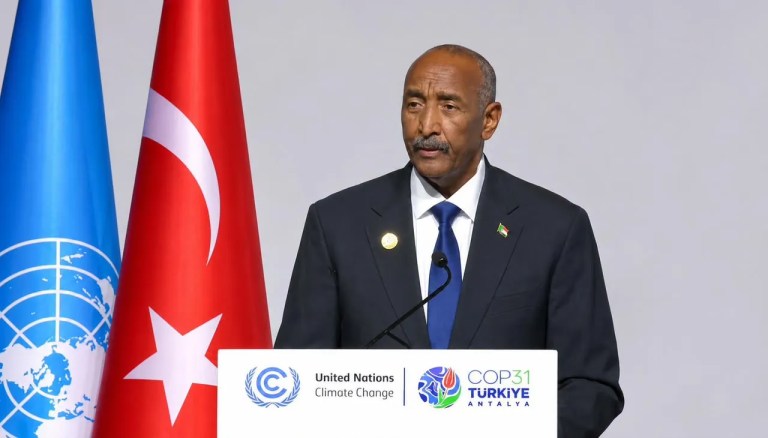
Chairman of the Transitional Sovereignty Council, General Abdel Fattah Al-Burhan, affirmed Sudan’s commitment to supporting the common positions and principles of the African Group, the Arab Group, the Group of 77 and China, and the Least Developed Countries. He stressed the importance of strengthening international cooperation and solidarity to ensure a fair and effective response to climate change that takes into account the circumstances, capacities, and national priorities of developing countries.
Addressing the Conference of the Parties to the United Nations Framework Convention on Climate Change (COP31) in the Turkish city of Antalya, Al-Burhan said that despite the exceptional challenges facing Sudan, the country continues to honor its climate commitments. He noted that Sudan submitted its Third National Communication and Biennial Update Report in April 2025, and is currently working on preparing its Fourth National Communication and First Biennial Transparency Report.
He explained that Sudan is among the countries most severely affected by the adverse impacts of climate change, despite its limited contribution to global emissions. He pointed to the growing risks of drought, floods, desertification, water scarcity, and land degradation, and the resulting decline in agricultural and pastoral production, threats to food security, and the erosion of livelihoods.
Al-Burhan noted that the war engulfing the country since 2023, and its consequences for infrastructure, services, and national institutions, have magnified the scale of climate challenges. He emphasized that addressing the impacts of climate change in Sudan is closely linked to achieving peace, food and water security, sustainable development, and strengthening the resilience of communities.
He stressed that climate adaptation represents an urgent national necessity for Sudan, calling for increased investment in water resource management, climate-resilient agriculture, pastoral systems development, restoration of degraded lands, combating desertification, protecting ecosystems, and developing early warning systems and disaster risk management mechanisms.
Regarding climate finance, Al-Burhan called for international pledges to be translated into actual financial resources characterized by fairness, speed, accessibility, and predictability. He also called for strengthening the capacities of national institutions to enable developing countries—particularly least developed countries and those affected by conflicts and crises—to benefit from financing mechanisms. He urged developed countries to increase funding allocated to climate adaptation programmes.
Al-Burhan affirmed that Sudan possesses promising potential in renewable energy, particularly solar power, land management, sustainable agriculture, ecosystem restoration, and water management. He called on international partners to support the transformation of these capabilities and plans into practical, scalable investments and projects that would contribute to creating employment opportunities and strengthening the country’s national capacity to address climate change.
He also stressed the importance of making climate action a means of promoting peace, development, food and water security, and stability, while building a safer and more equitable future for generations to come.