Hunger Threatens 4 Million Sudanese Refugees in Neighboring Countries
Sudan Events – Agencies
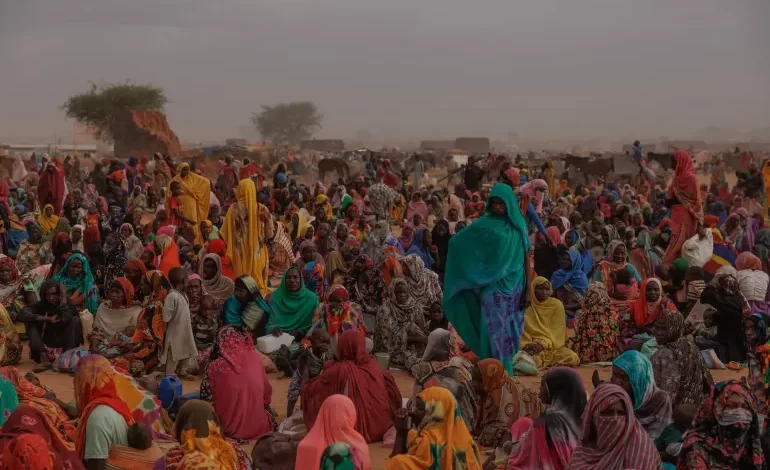
The World Food Programme (WFP) announced on Monday that more than 4 million Sudanese refugees have fled to neighboring countries in search of food, shelter, and safety since the outbreak of the civil war in April 2023, warning that they face the risk of sliding into deeper hunger and malnutrition.
The WFP’s warning comes amid a significant decline in life-saving food assistance due to funding crises.
In a statement, the program noted that Sudanese refugee families often arrive traumatized and malnourished, possessing little more than the clothes on their backs.
The organization stressed the urgent need to provide emergency aid to refugees fleeing to seven neighboring countries where WFP operates: the Central African Republic, Chad, Egypt, Ethiopia, Libya, Uganda, and South Sudan.
The program added that it had expanded its support to include host communities that generously welcomed Sudanese refugees despite already suffering from food insecurity.
The UN agency warned that without new resources, its assistance to Sudanese refugees in the Central African Republic, Egypt, Ethiopia, and Libya “could cease in the coming months.”
Food Rations Cut
The WFP reported that many vulnerable refugees in Uganda are living on less than 500 calories a day — less than a quarter of daily nutritional needs — while new waves of arrivals are pushing refugee support systems to the brink of collapse.
In Chad, which hosts around a quarter of the total Sudanese refugee population, the program said food rations would be reduced in the coming months unless additional contributions are secured soon.
Sean Hughes, WFP’s Emergency Operations Coordinator for the Sudan regional crisis, stated:
“We are facing a full-blown regional crisis that is worsening in countries already grappling with high levels of food insecurity and conflict.”
He added that millions fleeing Sudan are entirely dependent on WFP’s support, but without more funding, the organization will be forced to make further cuts, “leaving the most vulnerable families — especially children — at increased risk of hunger and malnutrition.”
WFP emphasized that children are the most vulnerable to “the prolonged effects of food insecurity,” with global acute malnutrition rates among refugee children at reception centers in Uganda and South Sudan surpassing emergency thresholds. Many children were already malnourished even before receiving aid.
The program estimates it needs over $200 million in funding to continue its emergency response for Sudanese refugees in neighboring countries over the next six months, in addition to $575 million required to carry out life-saving operations inside Sudan.
To avert the worsening humanitarian disaster faced by internally displaced people, Transitional Sovereign Council leader Abdel Fattah al-Burhan agreed to a ceasefire proposal made by UN Secretary-General António Guterres. In this context, Sudan’s Sovereignty Council announced that Burhan had agreed to a one-week humanitarian truce in El Fasher, the capital of Darfur, which has been besieged by Rapid Support Forces (RSF) for nearly two years.
The ceasefire agreement came during a phone call between Burhan and Guterres, in which the UN chief called for a humanitarian truce to facilitate aid delivery to thousands of besieged civilians. Guterres also welcomed the appointment of a Prime Minister in Sudan and reaffirmed his support for the country’s efforts toward completing a civilian transition.
On the Ground
Local sources told Al Jazeera that at least 20 civilians were killed in RSF attacks on villages south of El-Obeid, the capital of North Kordofan State, aimed at looting crops.
According to the sources, the attacks on the villages of Al-Hagoona and Lamina, located about 40 kilometers south of El-Obeid, left several injured who had to be transported to the city on donkeys.
The Shanabla and Bedairiya tribes condemned the attacks on their people in a joint statement issued yesterday, confirming that the victims were unarmed civilians.
Recently, RSF forces seized control of the areas of Al-Hamadi, Al-Debeibat, and Kazgail, south of El-Obeid, which remains under Sudanese army control.
A formal report submitted by Sudan to the UN Human Rights Council in Geneva revealed that hundreds of thousands of Sudanese have been killed, injured, raped, forcibly disappeared, or arbitrarily detained since the war broke out on April 15, 2023.
The report stated that the “rebel RSF militia has committed acts of genocide and extrajudicial killings” in Al-Jazira State, as well as in the areas of Geneina, Ardamata, Al-Jumouiya, Al-Salha, El-Obeid, Al-Nahud, Al-Khoy, and the Zamzam and Abu Shouk IDP camps.
Since mid-April 2023, the Sudanese army and the Rapid Support Forces have been engaged in a war that has killed over 20,000 people and displaced or forced around 15 million to flee, according to the UN and local authorities. However, a study conducted by U.S. universities estimated the death toll to be around 130,000.
Source: Al Jazeera