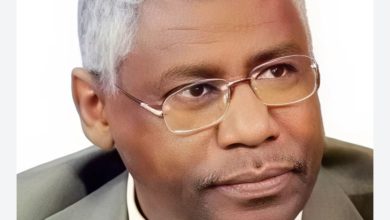
To a Long Shadow… Uncle Ahmed (1–2)
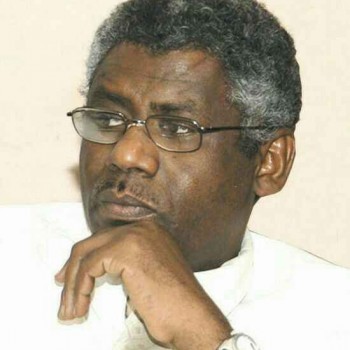
As I See
Adil El-Baz
1
Subhan Allah! No sooner had I finished reading the last page of The Memoirs of Ustaz Ahmed Abdel Rahman—whom we always fondly called Uncle Ahmed—than the sorrowful news reached me. I rushed to deny it in hope, telling myself it couldn’t be true. As usual, I had filled the margins of the book with comments, notes, and questions about the new information it contained, intending to send my queries to his daughter, Afaf, who had exerted great effort compiling these important memoirs—and who deserved the forgiveness and gratitude of her father, with which he graced the book’s introduction.
2
I first met Uncle Ahmed nearly forty years ago in the city of Al-Duwaym, to which he had family ties, having married Nour Ali Al-Haj, to whom he dedicated his memoirs, speaking of her with deep affection: “She was my eyes and my support in hardship and in ease.”
At the time, he was a leading figure in the National Islamic Front. From that first encounter, his image became etched in my memory: a warm, cheerful man—human in every sense of the word. From that day on, we never parted, through all the twists and turns of his life—so full of giving and sacrifice.
He never ceased giving—not for a single moment. His life was a continuous struggle, starting from his student days at Omdurman Ahlia. He lived a hard life, full of suffering, but he lived it for the people and among them. They loved him as he loved them, but he paid dearly for the convictions he held—until his soul returned to its Maker in Nasr City, Cairo, the night before last.
3
Whenever crises intensified and the storms of politics raged—as they so often did—we would seek out Uncle Ahmed. We always knew where to find him: either in parliament, at his home, or attending some social occasion. We were used to dropping by his house, where his family would always welcome us with warmth and hospitality. I don’t recall a single time we had to knock—his door was always open, and the reception room always full of guests.
We used to marvel at his remarkable ability to bring people together—people of differing views and backgrounds, united by nothing except their debts and Uncle Ahmed’s heart. He was a rare figure in social engagement—never missing an event, whether a wedding or a funeral, be it in the farthest corners of the capital or out in the provinces.
It’s told that when he and his comrade Omar Nour Al-Da’im were released from Nimeiri’s prisons, they insisted on paying condolences before even going home.
4
Uncle Ahmed’s guestroom was like a miniature parliament. Debates left unfinished under the parliamentary dome would continue in his elegant salon, and political knots too complex for others to untie were gently resolved by his unique and endearing wisdom.
Amazingly, that gathering place remained the same despite the ever-changing tides of his life: once a fugitive political activist during the National Front days; later a minister under May regime; then a prisoner under that same regime; afterward a leader in the Islamic Front, and finally, a minister again under the Ingaz government.
His circumstances changed, but Uncle Ahmed remained the same. So did his home—always open. We kept visiting, listening, recording, learning.
5
In his engaging memoirs, Ahmed Abdel Rahman recounts much of that turmoil and transformation. When you sit with him to hear his stories, his flowing narrative, rich with detail, draws you in—you never want him to stop. The same is true when reading his memoirs: you find yourself captivated by his smooth, story-filled style.
One of the most amusing anecdotes he shared was from the time he was appointed Minister of the Interior during Nimeiri’s era. The first issue he tackled was prison reform. He wanted to make prisons more suitable places to receive political detainees. He allowed families to bring food for their imprisoned loved ones, as the food provided by the government was problematic both in quality and quantity.
But no sooner had he successfully completed that mission than he found himself a guest in the very prisons he had reformed! Uncle Ahmed recounted, laughing: “I used to say all the time when I was Minister of Interior: ‘One day, they’ll throw us in here too.’” People laughed at the line—but it came true when Nimeiri imprisoned the Islamists in 1985.
To be continued…