How Burhan Became Sudan’s Most Powerful Man
Sudan Events – Agencies
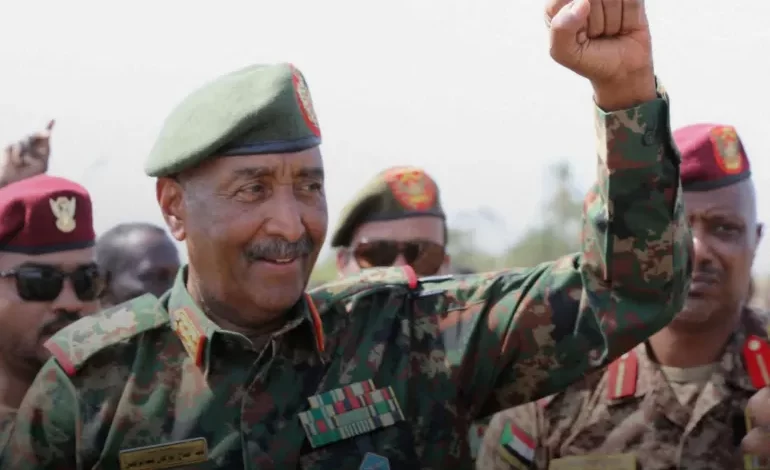
On a warm afternoon in March 2025, General Abdel Fattah al-Burhan, head of Sudan’s Transitional Sovereign Council and commander of the Sudanese Armed Forces, stood on the balcony of the Republican Palace in Khartoum, clad in his camouflage military uniform.
The palace no longer resembled the one he had known two years earlier. Bullet holes pocked its walls, windowpanes were shattered, and chunks of its outer stone facade lay in ruins. The once-grand halls through which Burhan had just walked bore visible scars of war.
Yet, Burhan raised his right fist in triumph, a smile of confidence lighting his face as he stood among soldiers whose expressions mirrored the same victorious sentiment. Outside, chants of “Khartoum has been liberated!” rang through the streets. Nearly two years into a devastating civil war, Burhan announced that Sudan’s capital was free from the grip of the rebel Rapid Support Forces (RSF), led by his former ally Mohamed Hamdan Dagalo, known as Hemedti.
Perhaps, in that moment, Burhan recalled a distant evening in a northern Sudanese village. As a boy, he once sat beside his father, Burhan Abdel Rahman al-Burhan, listening to tales of the land, the Nile, and a dream his father once had—a dream steeped in the mystical fervor of Sufi faith:
“You will one day play a great role in Sudan,” his father told him with a confidence that seemed half-spiritual revelation, half ancestral hope.
Those words were more than a father’s dream—they became a prophecy that lodged deep in the child’s soul, growing within him as if fate itself awaited him at some unknown crossroads.
Burhan was not the first Sudanese leader to be touched by such prophetic visions. In the Sudanese political and cultural imagination, leadership has long been entangled with mysticism and destiny—from Sadiq al-Mahdi to Omar al-Bashir, whose rise was marked by religious rhetoric and fatalistic symbolism.
Eventually, Burhan became a man of consequence in Sudanese politics—just as his father had predicted, and yet in ways no one could have fully foreseen. But Sudan today is not the country that Burhan or his father likely envisioned.
Bashir would rule for three decades until a nationwide uprising in December 2018 brought him down and reignited hopes for a democratic future. But those hopes were short-lived. The military returned to center stage—this time with a new face: General Abdel Fattah al-Burhan.
From Sufi Paths to the Corridors of Power
Burhan’s connection to Sufism ran deeper than personal piety. His grandfather, Abdel Rahman al-Burhan, is buried in Eidj, a prominent Sufi pilgrimage site. His mother, Safiya al-Siddiq, descended from Sheikh Ali al-Hafyan, a renowned Sufi figure. His paternal grandmother hailed from the prestigious family of Sheikh Aboud, to which former president Ibrahim Abboud also belonged.
He thus grew up in a rural, conservative environment imbued with spirituality and humility—far from the political storms brewing in the capital. But the calm of the countryside and its narrow horizons could not contain Burhan’s ambitions. Like many village youth with dreams of advancement and national service, he joined the military at a young age.
He completed his early education locally, then moved to nearby Shendi for secondary school before enrolling in the Sudanese Military Academy (Class 31). He underwent further military training in Egypt and Jordan, where he formed lasting ties with officers across the Arab world. This training paved the way for a steady climb through the military ranks.
Soon after joining the army, Burhan was deployed to the brutal civil war against the Sudan People’s Liberation Movement (SPLM) in the south—a 22-year conflict (1983–2005) that killed around two million people and displaced some four million. This followed an earlier southern conflict (1955–1972) that claimed roughly half a million lives.
Both wars raged in what would eventually become the independent nation of South Sudan in 2011. Burhan served in these southern campaigns and was later dispatched to Darfur in the early 2000s, as rebellion there surged against the Bashir regime.
As a brigadier general in Darfur, Burhan commanded troops in fierce battlegrounds. There, he encountered a man who would later alter both his life and Sudan’s history: Mohamed Hamdan Dagalo, or Hemedti.
At the time, Hemedti’s forces—then known as the Janjaweed militias, later formalized as the RSF—were fighting alongside the army. Despite widespread accusations of atrocities by both the army and the Janjaweed, Burhan managed to maintain a relatively clean reputation. His name never appeared among those indicted by the International Criminal Court for war crimes in Darfur.
Unlike many senior officers under Bashir, Burhan was not closely tied to the Islamist ruling party, the National Congress. This helped shield him from backlash by international or regional actors wary of Islamist politics. He remained a professional officer, loyal above all to the army, not the party.
Burhan’s Sufi background may have also distanced him from political Islamism, helping him avoid both visibility and culpability. Early on, he served as a training commander in eastern Sudan’s Jebeit military schools. Later, he took a diplomatic posting as military attaché in China—an experience that expanded his influence in foreign policy circles.
Upon return, he led the Border Guard Forces—one of the country’s most important military formations. He was then appointed Deputy Chief of Staff for Ground Operations, and later promoted to Commander of Ground Forces—a position that firmly entrenched him in the military’s command structure.
Burhan’s influence extended beyond Sudan. He oversaw Sudanese troops deployed to Yemen under the Saudi-led coalition in Operation Decisive Storm. There, he worked closely with Hemedti, whose RSF forces also joined the campaign.
British historian Willow Berridge, author of Civil Uprisings in Modern Sudan, notes that Burhan and the RSF developed close cooperation during the Yemen war. Journalist Jérôme Tubiana, writing in Foreign Policy, suggests that their relationship deepened through 2015, as Burhan commanded ground forces in which RSF fighters served.
On February 26, 2018, Burhan was promoted to the rank of full general and appointed Inspector General of the Army—making him the third-highest ranking officer. Bashir later offered him a governorship, but Burhan, sensing the mounting unrest, politely declined.
At a military event in Wadi al-Hamar, Nile State, shortly after the 2018 uprising began, Burhan made an impression. During a shooting competition attended by Bashir, several officers missed their targets. Burhan took a rifle, aimed, and hit every shot with precision, a feat celebrated in Sudanese military culture as “the cat’s paw”—where shots group tightly on the target. Just months later, he would confront Bashir not with marksmanship, but with a quiet message: “Your time is up.”
That moment came on April 11, 2019. After five months of nationwide protests—the longest modern peaceful uprising of its kind—the military arrested Bashir and declared a new transitional military council. But the streets rejected this move as mere continuity under new generals.
A Partnership of Rifles
In August 2019, General Abdel Fattah al-Burhan assumed leadership of the Transitional Military Council, promising to uphold commitments made to the public and the international community—including the UN and Western governments—to protect Sudan and guide it toward a democratic civilian-led government following transparent elections.
In the days that followed, he worked to reassure the public and the revolutionary political forces. He appeared in televised interviews, speaking in calm tones about the military siding with the people, and pledged to hand over power to an elected civilian government after the transitional period.
Burhan later recounted how, during Bashir’s final hours in power, he personally told the president that the army had decided to remove him for the sake of national stability. It was a portrait of a soldier who saw himself as doing the right thing—even if it meant disobeying the commander-in-chief.
One of Burhan’s first actions as transitional leader was to lift the curfew imposed by his predecessor, General Awad Ibn Auf, and order the release of all detained protesters. Hemedti, who had opposed Ibn Auf’s leadership and initially refused to join the military council, quickly welcomed Burhan’s appointment. Burhan, in turn, promoted Hemedti to the rank of lieutenant general—making him the youngest to ever hold such a senior position in Sudan’s military, despite lacking formal education or military training.
As this military partnership solidified, civilian forces became consumed by complex power-sharing negotiations, leading to a de-escalation of street mobilization. However, one faction of protesters continued a sit-in outside army headquarters, demanding immediate transfer of power to civilians.
That fragile peace shattered on June 3, 2019, when security forces—primarily believed to be from Hemedti’s Rapid Support Forces—violently dispersed the sit-in. Dozens of civilians were killed in what became known as the Khartoum Massacre.
Burhan in the Political Arena—and the Question of Normalization
During the transitional period, Sudan’s traditional civil-military duality deepened into a new binary: a civilian bloc, centered around the Forces for Freedom and Change (FFC), and the military bloc, consisting of the army and the RSF.
While the 2019 Constitutional Declaration aimed to balance both blocs through a joint Sovereign Council, in practice, the military—led by Burhan—wielded more power. He emerged as the de facto head of state, receiving foreign dignitaries and representing Sudan in key diplomatic meetings.
A Country Too Small for Two Generals
It was during this time that the most consequential and violent rivalry since Bashir’s fall began to take shape. The clash between Burhan and his deputy, Hemedti, was not a passing disagreement over governance—it was a zero-sum struggle for survival at the top of a fragile power structure. Publicly, their dispute was framed as a policy rift with civilians, but privately, it became clear: Sudan was no longer big enough for both men.
Despite growing tensions, Burhan and Hemedti continued to close ranks when civilian demands threatened military interests. The most explosive issue was the proposal to integrate the RSF into the national army—a demand by civilian leaders to dismantle parallel armed forces. Hemedti resisted losing control of his powerful militia. Burhan, meanwhile, was unwilling to compromise the army’s supremacy.
A true civilian transition would not only reduce the military’s grip on politics—it would also threaten its vast economic empire and potentially open the door to justice for past abuses. A 2022 report revealed that Sudan’s military and security services control more than 400 commercial and industrial entities, spanning agriculture, banking, and mining—a shadow economy that underscores the stakes.
Today, Burhan stands in a stronger position than at any previous point, perhaps even stronger than when Bashir was ousted. On the surface, it appears he has fulfilled his father’s prophecy by ruling Sudan. But for many Sudanese, the promise of freedom, justice, and peace remains unrealized.
Whether this chapter ends with the dawn of a new democratic era—if Burhan makes good on his pledge to hand over power—or devolves into yet another era of authoritarian military rule remains to be seen.
Between these two futures, Sudanese people are left to wonder: Is Burhan preparing to entrench himself as a long-term ruler under the guise of protecting the nation, or will he defy expectations and transfer leadership to an elected civilian government?
Whatever the answer, one moment is already etched in history: General Abdel Fattah al-Burhan once stood triumphantly on the presidential balcony, declaring Khartoum free from the grasp of the very man—Hemedti—who was once his closest partner in power.