Silent Moves and U.S. Pressure: Is a Settlement to the Sudan War Near?
By Al-Nour Ahmed Al-Nour
Khartoum – International and regional efforts to end the war in Sudan are accelerating. In recent days, undisclosed visits and quiet communications have taken place between Port Sudan, the country’s temporary administrative capital, and several Arab, African, and Western capitals ahead of a planned international peace conference on Sudan organized by Washington.
Observers believe a “political deal” is being prepared behind the scenes to resolve the Sudanese crisis, but it faces major challenges. Chief among them are the conflicting positions of influential regional powers involved in the Sudanese scene and the mistrust between the warring factions, who fear a settlement may undermine the political ambitions of military leaders in both the Sudanese Armed Forces and the Rapid Support Forces (RSF).
U.S. interest in Sudan significantly increased in early June, following a meeting between U.S. Deputy Secretary of State Christopher Landau, senior presidential advisor for African and Middle Eastern affairs Mossad Boulos, and the ambassadors of Saudi Arabia, Egypt, and the UAE—members of the “Quad” group on Sudan.
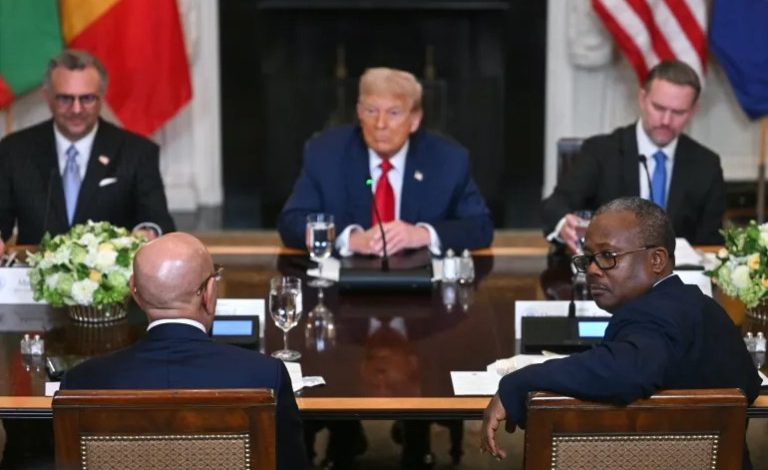
In his first statement on Sudan since returning to the White House, President Donald Trump revealed that Washington is making a serious push to end the conflict through a peaceful settlement path. This was met with cautious optimism among Sudanese and ambiguity in the positions of both the army and RSF.
Trump made these remarks during a recent meeting with the presidents of five African nations, where he emphasized the urgency of U.S. efforts to stabilize Sudan and other conflict-hit regions on the continent.
Rounds of Talks and Communications
Sudanese officials told Al Jazeera Net that the country’s leadership received a diplomatic briefing from the U.S. prior to the Quad meeting, indicating that Washington is working on a peace initiative for Sudan, though no further details were provided. The U.S. noted that it is consulting with partners to formulate the proposal.
According to anonymous sources, the Sudanese government informally communicated its openness to peace efforts, stressing that any initiative must be based on the roadmap submitted by the Sovereignty Council to UN Secretary-General António Guterres. This roadmap is already in motion with the appointment of a civilian prime minister and an amended constitutional document. Sudan’s leadership added that an official stance would be declared after reviewing the proposal’s details.
Two days ago, Port Sudan received an unannounced visit from a Saudi envoy. Sources told Al Jazeera Net that Sudanese leaders have also been consulting with Arab and African capitals to share their vision for ending the war.
Additionally, Sudan dispatched a security envoy to Arab, Western, and friendly countries to discuss the peace process.
Meanwhile, sources within the African Union told Al Jazeera Net that consultations are ongoing with international and regional powers, IGAD, and the AU itself to accelerate the peace process in Sudan through coordinated efforts. While there is currently no concrete peace plan, the sources expect one to materialize in the coming weeks.
On the other hand, an RSF media office official told Al Jazeera Net that their leadership had not received any communication from the U.S. but had followed international developments through the media.
The official expressed the RSF’s readiness for any serious peace initiatives, accusing the army of lacking the will for peace. He added, “We will continue fighting until we achieve our goals of peace and democratic transition through the government we are about to form in our controlled territories.”
Proposed Pathways
African sources (speaking anonymously) suggested that three potential tracks are being discussed:
1. Military Track: Direct negotiations between the warring parties leading to a ceasefire and military-security arrangements.
2. Political Track: Inclusion of political and civil forces in a national dialogue to agree on a post-war vision and governance plan.
3. Economic Track: Adoption of a reconstruction and recovery plan tied to specific political requirements.
Babiker Faisal, head of the Federal Gathering Party and a leading figure in the Democratic Civilian Alliance for the Revolution Forces (Sumoud), proposed three scenarios for ending the war:
First Scenario: Direct talks between the two authorities in Port Sudan and Nyala to reach a ceasefire agreement and form a national unity government. This approach is inspired by South Sudan’s previous temporary political settlements.
Second Scenario: Modeled after the Libyan case, this involves a ceasefire without a comprehensive political settlement, allowing each side to maintain control over its territories, leading to a forced coexistence between two separate governments on one land.
Third Scenario: A comprehensive, permanent ceasefire followed by a civilian-led political process addressing the root causes of the crisis to prevent recurrence. This requires broad civilian consensus.
Faisal argues that the first two scenarios would only bring temporary calm—as seen in South Sudan and Libya—while only the third can ensure sustainable peace.
He warned that continued conflict and lack of internal will for peace could result in foreign intervention imposing external agendas that may not align with Sudan’s national interests.
Dividing the Spoils of War
Meanwhile, international and security affairs expert Amer Hassan believes that a settlement implies dividing the outcomes of war between the army and the RSF—something the Sudanese people, who suffered death, displacement, and destruction, will not accept.
According to Hassan, the army has succeeded in removing the existential threat posed by the RSF’s attempt to seize state power, but the RSF has now become a dangerous rebellion in western Sudan backed by regional actors.
He stressed that the ongoing war must be resolved militarily and decisively by the army, arguing that any negotiations should only focus on dissolving the RSF, not granting it political or military gains.
Political and Diplomatic Complexity
Political analyst Faisal Abdelkarim believes Washington will seek to leverage the peace initiative to resume Sudan-Israel normalization, building on Trump’s first-term push that resulted in a 2020 meeting between Sovereignty Council chief Abdel Fattah al-Burhan and Israeli Prime Minister Benjamin Netanyahu in Entebbe, Uganda.
This was followed by Sudan signing the Abraham Accords in June 2021. According to Abdelkarim, Trump may attempt to arrange another meeting between the two leaders on the sidelines of the UN General Assembly in New York this September.
Abdelkarim points to major challenges facing any settlement in Sudan, including disagreements among influential regional powers—even within the Quad group—and the political ambitions of Burhan and RSF leader Mohamed Hamdan Dagalo (Hemedti), who both condition any solution on securing their future roles.