The Melilla Tragedy: A Sudanese Survivor Documents the “Friday of Death”

Sudan Events – Agencies
Although three years have passed since he survived the bloody events in Melilla, the tragedy remains vivid in the memory of Sudanese refugee and activist Hafiz Tarjouk. He even documented it in a book titled “Friday of Death”, hoping it would serve as “a narrative for justice.”
The massacre occurred on June 24, 2022, when hundreds of undocumented migrants—mostly from Sudan—gathered at the fence separating Morocco’s Nador city from the Spanish enclave of Melilla, attempting a mass crossing. The official Moroccan account stated that 23 people died in the clashes, but human rights organizations confirmed that the number was at least 37, in addition to dozens of injured and missing individuals.
In his book, published last December, Tarjouk provides what may be the first detailed account of the events from the perspective of someone who participated in them. He recounts the details of the planned mass escape attempt, which had been prepared in advance by migrants aiming to scale the fence. Through his testimony, Tarjouk gives voice to the victims—his fellow migrants—in an effort to document the tragedy and advocate for justice for those who lost their lives.
From El Fasher to Melilla
Tarjouk, born in 1998 in El Fasher, North Darfur, completed high school in 2019 and traveled to Egypt seeking a better future. He studied English and began medical school through a UNHCR scholarship but dropped out within a year, returning to Sudan at the end of 2020.
However, due to worsening political and economic conditions, he once again decided to seek a better life in October 2021, setting his sights on the UK. To get there, he embarked on a complex journey through the deserts and mountains of the Sahel and West Africa, avoiding Libya due to the extreme violence faced by migrants there.
Like many East and Central African migrants, Tarjouk chose the route through Morocco. He crossed the Sudanese border into Chad, then moved through Niger and Mali, passing through Mauritania, until he reached Dakhla on the Atlantic coast of Western Sahara. Though the journey may seem straightforward, it was “filled with horrors and repeated escapes from border guards and their dogs.”
From there, he traveled to northern Morocco to get closer to Mediterranean crossing points, passing through Marrakech, Rabat, and Fquih Ben Salah. There, he made several attempts to cross the fence—once through Melilla and once through Ceuta—but was repeatedly caught by border guards and sent back inland. Still, he never gave up on his goal of reaching the UK.
“We slept on the streets in the rain and cold. But Moroccans were generous with food and clothing. We worked for daily wages and sent money back to our families,” Tarjouk said, describing life in Morocco.
He wasn’t alone in his dream; hundreds of others also aimed to cross the fence. The repeated failure of individual attempts and the vigilance of Moroccan and Spanish border forces led the migrants to organize themselves for a coordinated mass crossing.
“It was like a movie,” Tarjouk recalls, saying the plan took three months of preparation—from March 3 to the day of the event, June 24, 2022. The secret operation was led by Sudanese and Chadian migrants based in Casablanca, forming a mafia-like network of eight groups spread across various Moroccan cities. Each group had a leader, deputy, treasurer, and logistics officer responsible for planning the journey, gathering supplies, and organizing willing migrants at secret gathering points called Tarkina.
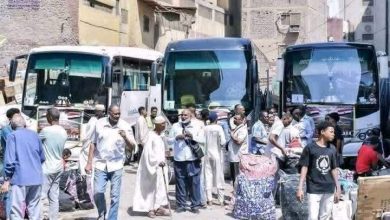
“We were about 1,700 migrants, mostly Sudanese ‘Janjos’ [a Sudanese term for marginalized seasonal workers], and others from Chad, Mali, Niger, Kenya, and Burkina Faso. We were stationed on Mount Gourougou overlooking Nador, waiting for the crossing moment,” he said.
But they were met with brutal force by Moroccan and Spanish security, who used tear gas, rubber bullets, and deadly baton strikes. Amnesty International reported that the methods used by Moroccan authorities contributed to the deaths of at least 37 people and injured many more. The fate of at least 77 migrants who attempted the crossing remains unknown. In July, a Moroccan court sentenced 33 migrants to 11 months in prison for charges including “illegal entry,” “setting fire to forests,” and “attacking public forces.”
“I narrowly escaped death. I almost lost my eye after being severely beaten by Moroccan forces,” Tarjouk said. After being arrested, he was transferred to Fquih Ben Salah, where he spent seven months doing temporary work.
The outbreak of war in Sudan between the army and the Rapid Support Forces in April 2023 complicated his situation further. “I could no longer return to my country.” He resumed his journey, this time through Tunisia, entering on foot from Algeria. He stayed in Sfax for a month, attempting to cross the sea twice before succeeding on the third attempt. On September 1, 2023, he boarded an 18-meter-long boat with 36 other Sudanese migrants and crossed the Mediterranean to Italy’s Lampedusa Island.
“We were organized—we rationed food and water and took turns sleeping in the boat. On the second day, the waves nearly drowned us,” Tarjouk recalled of the three days at sea. After spending 12 days in Italy and five months in Calais, France, he finally reached Yorkshire, UK, in March 2024.
A Story for Those Who Never Made It
A few months after arriving in the UK, Tarjouk wrote his testimony in a novel titled “Friday of Death”—a reference to the day of the tragedy. The book combines documentation with personal storytelling in simple Arabic, blending formal and Sudanese dialects.
He said: “After surviving the incident, I found myself breathing freely in a Moroccan city. I sat alone remembering what happened to me—and to so many of my companions who were killed. I told myself: one day, I will write about this as a memorial for those who lived it.”
Although the central event is the Melilla tragedy, the 13-chapter book also delves into the reasons behind Sudanese Janjos’ migration, as told through the voice of one of them, and the dangerous routes refugees take—from deserts to cities, from forests to the sea.
“I tried hard to write about what I saw during the incident and the lives of migrants in Morocco. I wanted to express the suffering that migrants face in general,” Tarjouk explained. He received support for the book from Sudanese writer Abdelaziz Baraka Sakin, who also helped him choose the title. He was also assisted by Omar Naji, head of the Moroccan Association for Human Rights in Nador, who provided data on the victims and missing persons. The book includes the names of 69 migrants—both deceased and missing—and 132 others who were imprisoned following the events.
“The victims were forgotten as if they were not human. No one was held accountable,” Tarjouk said. “I want justice for those who didn’t make it, compensation for their families, and the release of those still imprisoned in Moroccan jails.”
Today, after more than a year in the UK, Tarjouk has been granted asylum and is preparing to enter university. “I’ve changed direction—I no longer aspire to study medicine. Now I study English… and I continue telling the story so it won’t be forgotten.”