Prospects for Burhan’s Committee to Disarm Khartoum
Sudan Events – Agencies
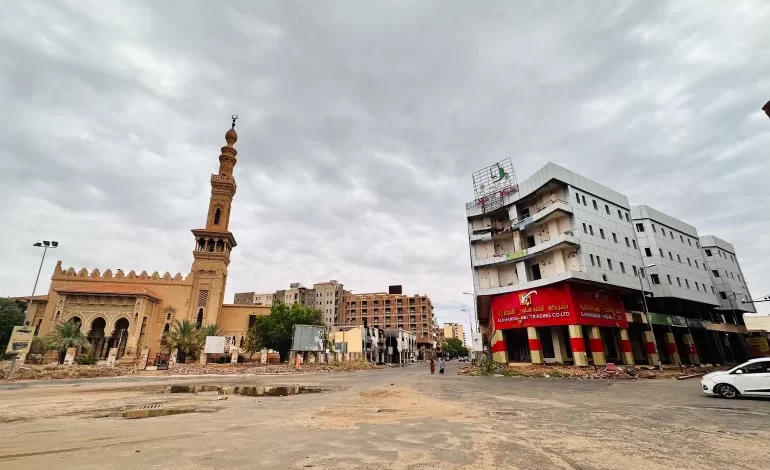
Amid the security breakdown that has plagued Khartoum since the outbreak of war between the Sudanese army and the Rapid Support Forces (RSF), Sudanese authorities are striving to restore normalcy to the capital’s streets. To that end, the Chairman of the Sovereignty Council, General Abdel Fattah al-Burhan, has formed a high-level committee tasked with clearing the capital of armed presence.
The decision was widely welcomed by citizens and business sectors, but it also raised questions about the feasibility of implementation, given the complex security and political situation.
The committee, which includes ministers, military and civilian officials, has been assigned multiple tasks: restoring basic services, eliminating military presence, stabilizing the security situation, and rebuilding infrastructure. However, executing these plans requires precise coordination among various security and military bodies.
Who is on the committee tasked with clearing armed presence from the capital?
The committee, established by General Burhan, is headed by Sovereignty Council member General Ibrahim Jabir. Its members include the Prime Minister, Ministers of Defense, Foreign Affairs, Energy and Mining, Health, Education, Interior, the Governor of Khartoum, and Major General Azahri Abbas Qasim Al-Sayed, who was appointed as the committee’s secretary.
What are the committee’s responsibilities?
The committee aims to normalize civilian life in the capital and facilitate the return of residents to their homes. Its primary task is to remove all combatant forces and armed groups from Khartoum within two weeks, in coordination with the Armed Forces General Staff.
Other responsibilities include enforcing state authority, eliminating negative practices, deporting illegal foreigners, clearing all informal settlements without exception, and restoring essential services such as electricity, water, health, education, transport, and markets. The committee is also tasked with infrastructure rehabilitation and proposing alternative locations for relocating government ministries.
What are the main challenges facing the committee?
Security and strategic expert Major General Dr. Amin Majzoub told Al Jazeera Net that the most complex task is clearing the capital of armed groups. This requires a detailed plan and organized fieldwork, starting with a coordination meeting among leaders of the armed forces, police, intelligence services, and joint forces from Darfur armed movements and mobilized groups.
This group would identify the locations, numbers, weapons, and withdrawal mechanisms of the forces, and determine whether new camps should be established.
Majzoub warned that the biggest challenge would be a lack of coordination, stressing that failure to implement the decision to end armed presence could lead to catastrophic consequences.
What is the position of the joint force on the committee’s decisions?
Although Abdullah Yahya, a Sovereignty Council member and leader of one of the Darfur armed movements, is on the committee, the Governor of Darfur and head of the joint force, Minni Arko Minawi, told the press that the Sovereignty Council had not officially informed them of any decision regarding the evacuation of combatant forces from the capital.
He said he learned of the decision through media reports and had not received any formal or informal communication on the matter.
How can Khartoum become livable again?
Security and strategic expert Major General Tareq Abdel Karim told Al Jazeera Net that removing armed groups is only part of a broader mission assigned to the committee. The main goal is to make Khartoum livable again by restoring services such as education, healthcare, electricity, and water, and rebuilding war-damaged infrastructure.
While some aspects of the security breakdown can be addressed by deploying police forces, Abdel Karim emphasized the importance of tackling major issues such as informal settlements and the presence of foreign nationals.
He stressed that time would be a critical factor in accomplishing the committee’s tasks, which should be pursued in coordination with all relevant bodies.
Where will the military formations be relocated?
Majzoub highlighted key unanswered questions, including whether the armed forces will remain in their old camps or be relocated elsewhere.
He emphasized the importance of transparency in presenting the plan to the public and taking into account security threats, especially given the rise in criminal gang activities such as kidnapping, murder, and intimidation in various parts of Khartoum.
What is the scale of security breakdowns in the capital?
Despite social media circulating reports of armed robberies — the most notable being the robbery of a gold trader in Omdurman — police spokesperson Brigadier General Fath al-Rahman Mohamed al-Tom told Al Jazeera Net that such incidents are clearly declining.
He noted that the security task force is focusing on dismantling looting networks, particularly those impersonating security forces, and that dozens of suspects have been arrested.
What do citizens think about the committee’s work?
Citizens told Al Jazeera Net that the proliferation of armed groups in the capital has allowed criminals to exploit the situation by wearing military uniforms and posing as security personnel to commit armed robberies. In response, gold traders in Omdurman launched an open strike following the robbery of one of their own on Al-Wadi Street.
Khaled Al-Khanjar Tibidi, head of the Gold Traders’ Chamber and senior goldsmith in Khartoum State, told Al Jazeera Net that they strongly support clearing the capital of armed presence “sooner rather than later.” He argued that the war is over and the continued presence of armed men among civilians poses a grave security threat, especially with thousands of criminals having escaped from prisons at the start of the conflict.
Similarly, Abu Bakr Ahmed, a trader in the Sabreen Market — the largest popular market in northern Omdurman — voiced his strong support for disarmament. He said the presence of diverse armed groups had turned from “a blessing to a curse.” Many traders now close their shops at 5 p.m. out of fear of lawlessness.
He also pointed out that the heavy security presence gives a misleading impression that the war is ongoing, although the capital is effectively free of RSF militias. Therefore, he called for the police to fully assume responsibility for maintaining order and for all combatant forces to withdraw to restore normal life.
Citizen Mohamed Abdel-Mutalib told Al Jazeera Net that he only leaves his home with his family in the evenings when absolutely necessary, due to frequent reports of looting and shootings on social media.
He strongly supports ending the military presence in Khartoum, calling it a necessary step to restore public confidence and encourage displaced persons and refugees to return to their homes in the capital.
Source: Al Jazeera