Sudanese Authorities Destroy Thousands of Unexploded Ordnances
Sudan Events – Agencies
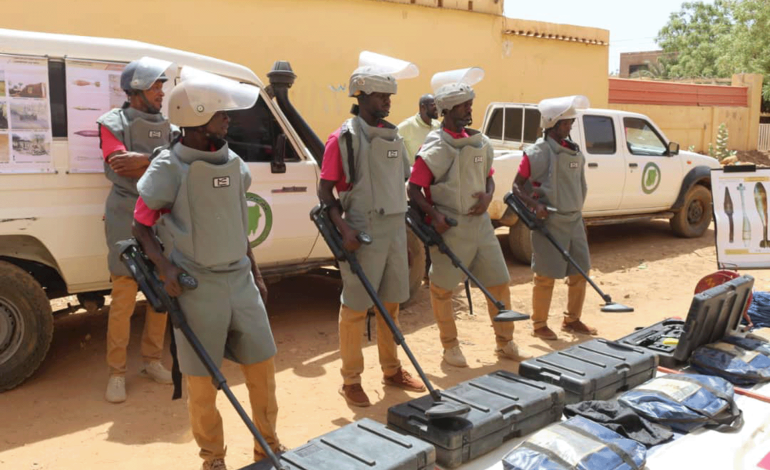
The National Mine Action Center in Sudan has announced the removal of thousands of remnants of war and unexploded ordnances, as well as the discovery of 5 to 6 fields of internationally banned anti-personnel landmines.
Accusations Against the Militia
The center accused the Rapid Support Forces (RSF) of planting minefields in areas of central Khartoum and Salha in southern Omdurman, which are currently being handled. In the Jili area, north of Khartoum, the mines were cleared by the engineering corps.
Major General Khalid Hamdan, the center’s director, told Al Jazeera Net that more than 37,000 unexploded shells have been destroyed in the past year, including 24,000 rounds of small arms ammunition in Khartoum State, 8,000 in Al-Jazira State, 7,000 in Sennar, and more than 1,200 in North Kordofan.
Hamdan added: “We have now collected more than 50,000 shells in Khartoum State, over 40,000 of them from small arms. These remnants will soon be destroyed.”
He clarified that the unexploded ordnances include rocket launchers, mortars, and various calibers of shells that were fired but did not detonate.
He also stated that the RSF heavily planted anti-tank mines north of Bahri, particularly in areas adjacent to the Jili refinery, the Jili region, and areas of Garri toward Hajar Al-Asal in northern Bahri.
The National Mine Action Center has recorded 59 deaths and injuries resulting from the explosion of war remnants in 28 incidents across several Sudanese states in 2024 (Khartoum, Al-Jazira, Sennar, North Kordofan’s Um Rawaba area, and the Blue Nile region), including 14 deaths and 45 injuries.
Hamdan noted that seven teams are currently operating in Khartoum—two funded by the government and five by the United Nations—along with teams working in Al-Jazira, White Nile, Sennar, North and South Kordofan, as well as awareness teams funded by UNICEF.
Lack of Funding
Hamdan said that limited government and UN funding remains one of the main challenges facing the center, which needs more teams to deal with war remnants, particularly in Khartoum, which is the most affected. He noted that only Canada has provided support to Sudan, while the European Union has offered only promises.
He added that the loss of all assets and equipment used in mine action by the center and related organizations poses another major challenge, especially with the widespread presence of war remnants throughout the country.
Prior to the outbreak of war in mid-April 2023, the National Mine Action Center had declared that Sudan was on the verge of being declared free of war remnants. However, war remnants and contamination have since spread to new areas, particularly urban centers, increasing the burden on civilians.
War remnants are now present in over 80% of Khartoum State and around 50% of Al-Jazira State.