How the Involvement of Foreign Mercenaries Is Escalating the War in Sudan
Sudan Events – Agencies
Sudan’s conflict is undergoing a dangerous and significant shift, as signs of internationalization become increasingly apparent. This is especially evident in the growing involvement of foreign fighters alongside the Rapid Support Forces (RSF), raising fears that the war may spiral beyond a local crisis into a wider regional and international conflict.
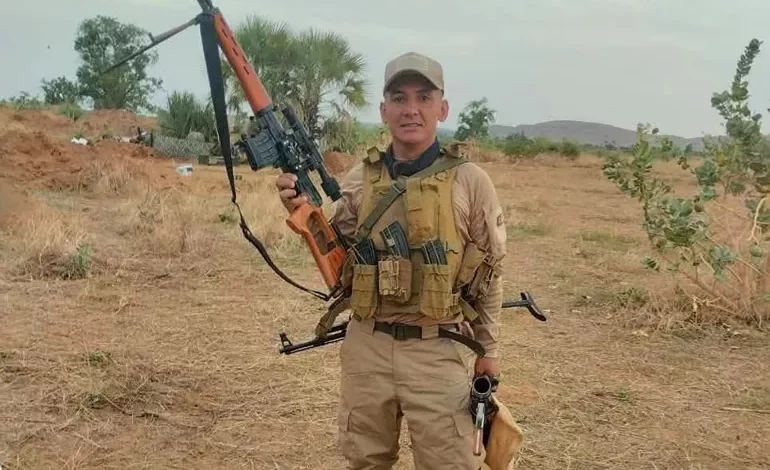
This week, activists and field sources circulated video footage reportedly showing a Colombian national fighting with the RSF during their recent assault on the city of El Fasher in western Sudan. The footage has sparked intense speculation about the nationality and identity of foreign combatants engaged in the war.
According to military sources speaking to Al Jazeera Net, the joint forces of the armed struggle movements discovered the body of a Colombian fighter during a sweep operation near the battlefront. They also found communication devices and radio equipment in Spanish, further reinforcing claims of foreign mercenaries actively participating in ground combat.
Official Confirmation
In a statement to Al Jazeera Net, Colonel Ahmed Hussein Mustafa, spokesperson for the joint force, confirmed that the circulated videos were retrieved from the phone of a foreign soldier of Colombian nationality, who had recorded his participation in the fighting before being killed.
“During our sweep operations,” Mustafa said, “we seized advanced military equipment not used by Sudanese army units, including specialized communication gear and camouflage patches typically employed in special operations, indicating the involvement of professionally trained foreign operatives.”
In contrast, Basha Tbeiq, political adviser to the RSF commander, denied the presence of any foreign fighters within RSF ranks. Speaking to Al Jazeera Mubasher, he described the accusations as “a desperate attempt to tarnish the recent battlefield victories” of the RSF, and claimed that “armed movements routinely resort to such allegations whenever our forces advance.”
Meanwhile, field investigations and expert reports in security strategy suggest that the RSF has indeed been deploying foreign fighters, most of them reportedly from Colombia, with advanced combat experience.
Strategic and security analyst Osama Aidarous told Al Jazeera Net that both the RSF and its backer have relied on foreign personnel from the onset of the war to carry out highly technical tasks — such as neutralizing aircraft and operating drones — tasks they lack the capacity to execute themselves.
He added that in recent months, particularly following a string of Sudanese army victories, there has been a noticeable increase in the number of foreign mercenaries on the battlefield. Their role, he noted, has expanded from technical support to direct participation in ground combat, especially within infantry units.
Foreign Agendas at Play
Aidarous explained that this escalation reveals a high level of attrition within the RSF, particularly among its field commanders. This, he said, has pushed its foreign backer to intensify military efforts to seize the strategically vital city of El Fasher.
“It’s clear this external actor has grown increasingly desperate to implement its full project in Sudan. It now seems focused on asserting control over El Fasher, as a symbolic political and military win to offset its cumulative losses,” he added.
For his part, Ahmed Abdel Rahim Abuoh — an expert in international law and strategic national security — revealed that the RSF is supported by a complex network of foreign backers. Some nations, he told Al Jazeera Net, offer direct financial aid, while others allow their airports and territory to be used for transporting weapons and foreign fighters. This forms part of a broader system designed to destabilize Sudan.
Abuoh also pointed to RSF efforts to reinforce its ranks with fighters from countries known for their mercenary networks. He argues that these moves are motivated by the narrow interests of certain leaders, without regard for the broader regional and international consequences.
He warned that the continued conflict in Darfur could create fertile ground for the growth of irregular migration and organized crime through Libya’s coasts — posing a direct threat to the security of southern Europe. He stressed the urgent need for the international community to respond by imposing immediate sanctions on countries supporting the RSF, as a crucial step toward enabling the Sudanese government to safely deliver humanitarian aid to besieged areas.
He further cautioned that any calls for a ceasefire without addressing the RSF’s logistical support systems would be ineffective and may only further entrench the crisis.
Compelling Evidence
Former editor-in-chief of the Sudanese Armed Forces Newspaper, Ibrahim Al-Houri, stated via Facebook that the body of a foreign fighter was found during a sweep operation. The fighter reportedly carried sophisticated military equipment, including modern communication devices and a camouflage badge indicating affiliation with elite Colombian army units.
Al-Houri noted that the confiscated badge featured a faint tactical version of the Colombian flag and the word “Colombia,” offering concrete proof of the fighter’s military identity. He added that such insignia are typically used by elite forces and special operations units, suggesting the individual may have been a retired soldier.
According to Al-Houri, the fighter was reportedly part of a group calling itself the “Desert Wolves Brigade,” a unit believed to be active in high-conflict zones, conducting specialized combat operations.
In this context, growing questions remain about the extent of foreign fighters’ influence on the trajectory of Sudan’s war. There is growing concern that their presence is accelerating the internationalization of the conflict, particularly amid continued violations against civilians — most prominently in El Fasher, the capital of the war-torn Darfur region.
Colombian President Responds
Reacting to the developments, Colombian President Gustavo Petro announced that he had urgently requested the drafting of legislation to ban the recruitment of mercenaries, following reports of Colombian nationals fighting alongside the RSF in Sudan.
In a post on X (formerly Twitter) on Thursday, Petro described mercenary recruitment as a form of human trafficking that turns people into tools for killing.
“They wanted war inside Colombia so badly that, with conflict waning at home, they sought it abroad — in a place that never harmed us,” Petro said.
He labeled those responsible for recruiting and deploying mercenaries as “murderers” and “ghosts of death.”
Petro added that he had instructed Colombia’s ambassador to Egypt to verify the number of Colombian fatalities in Sudan, amid unconfirmed reports suggesting up to 40 deaths. “We’ll see if we can recover their bodies,” he concluded.