Sudan: Shifting International Stance, Fierce Battles, and Silent Political Maneuvers
Sudan Events – Agencies
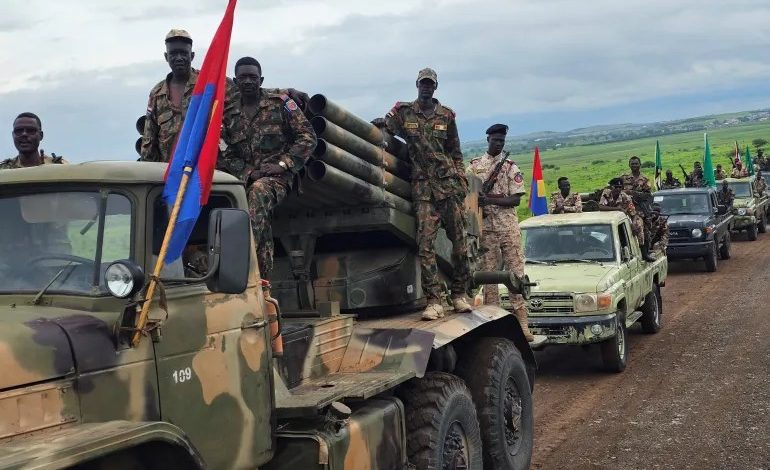
More than 28 months into Sudan’s war, the international community has sharpened its tone against the Rapid Support Forces (RSF), rejecting its attempt to form a parallel government in areas under its control. At the same time, the army is preparing for decisive operations in Kordofan as a prelude to advancing into Darfur.
Behind the scenes, quiet political reviews and backchannel discussions are underway in search of a way out of the deep divisions, coinciding with the accelerating return of growing numbers of displaced people and refugees to their home areas.
Since the army regained control of central Sudan and completed its hold on the capital Khartoum in May, it has shifted its military focus to Kordofan, where it has made significant gains in the north and west of the region. The RSF, however, has managed to halt this advance by mobilizing large forces and turning Kordofan into a forward defensive line protecting Darfur.
Over the past two months, the fighting has been marked by a cycle of advances and withdrawals. The army has relied heavily on drone warfare to wear down its adversary by cutting RSF supply lines, targeting field commanders, and destroying vehicles. In a first since the outbreak of the war, forces of the SPLM-North under Abdelaziz al-Hilu have appeared outside their South Kordofan strongholds, fighting alongside the RSF under the framework of the “Ta’sis” alliance led by Mohamed Hamdan Dagalo (Hemedti).
According to the Joint Forces in Darfur, al-Hilu’s fighters took part in recent assaults on El Fasher and are also involved in the sieges of Kadugli, the South Kordofan capital, and Dilling—creating dire humanitarian conditions similar to those in El Fasher.
A New Phase
In response, the army and its allied factions have set their sights on breaking these sieges, including that of Babanusa in West Kordofan. Political and military mobilization has already begun in El-Obeid, the capital of North Kordofan, and in Port Sudan, the country’s temporary administrative capital, in preparation for a new phase of operations.
Military analyst Abubakr Abdel Rahim predicts “fierce battles” in Kordofan in the coming weeks, noting that the army’s recent strategy of attrition is likely a prelude to a larger confrontation—similar to last year’s campaigns in Jabal Moya, Sennar, and Wad Madani in Gezira State.
He added that the recent visits of Sovereign Council Chairman and army chief Abdel Fattah al-Burhan to front-line positions in Rahid al-Nuba, followed shortly by his deputy Yasir al-Atta, are strong signals of imminent large-scale offensives.
Abdel Rahim argues that the army’s push into Kordofan and its bid to move on Darfur are also aimed at preempting any peace negotiations that might freeze the current battle lines. The RSF, meanwhile, is seeking to tighten its grip on El Fasher to strengthen its leverage in potential future talks.
International Escalation
Last week saw a notable shift in international positions toward the RSF. The UN Security Council issued a statement rejecting its announcement of a parallel government, warning that such a move threatens Sudan’s unity and risks worsening the conflict. The Council reiterated Resolution 2736 (2024), which demanded the lifting of the siege on El Fasher.
Three days later, U.S. Special Envoy Musaad Boulos condemned the killing of civilians by RSF forces in Abu Shouk camp near El Fasher, urging the group to end the blockade.
UK Foreign Secretary David Lammy threatened to refer RSF leaders to the International Criminal Court over abuses against civilians, while Germany’s foreign ministry warned that “hundreds of thousands” of El Fasher’s residents face the risk of starvation.
Sources told Al Jazeera Net that Burhan’s meeting with U.S. envoy Boulos in Zurich followed a series of security understandings between Khartoum and Washington on counterterrorism, irregular migration, and human trafficking, with expectations that an American envoy will soon be dispatched to Port Sudan.
Domestic Political Shifts
The polarization among Sudanese factions remains entrenched. Some groups joined the “Ta’sis” alliance alongside the RSF, while others stood firmly with the army. A number of civilian forces opted for neutrality or distance.
But shifting battle lines and regional and international pressures are driving many actors to reconsider their positions and seek compromise instead of exclusionary strategies.
Political sources point to recent undisclosed meetings between former rivals, where initial understandings were reached on the need for mutual concessions to prevent scenarios threatening the country’s unity.
In this context, AU, IGAD, EU, and Finland’s CMI officials have held consultations with the Democratic Bloc of the Forces for Freedom and Change, proposing a possible meeting in Helsinki this September with the “Sumood” alliance led by Abdalla Hamdok.
By contrast, Islamist-leaning factions and other parties boycotted informal talks organized by a French group in Brazzaville, rejecting what they called the “Islamist bloc” label and insisting Sudan’s fate should be decided only by its own people.
In Port Sudan, the Sovereign Council’s political committee has intensified consultations with political and social forces to form a transitional parliament as stipulated in the amended constitutional declaration. Parallel talks are also underway on drafting a roadmap for an inclusive national dialogue, with indications that some criminal cases against opposition leaders may be frozen as a goodwill gesture.
Return of Refugees and Displaced
On the ground, relative stability in Khartoum and central Sudan has accelerated the return of displaced people and refugees. UN estimates suggest more than 1.3 million people have returned to their areas since the start of the year, while government sources claim over 3 million have gone back in Gezira and Sennar states alone.
Several initiatives are supporting this return, including free airlifts from Cairo, expanded train services between Egypt and Sudan, and new sea routes from Jeddah across the Red Sea.
The return extends beyond civilians. Sudanese media outlets are gradually reestablishing themselves in Khartoum, with preparations underway for the reappearance of print newspapers after more than a century of continuous publication was broken. Thousands of journalists and correspondents are also returning to the capital to resume their work after losing their livelihoods during the conflict.
Meanwhile, the Ministry of Energy has announced that full power supply to Khartoum State will be restored by the end of September, most water networks have been reactivated, and partial reopening of Khartoum airport for domestic flights is being prepared.
Source: Al Jazeera Net