Why Does the RSF Insist on Targeting Abu Shouk Camp After Zamzam?
Sudan Events – Agencies
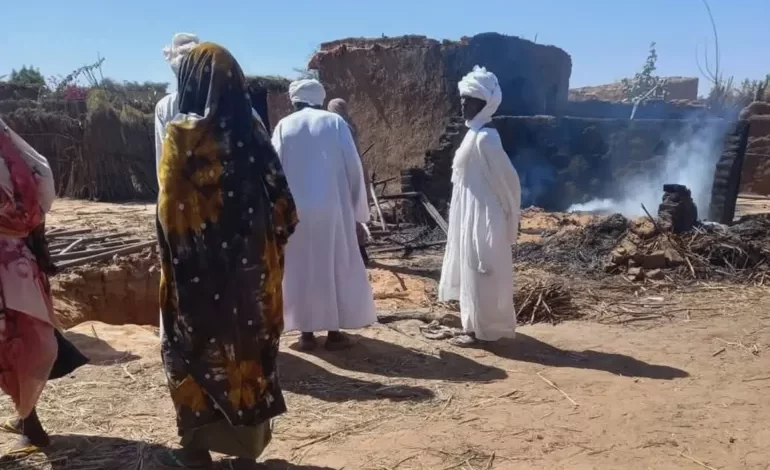
The Rapid Support Forces (RSF) have intensified their attacks over the past two days on Abu Shouk camp for displaced people, located on the outskirts of El Fasher, the capital of North Darfur State. The escalation comes amid a suffocating siege the RSF has imposed on the city since June 10, 2024, with UN warnings of a worsening humanitarian crisis and mounting violations against civilians.
In response, the Sudanese Armed Forces (SAF), in coordination with the Joint Force of armed struggle movements and the Popular Resistance, repelled the RSF assault on El Fasher and the vicinity of Abu Shouk camp, in what the military command described as “Battle No. 232.”
Colonel Ahmed Hussein Mustafa, spokesperson for the Joint Force, told Al Jazeera Net that the army, joint forces, and the Popular Resistance fought fierce clashes on multiple fronts around El Fasher and Abu Shouk. He said they succeeded in breaking waves of infiltration and forcing attackers to retreat under heavy fire, leaving behind their dead and large quantities of equipment.
He added that Saturday’s operation destroyed five RSF combat vehicles, seized eight others in good condition, and secured strategic sites previously used as bases for attacks and looting.
Popular Resistance
Speaking to Al Jazeera Net, Abu Bakr Ahmed Ammam, spokesperson for the Popular Resistance in North Darfur, said the assault on Abu Shouk is part of a systematic escalation targeting defenseless civilians, echoing what happened at Zamzam camp, where displacement camps have now become open battlegrounds.
He stressed that the RSF is using these attacks to terrorize residents and impose a new reality by force. But he noted that the Popular Resistance, working alongside the army and the Joint Force, has managed to neutralize hundreds of RSF fighters and capture several combat vehicles.
Ammam urged the international community to act urgently to lift the siege on El Fasher, especially amid disease outbreaks and acute shortages of food and water. He vowed that the Popular Resistance “will not back down from defending the city, no matter how the aggression escalates.”
Eyewitnesses told Al Jazeera Net that RSF fighters stormed Abu Shouk camp on Saturday morning from the north and east, killing six people and abducting eight women—including two young girls—to an unknown location. Panic and fear spread throughout the camp, where residents already face dire conditions in the absence of meaningful international protection.
A Repeated Pattern
Local observers note striking similarities between the assault on Abu Shouk and the RSF’s attack on Zamzam camp four months earlier, which involved multi-directional shelling, house burnings, targeted killings, and the abduction of women amid accusations of grave abuses against civilians.
Activists argue that the pattern at Abu Shouk is almost a replica of Zamzam, particularly in targeting the most vulnerable groups, fueling fears of a deliberate plan to empty the camps or use them as leverage in the ongoing war.
Abu Shouk camp lies about four kilometers north of El Fasher. It was established on April 20, 2004, as a temporary shelter for those displaced by the Darfur war that erupted in 2003. Over time, the camp grew into a densely populated neighborhood housing more than 47,000 displaced people from Jebel Marra, Tawila, and Shangil Tobayi, becoming part of the city’s urban fabric—and, in the current escalation, a military target.
Colonel Mustafa explained that targeting camps like Zamzam and Abu Shouk carries political and social symbolism, as they host all of Darfur’s ethnic and social groups—from Zaghawa and Fur to Arabs, Masalit, Tunjur, and Berti.
“This diversity made the camps models of coexistence,” he said, “which is why the militia attacks them—to undermine social cohesion and sow division. Zamzam was outside El Fasher, but Abu Shouk lies inside it. That shows the RSF is trying to dismantle the city from within by striking at the vital cells that embody the true spirit of Darfur.”
A Humanitarian Plea
In remarks to Al Jazeera Net, relief activist Yousif Adam described conditions inside Abu Shouk camp as “catastrophic by every measure,” reflecting the worsening humanitarian crisis. He said aid teams face immense challenges in reaching those in need due to the RSF’s heavy artillery shelling of the camp.
He added that the situation is deteriorating rapidly, with large numbers of women and children suffering acute food shortages. Many have been forced to eat livestock fodder known locally as ambaz, supplies of which are nearly exhausted. With no functioning markets and no access to basic staples, families face impossible choices.
Despite repeated international calls for a ceasefire and an end to the siege of El Fasher, fighting continues unabated, with Abu Shouk camp and the city’s western districts at the center of the clashes. Observers warn that if the violence persists, it could collapse the city’s social fabric and plunge Darfur into an even more complex crisis.
Source: Al Jazeera