Khartoum Embraces Life Again: A Wave of Voluntary Returns Amid Health and Service Challenges

Sudan Events – Agencies
Amid the rubble of Khartoum’s commercial market, 60-year-old fabric trader Mohamed Ezzeddin sits trying to reorganize the remnants of his war-ravaged shop. The walls still bear graffiti praising the Rapid Support Forces, while the store remains shrouded in darkness due to a power outage.
“I’ve been trying for days to muster the resolve to get back to work,” Ezzeddin told Al Jazeera Net as he attempted to tidy up his shop. “But as you can see, the market’s recovery is still a long way off.”
Living in the southern part of the capital, Ezzeddin says housing conditions are relatively better, with the number of returnees increasing since last Eid al-Adha. Still, he notes that water and power cuts, coupled with outbreaks of fever—particularly dengue—have driven many people to leave again or advise others not to return.
On the Nile’s Banks
On the western bank of the Nile, near Omdurman, farmer Bella Ibrahim stands watching over his crops, visibly optimistic after returning to his fields.
“Until the start of this year, no one could come near this area because of snipers and gunfire,” he said, pointing to leftover munitions still scattered across the land. “Now we’re back to farming and producing enough to supply the capital, north and south.”
Khartoum State Minister of Agriculture, Animal Resources, and Irrigation, Fadl al-Mawla Abdel Latif, confirmed Ibrahim’s account. He said most farmers had resumed cultivation along the Nile, with vegetable, onion, and potato production returning in abundance—particularly in the northern countryside.
The minister added that the government had distributed seven varieties of improved seeds to more than 2,000 households in Khartoum, Bahri, and Omdurman to support home-based agriculture.
Still, he acknowledged major setbacks, with seven large agricultural projects—including Sleit, Soba West, Al-Asaylat, and Sondos—remaining out of operation.
Health Crises
In the southern and central neighborhoods of al-Imtidad and al-Kalaklat, residents are returning in large numbers. Yet public health challenges loom. Two years of abandonment have left piles of garbage and overgrown weeds, creating an ideal breeding ground for flies and mosquitoes. Malaria and dengue fever cases are surging at alarming rates.
“The number of deaths from these diseases is high. My friend died of fever just yesterday, and dozens more are suffering,” said Ayman Hamid, a resident of Abu Adam.
Hamid told Al Jazeera Net that the Health Ministry was concentrating its efforts on major hospitals, while smaller neighborhood clinics—vital for local access—remained shuttered. He said he was forced to leave his area to transport a neighbor, who had just returned from Egypt, after the man contracted dengue fever only days after arriving.
Security Stability
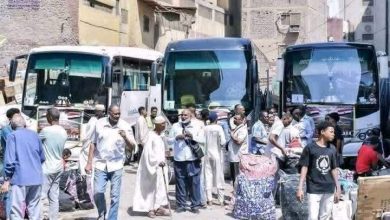
Despite dire health and environmental conditions, a relative improvement in security—bolstered by a visible police presence—has encouraged voluntary returns, particularly from abroad. Egypt, which has hosted the largest number of Sudanese since the war began, is now seeing a notable uptick in return flows.
Engineer Omaima Abdullah, head of the Voluntary Return Committee within the Defense Industries System, told Al Jazeera Net that her committee had organized eight train convoys by mid-August 2025. Each carried around 1,200 Sudanese from Cairo to Aswan, before they were transferred by bus to various states.
Meanwhile, Khartoum State authorities are monitoring the demographic shifts. State Minister of Social Affairs Sadiq Farini said his ministry had been accompanying neighborhood “liberation” operations on the ground to provide food and supplies to residents through communal kitchens and other aid channels.
Farini added that the government had prepared a three-month emergency plan targeting vulnerable groups and impoverished families as the pace of returns accelerates.
He acknowledged that water and power shortages continue to disrupt daily life, but stressed that conditions are far better now than at the onset of the war. “Khartoum State is committed to gradually restoring essential services in tandem with the return of its people,” he said.
Source: Al Jazeera