Renewed Crisis for Sudanese Schools in Egypt Amid Closure of Educational Centers
Sudan Events – Agencies
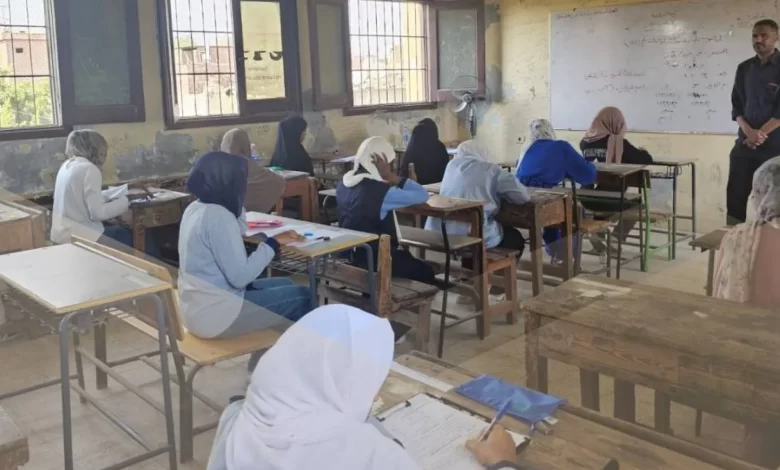
The crisis over the legal status of Sudanese schools in Egypt has resurfaced following the suspension of several “schools and educational centers” and official warnings issued to others over administrative and regulatory violations. The move has sparked debate among Sudanese residents in Egypt regarding its impact on their children’s education.
In June last year, Egyptian authorities ordered the closure of all Sudanese schools operating in the country until their legal frameworks were regularized and new regulations agreed upon. Some institutions were later allowed to reopen.
On Saturday evening, the “Sudanese Friendship School,” which operates under the Sudanese Embassy, announced that, under the supervision of the embassy’s Cultural Affairs Office, it had suspended the activities of 73 schools and educational centers in Egypt and banned them from teaching the Sudanese curriculum entirely. The decision cited reasons such as “premature opening of the academic year, the adoption of extended-year systems, or printing textbooks without the school’s approval.”
The school also issued final closure warnings to 40 institutions, granting them 72 hours to comply with regulations. These schools were either advertising or had already started registration for the 2025–2026 academic year, or failed to cooperate with the embassy’s “School Survey Committee.”
According to recent statements from the Sudanese Embassy’s cultural attaché in Cairo, reported by the Sudan News Agency, embassy officials conducted field visits in April and May to schools in Cairo and Giza as part of preparations for accommodating Sudanese students.
The decision by the Friendship School raised questions among Sudanese communities in Egypt as to why the embassy itself did not take direct responsibility for such measures. The embassy could not be reached for comment by Asharq Al-Awsat.
Meanwhile, Mohamed Jabbara, a member of the Sudanese-Egyptian Friendship Association, confirmed that Egyptian authorities had only issued one official license to the Friendship School. He explained that the school, in cooperation with the embassy’s cultural office, was authorized to grant affiliated licenses to other centers under specific conditions.
“The school is working to ensure the necessary requirements are in place for students’ official registration,” Jabbara told Asharq Al-Awsat, noting that many of the suspended schools had not yet opened, while some only had preliminary approvals. He added that the demand for schools may decrease as more Sudanese citizens return home.
On Sunday, 13 trains departed as part of the voluntary return initiative for Sudanese citizens in Egypt, according to Egypt’s Ministry of Transport. Nearly 10,500 Sudanese nationals have been repatriated through 11 trips so far, with an average of 940 passengers per journey.
Official estimates suggest that Egypt currently hosts around 1.2 million Sudanese who fled the ongoing war, in addition to millions more long-term residents.
Sami Al-Baqi, spokesperson for the Sudanese Teachers’ Committee, said the measures were aimed at curbing “education brokers who exploit students’ futures amid the lack of a clear reference framework from the embassy and the absence of host-country regulations.”
He warned, however, that the new decisions could allow the Friendship School to monopolize Sudanese education in Egypt without addressing the real challenges facing students. Al-Baqi stressed that the embassy’s Cultural Affairs Office should be the body overseeing Sudanese formal education in Egypt, predicting that Sudanese authorities might intervene to amend or overturn the recent measures.
The start date for the Sudanese school year in Egypt has yet to be set and, according to Al-Baqi, will depend on when classes begin in Sudan’s River Nile State.