Analysis: What Does the Liberation of Bara Mean for the Course of the Sudanese War?
Sudan Events – By Munzir Osman / AI Editor
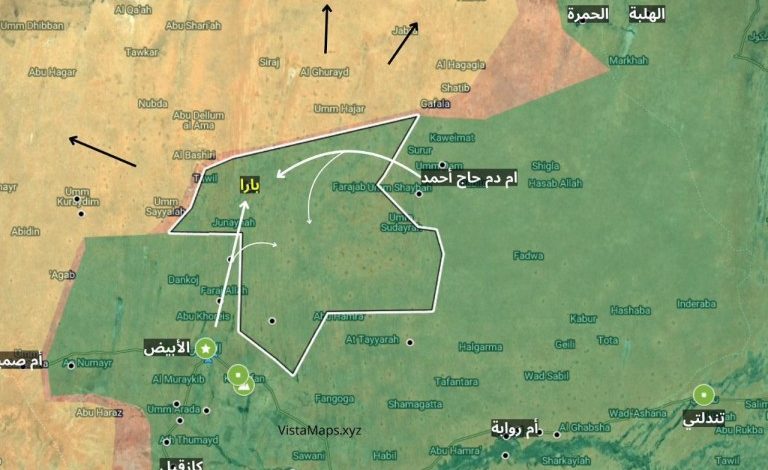
The Sudanese Armed Forces (SAF) have announced the liberation of the strategic city of Bara in North Kordofan, following what was described as fierce battles that inflicted heavy losses on the Rapid Support Forces (RSF).
Bara lies around 60 kilometers from El-Obeid and serves as a key transportation hub linking the capital, Khartoum, to the depths of Kordofan and Darfur—granting it both military and economic significance.
Observers argue that retaking Bara brings a series of advantages:
1. Securing the western approaches to Khartoum over a stretch of more than 500 kilometers.
2. Safeguarding El-Obeid and reinforcing its role as an administrative and economic center.
3. Reactivating El-Obeid’s airbase to launch wide-ranging air operations westward.
4. Opening the road to West Kordofan and Darfur, effectively dismantling the RSF’s plan to turn Kordofan into a buffer zone.
Political and Popular Reactions
Darfur’s regional governor, Minni Arko Minnawi, welcomed the victory, describing it as “a triumph for all of Sudan” and stressing that the resilience of citizens is a sign of “approaching deliverance.”
He emphasized that the unity of the army with joint forces and popular resistance gave the battle a national character, reaffirming that defending the land is a collective cause beyond divisions.
Air Power and Logistics
The Sudanese Air Force announced strikes on five separate RSF targets across Greater Kordofan, coinciding with the takeover of Bara—signaling an intensification of the aerial campaign.
Moreover, the reopening of the supply route from Omdurman to Kordofan allows smoother military logistics, granting SAF a logistical edge for future operations.
Towards El-Fasher and Darfur
Analysts argue that the liberation of Bara marks a transition for the army from a defensive to an offensive posture.
With talk of coordinated advances across Greater Kordofan, the next phase is expected to focus on Darfur—where the city of El-Fasher remains the “decisive battlefield” that could determine the war’s outcome.
Key Implications of Liberating Bara
1. Geographic Position and Military Symbolism
Bara, located in North Kordofan about 60 km northeast of El-Obeid, serves as a strategic gateway between Khartoum and the interior of Kordofan and Darfur.
Its capture secures vital supply lines and shifts the military balance in one of the most crucial theaters of war.
Historically, Bara also carries symbolic and economic weight, making its liberation both a morale boost for SAF and a meaningful victory for local communities.
2. Securing Strategic Depth for Khartoum and El-Obeid
With Bara under control, the 500 km stretch west of Khartoum is better protected, reducing risks of RSF incursions into the capital.
Most importantly, the victory ensures the security of El-Obeid, the capital of North Kordofan and a key hub linking eastern and western Sudan.
3. Reactivating the El-Obeid Airbase
El-Obeid hosts a major airbase whose operations had been constrained by RSF threats around Bara.
The city’s liberation allows SAF to fully restore the base, enabling deeper air raids into West Kordofan and Darfur.
This turns El-Obeid into a primary launchpad for expanded military campaigns, reducing reliance on distant bases such as Wadi Seidna or Merowe.
4. Shifting the Balance Westward
Bara represents the entry point for SAF’s westward push into Kordofan and Darfur.
Its capture nullifies RSF’s strategy of creating a “buffer zone” and secures SAF’s supply corridor from Omdurman into Kordofan.
Pressure will now mount on Darfur, with coordinated offensives expected against major cities like El-Fasher and El-Geneina.
5. Political and Psychological Dimensions
Governor Minnawi’s remarks underline the broader significance of the victory—not merely military but also a signpost toward the liberation of Darfur as a whole.
The win strengthens bonds between SAF and popular resistance forces, transforming the conflict into a truly national struggle.
A potential visit to the area by General Abdel Fattah al-Burhan could further cement the victory’s political weight and send a strong message to both allies and adversaries.
6. Battlefield Consequences
The continuation of heavy airstrikes, with reports of SAF targeting multiple RSF positions across Greater Kordofan, indicates preparation for broader ground offensives.
Reopening the direct supply line from Omdurman to Kordofan will streamline troop and equipment movements, granting SAF greater operational flexibility.
Strategically, the liberation of Bara accelerates scenarios of SAF forces converging on Darfur, with El-Fasher—dubbed “Sudan’s Stalingrad”—likely to become the decisive battleground.
Conclusion
The liberation of Bara is more than a battlefield success—it represents a strategic turning point in Sudan’s war.
Security: Protects Khartoum and El-Obeid.
Military: Opens the path westward and reactivates El-Obeid’s airbase.
Political: Boosts public confidence and undermines the notion of “buffer zones.”
Strategic: Puts SAF on the offensive, paving the way for the battle over Darfur—with El-Fasher as the likely decisive showdown.