War and Cholera Deepen Crises in Darfur and Kordofan
Sudan Events – Agencies
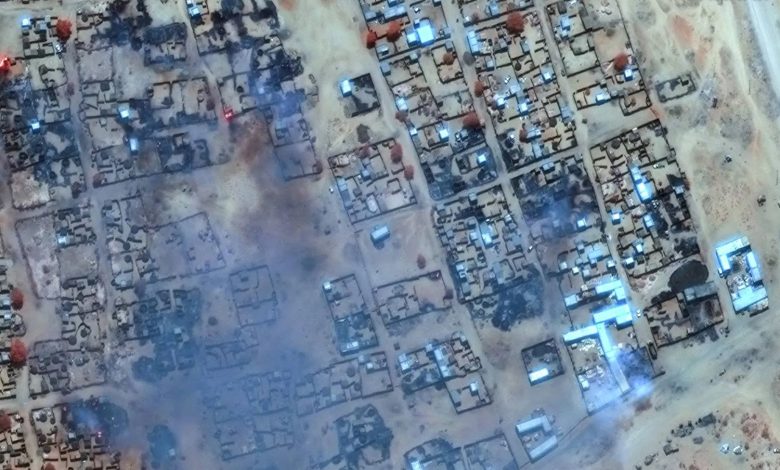
Local sources in Sudan report that intensifying clashes in the Darfur and Kordofan regions, coupled with a worsening cholera outbreak, are “escalating and devastating both regions and their populations.” According to the sources, Al-Fashir—the largest city in Darfur—witnessed fierce fighting early Monday between the Sudanese army and the Rapid Support Forces (RSF), which have besieged the city for over a year.
Sources told Asharq Al-Awsat that the army continues to repel repeated RSF offensives targeting the southern and eastern approaches to Al-Fashir, in a push to reach the army’s divisional headquarters in the city center. Al-Fashir remains the army’s last stronghold in Darfur, while the RSF controls much of the vast region.
Meanwhile, Sudan’s General Coordination for Displaced Persons and Refugees announced that 25 people had died in Darfur within 48 hours. Citing spokesman Adam Regal, Sudan Tribune reported that 12 people died from cholera on Saturday and 13 more on Sunday.
The cumulative caseload since the outbreak began has now reached 11,733, including 454 deaths. The worst-affected area lies 60 kilometers west of Al-Fashir, accounting for 5,417 cases and 78 deaths. The spokesman said the region recorded 58 new infections on Sunday, warning that the epidemic continues to spread in Jebel Marra, Zalingei, Nyala, and displacement camps in South Darfur.
“These challenges threaten people’s lives and represent a nightmare and a forgotten humanitarian catastrophe ignored by the international community in a country torn apart by war, famine, disease, and food shortages,” Regal said.
Darfur has faced an unprecedented cholera outbreak since June, according to humanitarian agencies and civil society groups.
Escalating Battles in Kordofan
In Kordofan, the RSF released video footage on social media claiming to have regained control of the strategic area of Kazgil in the north, capturing large numbers of army troops and allied fighters.
The region has seen a surge in fighting in recent days, with ongoing clashes about 40 kilometers south of El-Obeid, Kordofan’s largest city.
In a statement on Telegram, the RSF said it had secured full control of Kazgil and Al-Riyash on Monday after decisive battles with the army, and was advancing on multiple fronts toward El-Obeid. The statement claimed the army suffered “heavy casualties amounting to hundreds of dead,” while the RSF seized 43 military vehicles and destroyed dozens more.
The RSF described the operation as a significant step in its broader campaign to capture El-Obeid and push toward other strategic targets.
Sudan Shield Forces and Rising Casualties
Armed groups fighting alongside the army have mourned the loss of several senior commanders in recent battles around El-Obeid. The Sudan Shield Forces, led by Abu Aqla Kikel, announced the death of Qamar al-Din al-Jazouli, commander of the Dinder sector, in Bara—retaken by the army last week in what it called its biggest gain in Kordofan. Also killed was officer Mohamed Malik al-Zein, a member of Kikel’s security detail.
Kikel, who defected from the RSF last year to join the army, commands forces largely drawn from central Sudanese tribes. His troops have fought in campaigns to retake Gezira state and Khartoum, and are now deployed in Kordofan.
Separately, the commander of the Al-Baraa bin Malik movement, Musbah Abu Zaid Talha, confirmed on Facebook that five of his group’s leaders were killed in Kordofan, including Abdel Rahman al-Kheir (Khartoum sector), Khalid Abdullah and Abdel Aziz Yahya (Port Sudan sector), and Mohamed Abdullah and Abdel Sattar Jaber (West Kordofan sector).
The U.S. Treasury last week sanctioned Al-Baraa bin Malik, one of the most prominent Islamist militias linked to ousted president Omar al-Bashir, citing its role in fueling the April 2023 war and its receipt of training and weapons from Iran’s Revolutionary Guard.
Allegations of Atrocities
The U.S. Treasury accused Al-Baraa bin Malik fighters of committing “brutal torture and extrajudicial executions” of civilians in areas recaptured by the army in Khartoum and central Sudan, describing the group as a major obstacle to ending Sudan’s civil war.
In August, senior commander Muhannad Ibrahim Fadl, the group’s military operations chief, was killed. He was eulogized by Islamist leader Ali Ahmed Karti, secretary-general of Sudan’s Islamic Movement.
Pro-RSF social media accounts claimed that recent militia leaders were killed in Bara by drone strikes with precise targeting coordinates.
There is no official death toll for Al-Baraa bin Malik, estimated to number around 20,000 fighters, though the RSF claims to have killed hundreds of them in Kordofan battles.
The army and its allies also suffered heavy losses in clashes around Al-Khuwei, Umm Sumaymah, and Kazgil in May, forcing them to withdraw to their main base in El-Obeid. The military now views the current Kordofan battles as key to opening the way toward breaking the RSF siege of Al-Fashir, Darfur’s largest city.