What Lies Behind the Deportation of Migrants from Sudan?
Sudan Events – Agencies
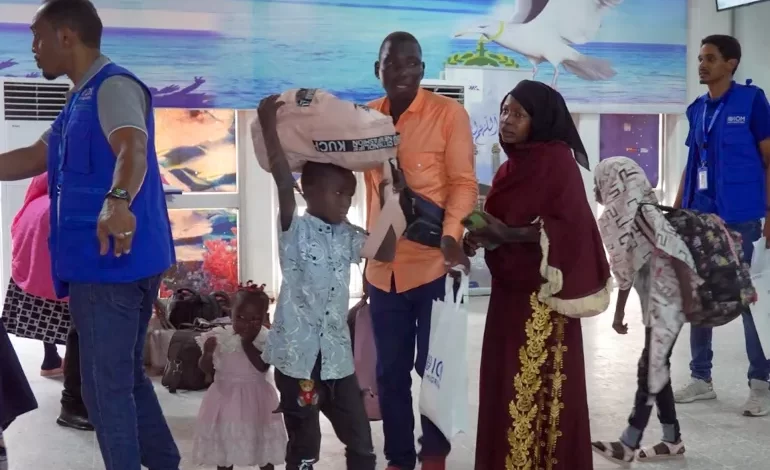
The International Organization for Migration (IOM) has repatriated a group of stranded Nigerian migrants from Sudan to Kano, Nigeria, in what the organization described as a highly significant humanitarian operation.
A total of 300 migrants are to be returned in two phases. The first flight departed today, Thursday, carrying a number of migrants from Port Sudan International Airport to Lagos, while the second is scheduled for September 24.
A Difficult Departure
Clutching a small prayer bead in his hand, 30-year-old Nigerian migrant Ibrahim Mohammed sat watching families line up at Port Sudan airport, preparing to return with him to Kano. “I wished my wife could be on the same flight. I’m expecting a child soon. Perhaps she’ll join me in the coming days,” he told Al Jazeera Net.
Ibrahim had been working as a rickshaw driver in the Mayo district of southern Khartoum before fleeing to Port Sudan in the early weeks of the war, abandoning his vehicle without knowing its fate. “Life is more precious,” he said.
He never imagined what would follow—sleeping in the streets, working as a porter, and often going days without food.
After two years in Port Sudan, he says his situation has slightly improved, having found a job that provided him with shelter and daily sustenance.
Ibrahim first arrived in Sudan five years ago with nothing but a small bag containing a single pair of shoes and two pieces of clothing. He worked in Khartoum until he was able to improve his life.
All he hopes for now, he says, is to one day return to Sudan. “It was my inability to provide for my family that pushed me to join this repatriation program,” he said, expressing his deep longing to reunite with his loved ones.
Like Ibrahim, Mohammed Abdullah broke down in tears when asked how he felt about returning to Nigeria. After a pause, he said his father had died in Nigeria during his time in Sudan. Mohammed had arrived in the country 12 years ago with part of his family, whom he now leaves behind.
He once ran a phone repair shop in the Mayo district, which he was forced to abandon when the war broke out, fleeing instead to Port Sudan.
In Cooperation with the Government
Mohamed Refaat, IOM’s Chief of Mission in Sudan, said the organization’s flight carried 146 migrants stranded in conflict zones across the country, most from Khartoum and others from Gezira state.
Speaking to Al Jazeera Net, Refaat explained that the migrants repatriated were Nigerians who will be returned to Kano state. Most had been in Sudan for two to three years, and the majority belonged to vulnerable groups such as women, children, and people with disabilities who had originally come to Sudan seeking work or education.
He confirmed that the program was carried out in direct cooperation with the Sudanese government and that two further flights will follow in the coming months to return the remaining Nigerian migrants.
For his part, Acting Commissioner-General for Humanitarian Aid, Counselor Ahmed Mohammed Osman, said the program to return Nigerians from Sudan falls within broader efforts to facilitate the voluntary return of foreigners and migrants. He noted that most of those repatriated today were students and persons with disabilities, with women and children making up about 90 percent.
Osman stressed that the Sudanese government continues to make “immense and tireless efforts” to host refugees and foreign migrants, who share food, shelter, and services with the Sudanese people.
He explained that the Nigerians repatriated today—and those to follow—were hosted in Sudan with UN coordination. He added that the partnership between the government and IOM would contribute to addressing the challenges of irregular migration.
Osman further noted that this repatriation reflects support for sustainable solutions, particularly after the migrants’ living conditions deteriorated in the wake of the war engulfing the country.
“Voluntary Return”
Ambassador Onour Ahmed, Director of Borders and Foreigners at Sudan’s Ministry of Foreign Affairs, said the operation was part of the government’s efforts—carried out in coordination with IOM—to regularize the status of foreigners in Sudan. He confirmed that the flights would operate from Port Sudan to Lagos.
Speaking exclusively to Al Jazeera Net, he emphasized that this was a voluntary return of migrants who had entered Sudan irregularly without legalizing their status, clarifying that they were not refugees.
Meanwhile, Osman Abdullah Awad al-Karim, Assistant Commissioner for Refugees in Red Sea State, said the move reflects Sudan’s policy of regularizing the presence of foreigners following recent events. He added that this marks the second wave of deportations of foreigners from Sudan. “Sudan maintains asylum entry points at all its borders for those whose humanitarian conditions necessitate refugee protection,” he said.
Source: Al Jazeera