A Reading of Kamil Idris’ Speech at the United Nations: Message and Impact
Sudan Events – Agencies
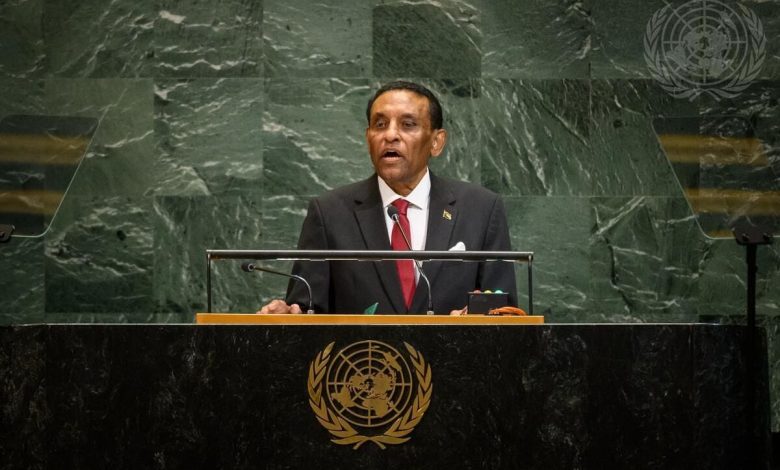
The United Nations General Assembly has witnessed an official international recognition of the legitimacy of Sudan’s civilian government, as Prime Minister Dr. Kamil Idris addressed the world body on behalf of Sudan and the Sudanese people.
Civilian Rule
Delivering his speech late on Thursday during the 80th session of the UN General Assembly, Idris reaffirmed his civilian government’s commitment to strengthening democratic transition and civilian governance. Speaking before Assembly President Annalena Baerbock and UN Secretary-General António Guterres, as well as heads of state and international delegations, Idris emphasized that his government was acting in fulfillment of the pledge made by General Abdel Fattah al-Burhan to appoint an independent civilian cabinet.
Confronting Challenges
Idris opened his address with the slogan: “Hope Renewed in Our Unity, Strength Found in Our Peace,” stressing the urgency of addressing global challenges that undermine international order, including the erosion of international law and the surge in genocide and aggression. He highlighted Sudan’s suffering at the hands of the rebel Rapid Support Forces (RSF), which over the past three years have displaced civilians, carried out killings, looting, and sexual violence, seeking to seize control of the country’s resources and alter its demography.
Building Trust
He urged for greater trust, transparency, and a strengthened role for the General Assembly in preventive diplomacy and peaceful conflict resolution. Idris rejected unilateral sanctions imposed for political reasons, describing them as violations of international law that undermine the rights of nations to development, especially in the Global South. He also denounced the exploitation of human rights as a tool of political pressure, and reaffirmed Sudan’s rejection of hate speech, racism, and Islamophobia.
State Sovereignty
The Prime Minister underscored that preserving state sovereignty and national institutions is existential for the Sudanese people, warning that democratic transition cannot succeed without reinforcing these institutions. He called on the international community to halt arms flows to terrorist militias and to classify them as terrorist organizations. Idris warned that violations of UN Security Council Resolution 1591 prolong the war and obstruct peace.
He outlined his government’s roadmap: a ceasefire, RSF withdrawal from occupied areas, lifting the siege on El Fasher, and facilitating the return of displaced persons and refugees. He pledged that his technocratic civilian government will engage all political forces in a comprehensive national dialogue leading to free and fair elections, while ensuring the participation of Sudanese in the diaspora.
Protecting Civilians
Idris also stressed his government’s commitment to international humanitarian law, presenting a national plan to protect civilians, including mechanisms for humanitarian aid and measures to combat violence against women and children. He renewed calls for African-led solutions to conflicts free of foreign interference, warning that global silence on RSF atrocities only emboldens further violations.
He concluded by pledging to safeguard Sudan’s dignity and sovereignty, reject any external dictates that threaten national security, and press ahead with efforts to build peace, combat poverty and corruption, and rebuild the country—emphasizing the central role of women and youth in the national dialogue for a stable democratic future.
A Critical Juncture
The Prime Minister’s speech came at a decisive moment for Sudan, underscoring the existence of a legitimate government and recognized national institutions, even as parts of the international community continue to describe the conflict in vague terms that obscure the reality on the ground.
Contradictions and Manipulation
The very invitation extended to Idris and his delegation to participate at the UN signals international recognition of his government as Sudan’s sole legitimate authority. Observers argue that international statements referring to “warring parties” deny this legitimacy and only complicate peace efforts by mischaracterizing the crisis.
A Powerful Speech
Analysts described Idris’ speech as one of the most forceful ever delivered by a Sudanese leader before the UN General Assembly. It laid out Sudan’s case with clarity and urgency, raising questions about how effectively the message was received and what lasting impact it may have on international engagement with Sudan.
Expert Reactions
Political analyst Dr. Khalid al-Tijani argued that the speech’s greatest significance lay in establishing Idris’ presence as Sudan’s Prime Minister in a global forum, at a time when efforts were underway to cast doubt on the government’s legitimacy. He said the speech was “well-rounded” and vital in asserting Sudan’s sovereignty, stressing that the conflict must be correctly diagnosed: Sudan is a state under aggression by local proxies, not a civil war between two equal sides.
Al-Tijani warned that international statements portraying the crisis as a conflict between “two parties” fuel the war and embolden militias, particularly as the RSF continues its atrocities, including the starvation of civilians in El Fasher.
Similarly, Osman Mirghani, editor-in-chief of Al-Tayar newspaper, said Idris’ participation at the UN sent a strong message affirming Sudan’s civilian path. He praised the speech’s emphasis on peace, resilience, and the humanitarian toll of war, but noted that it lacked concrete domestic actions to reinforce its message, such as the formation of a peace commission or a legislative council.
Mirghani cautioned that while the speech was positive in tone, it may not shift international skepticism, as many still view Idris as a civilian façade for entrenched military power. He concluded that without tangible steps at home, the address alone may not alter the international community’s stance toward Sudan.